Science1 distinct publisher3 min readPublished
In simulation the cubes kept their answer with 15 percent of them deleted and rebuilt the gaps, and in hardware 197 blocks named their object every time, which is a smaller and cleaner claim than fault-tolerant computing.
The Scientist · Science desk

Compiled by The ScientistSomething wrong?How this is made
A cube guessing blind across seven categories would be right about 14 percent of the time [1], so an 85 percent floor is genuine signal and the 100 percent ceiling is a small label space learned to saturation [7]. Nearly 500 shapes spread across those seven classes is roughly 70 examples per class [3], which tells you this is a consensus problem wearing the clothes of a recognition problem.
That framing matters because the interesting quantity here is how the consensus forms, not the accuracy score. Each cube carries one vector holding both its memory and its current guess, and its network does a single job: update that vector from the vectors of the cubes touching it [5]. Early on, a cube knows only something like whether it sits on an edge, and information about what lies two or ten cubes away arrives second-hand, passed along [6]. The lineage is cellular automata, Conway's Game of Life from 1970 being the familiar case [14]. The assembly settles on "chair" without any cube holding a model of the whole chair. Sabine Hauert of the University of Bristol, who was not involved in the work, called it remarkable that the bricks can infer the global shape of the collective using only local information [11].
Sebastian Risi, the senior author, puts the motivation as local self-organization "where you don't have one failure point" [3], and the damage experiments are where that gets tested. Remove 15 percent of the simulated cubes and the survivors often still name the object, work out which cubes are missing, and regenerate the neighbours [8]. Simulated systems past 18,000 cubes still guessed what they were in [9]. The physical run is where the counts drop: up to 197 blocks a few centimetres across, each with circuitry doing the computation locally, correct 100 percent of the time [10]. That is about 91 times fewer units than the largest simulation [2].
The open question is whether a real structure holds its answer when you pull bricks out of it. The damage tolerance and the regeneration are simulation results; the hardware result is a clean classification at 197 units [8][10]. Those are different experiments, and only one of them ran on silicon. The hardware also establishes that local computation on real circuits reproduces the simulated inference at that scale, not what the inference costs in latency or power as the count climbs toward five figures.
Risi's near-term use is edutainment, construction bricks that tell you where the next one goes, or a built dinosaur that roars, with modular robots that assemble themselves as the long horizon [12]. The self-healing circuits that Scientific American sketches as the eventual payoff sit further out again [13]. So the earned claim is narrow and real: a collective of independent local rules can compute a global property with no controller anywhere in it, demonstrated on 197 physical blocks and stress-tested for damage only in software.
Ranked by verification strength, evidence, and original report placement.
New research on smart 'bricks' that can identify the object they collectively form was published in Nature Communications.
Sebastian Risi is the paper's senior author and a computer scientist at IT University of Copenhagen and Sakana AI.
Risi says a future in which machines build themselves is "all about local self-organization where you don't have one failure point."
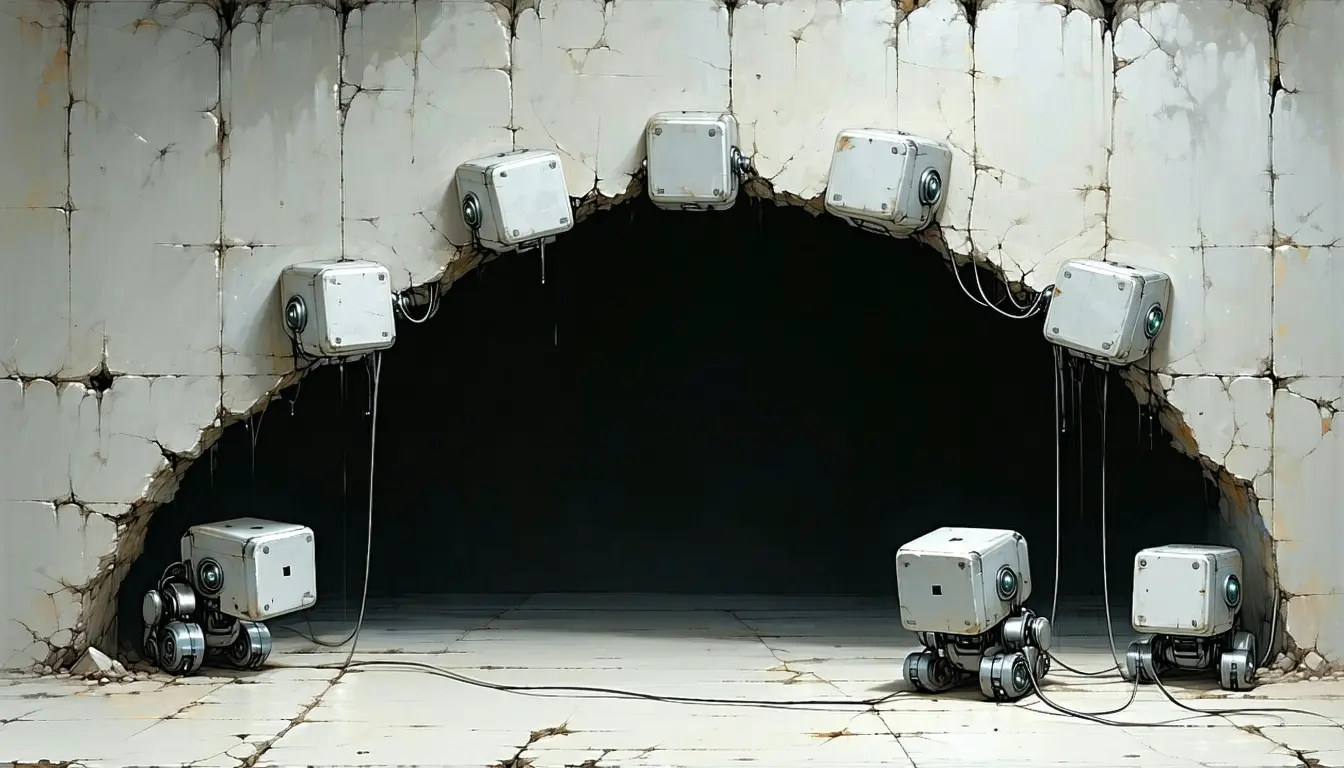
The researchers first simulated cubes, each with an independently operated neural network, assembled into nearly 500 3D shapes across seven object categories: boats, cars, chairs, guitars, houses, planes and tables, and tested whether the cubes could identify their category.
Each virtual cube contained a vector holding its memory and a guess about the object category, both able to evolve over time, and each cube's neural network told it how to update its vector based on its neighbours' vectors; together the cubes formed a neural cellular automaton.
The simulated cubes passed messages and altered their vectors based first on their own immediate environment, such as whether they were on an edge, then on their neighbours', and so on.
Distinct publishers with included, body-backed reporting in this cluster.
1 article · September 6, 2026
Follow any of these and your For You feed starts watching them — no settings page required.
science
Narwhal tusks hide two spirals twisting against each other, and the mismatch is the point3 distinct publishers
science
Mount Sinai puts a youth protein on aging microglia, and the mice answer1 distinct publisher
science
Half the resistance genes in livestock manure also show up in 875 wild farm mice1 distinct publisher
science
High-pressure experiments rule carbon out as the missing light element in Mercury's core1 distinct publisher
Evidence-backed comparisons of source perspectives and observed adoption signals. Read the methodology
Which Builder, Operator, and Investor concerns the observed source mix emphasized—not a truth score.
Evidence, demonstrated adoption, hype gap, incentives, and confidence are assessed independently, each on its own current evidence. How these are measured.
One peer-reviewed paper, one outside voice
The numbers are specific and the mechanism is described well enough to argue with: an 85 to 100 percent band over seven categories, tolerance to 15 percent deletion, 100 percent identification across up to 197 physical blocks. All of it reaches us through a single retelling of a single Nature Communications paper, and Sabine Hauert, the one commentator outside the author list, endorses the interpretation rather than examining the method. The unanswered question that would move this number is whether the tested shapes were held out from training.
Bench hardware, no users
Adoption is a table in a lab. The hardware run tops out at 197 connected blocks, the scaling evidence is entirely in simulation, and the only named uses are things Risi imagines building rather than things anyone has built: a dinosaur that roars, bricks that tell you where the next one goes. No product, no partner, no deployment appears in this reporting.
Framing reaches past the demo
Scientific American opens on self-healing circuits and computers that repair damage as it happens, then reports an experiment where an assembly decides which of seven object categories it belongs to. The regeneration result is real but lives in simulation, and the distance is quantifiable: 18,000 cubes in software against 197 in hardware, roughly ninety to one. The body of the piece is disciplined about what was measured; the promise attached to it comes from the framing rather than the data.
Author supplies frame and applications
Risi is the senior author and also the source of both the interpretive quote about local self-organization and the commercial suggestions, and he holds a post at Sakana AI as well as the IT University of Copenhagen, which the piece states plainly. Hauert's independence is disclosed too. Nothing is hidden; the weight simply sits with the people who did the work, and a general science outlet reporting a Nature Communications result has its own appetite for the biological framing that opens the story.
Firm numbers, single account
Confidence lands mid-range for a reason that has nothing to do with the quality of the experiment: the figures are precise and the method is described clearly, but a single publisher relaying a single paper leaves no cross-check, and no replication is reported. The physical result raises confidence more than the simulated scaling does, since 197 blocks answering correctly every time is harder to overstate than a number produced in software.