Science1 publisher3 min readPublished
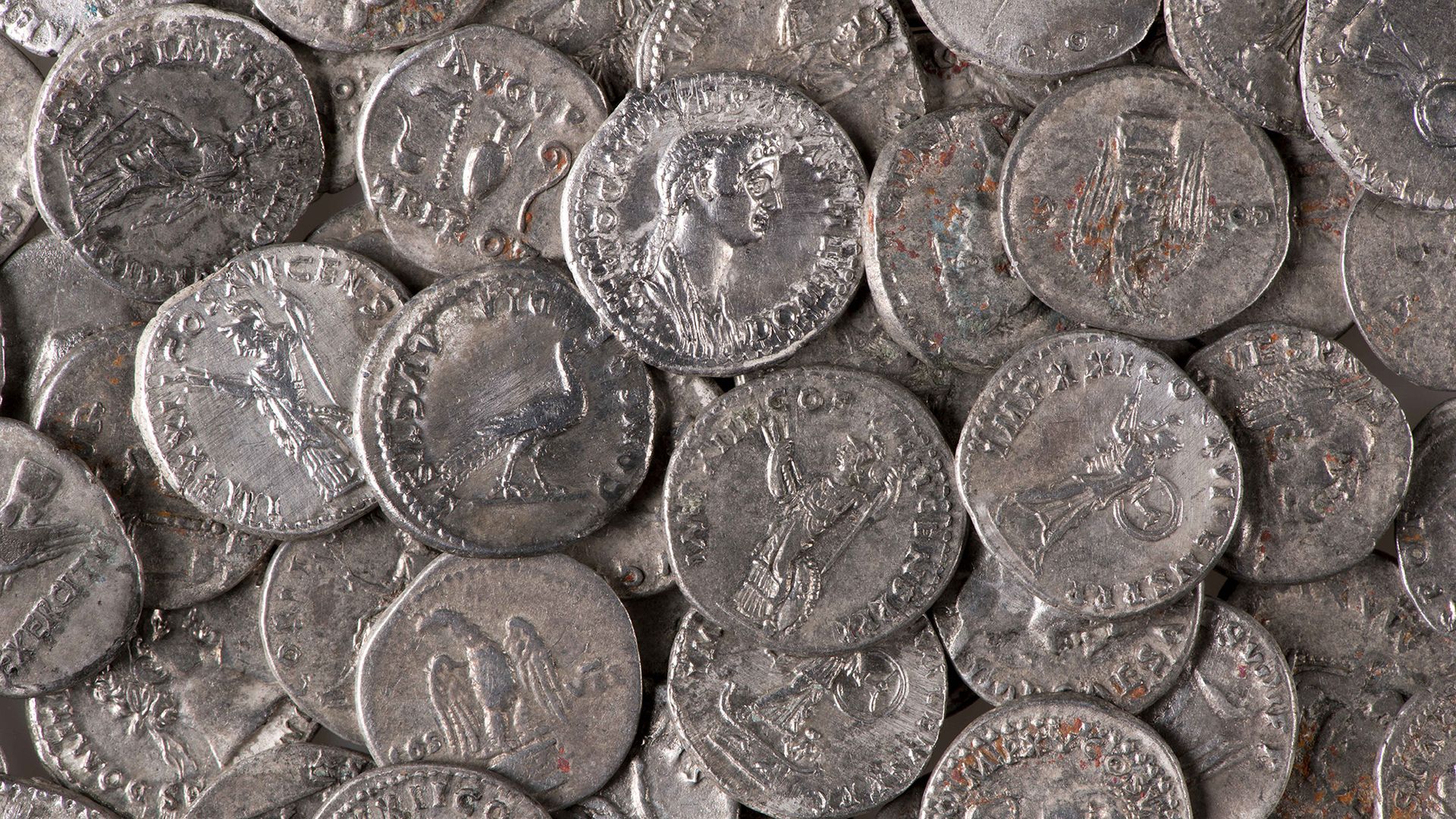
Rhineland excavators lifted the 934-coin Wesseling hoard inside a single block of soil
Most of the silver was struck under the Flavian emperors, a generation before the hoard's newest coin. The find spot just inside the Rhine frontier lets archaeologists argue the money went into the ground soon after.
The Scientist · Science desk
What happened
- An excavation in a field near Wesseling, a few miles south of Cologne, recovered 934 Roman silver coins weighing about 3.1 kilograms, found about a year ago and now shown at the LVR-Landesmuseum in Bonn.
- Oliver Riedl, licensed by the state and trained by regional archaeological authorities, dug up 15 coins and then stopped when his detector signaled a much larger mass below, and he called the office.
- Archaeologists removed the block of earth holding the rest of the coins whole and X-rayed it before opening it.
- The newest coin in the hoard was minted in 124 or 125, the oldest in 148 B.C., and most were struck under the Flavian emperors between A.D. 69 and 96.
- Live Science, reporting the Rhineland regional government's statement, called it the largest find of Roman silver coins from Hadrian's reign anywhere in Germany.
Compiled by The ScientistSomething wrong?How this is made
Why it matters
- capability With 919 coins lifted in the soil that held them and imaged before anyone opened it, the excavators can argue about how the hoard was assembled and deposited. A pit emptied by hand leaves you the coins and little else.
- constraint The burial date rests on a regional regularity. No measurement of this deposit produced it. A comparable hoard found on the far side of the Rhine would carry the opposite default, because there such finds often went into the ground much later.
- contradiction Live Science's span figure does not match its own dates, so a reader who takes "more than three centuries" at face value ages the coin series by roughly three decades more than the mint dates allow.
- precedent Rhineland authorities now have a 934-coin case to put in front of licensed finders when they ask them to stop and phone in, and that training is meant to prevent the illegal detecting the statement complains about.
The newest coin fixes the earliest year the silver could have gone into the ground [5]. It does not tell you the year it did. Marjanko Pilekic, a numismatist at the German Historical Museum in Berlin who was not involved in the find, told Live Science in an email that the location narrows the gap, because the hoard lay just inside the empire's northern frontier, the limes, which ran along the Rhine nearby [19]. "In this case, we can cautiously assume that the hoard was buried not long after the most recent coin was minted," Pilekic said [20]. Outside the empire, in the regions Romans called the Barbaricum, such hoards were often buried much later, he said [21].
The composition points the same way by a different route. Most of the coins were struck under Vespasian, Titus and Domitian, between A.D. 69 and 96 [7]. That leaves roughly 28 years between the end of the Flavian run and the newest coin in the pile [4]. Erich Classen, head of archaeology for the Rhineland regional government, said the owner appears to have gathered most of the money around A.D. 100 and buried it only under Hadrian [15]. "We can only speculate about the motives, but very likely someone wanted to keep this money safe," Classen said. "Banks did not exist at that time." [16][17] He added: "It is possible that the owner died beforehand without being able to pass on the knowledge of the coins." [18]
Mass over count, 3,100 grams across 934 coins [2][1], gives an average of about 3.3 grams a coin [1]. Live Science wrote that the coins span more than three centuries [8]; from 148 B.C. [6] to A.D. 125, with no year zero in between, is 272 years [2].
Rahel Otte, the regional archaeologist who led the excavation, gave a wage comparison: 300 denarii was a legionary's yearly pay under Hadrian, with around half deducted for food and equipment [22]. That leaves roughly 150 denarii of disposable pay a year, and 934 divided by 150 is 6.2 [3]. Otte said a legionary "would have had to save all his available money for about six years to accumulate the Wesseling treasure find" [23].
Fifteen coins came up by hand. The other 919 came up inside the dirt that held them [5], and the Rhineland statement says the block was X-rayed before it was opened [14], though it does not describe what the X-ray showed. Riedl is licensed by the state and has been trained by regional archaeological authorities [12]. Unlicensed detectorists also work in Germany and, according to Live Science, are known to often disrupt the archaeological value of their finds [13].
Who put the money in the ground is open. Otte said it was unclear who buried the hoard, and that it may have been someone who lived on one of the Roman estates in the area [24].
What to watch
- The excavation report, including what the X-ray of the lifted block showed and whether the coins sat in a container.
- A mint-by-mint breakdown of the 934 coins, which would test Classen's reading that most were gathered around A.D. 100.
- Whether the Rhineland authorities publish counts of licensed reported finds against illegal ones.