Product1 publisher3 min readPublished
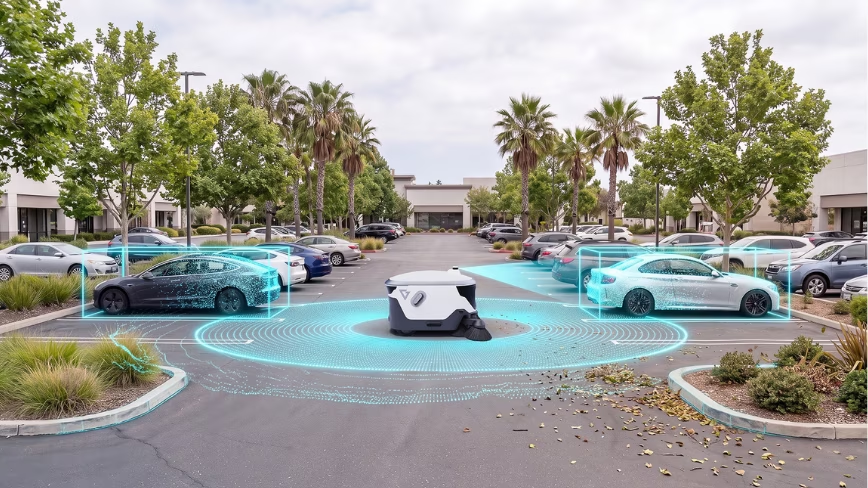
Viabot's cleaning robot also uses its sensors to detect loitering and trespassing
Viabot's $24m Series A funds an outdoor sweeper whose navigation sensors are also sold as "soft security" that flags loitering for human monitors. The litter case behind the pitch runs on a 2020 count and a 2009 cost figure.
The Product Desk · Product desk
What happened
- Viabot raised a $24m Series A led by Walden International, with CDIB Capital and Stalwart Ventures joining existing backers including Baseline Ventures, ERA Ventures, Morado Ventures and SOSV.
- The same machine is sold as what the company calls soft security, with its sensors identifying loitering and trespassing in restricted areas and human staff monitoring and responding to the alerts.
- The flagship Viabot One sweeps debris from large commercial properties, services 25 million square feet, and is sold as robotics-as-a-service.
- Viabot's own specifications give the machine up to six hours of operation before it returns to its dock, while the release sells the security function as 24/7 and always-on.
Compiled by The Product DeskSomething wrong?How this is made
Why it matters
- decision With a swappable tool head, the thing a facilities team keeps paying for over the contract term is the sensor platform, so a security purchase now sits inside a cleaning budget.
- exposure Visitors to the retail, campus and healthcare sites Viabot names get assessed for loitering by a machine badged as a sweeper, and TNW says the people on site are told nothing.
- constraint The battery caps the robot's presence at a quarter of the day at most, so whatever the buyer is paying for round-the-clock coverage is paying for people watching a queue.
- contradiction A buyer who checks the litter case finds the trend pointing the other way from the pitch, because the organisation supplying the figure has since revised it down by about 15 billion pieces.
A shopper crossing a mall car park after closing sees a machine sweeping grit near the trolley bays. In Viabot's own description of the product, that machine is also checking whether she is loitering, and a person on shift is watching the alert it raises [5].
One chassis does both jobs because the base takes interchangeable tools, according to Viabot [7]. The brush comes off the base; the cameras, lidar, depth sensors and differential GPS that plan the route stay on it [4].
Six hours off the dock is a quarter of a 24-hour day [18]. The staffing is the part that runs continuously: Viabot says human personnel monitor and respond to the alerts [5]. TNW notes that China's robot traffic units work eight or nine hour shifts on a rota [9].
Other companies already sell the capability under its own name. TNW has covered Ascento's guard robot, which carries thermal and infrared cameras and is sold openly as security [10]. Samsung has turned a robot vacuum into a mobile monitoring device for the home, on hardware bought for cleaning [11]. According to TNW, packaging the function as sweeping changes who agrees to it: a property manager buying cleaning is procuring a monitoring system without it being obvious, and the people on the site are told nothing [12].
Then there is the market case. Keep America Beautiful's May 2026 study puts roadway litter down 22% to 2,204 items per mile, and litter in rivers, streams and lakes down 45% [15]. The nearly 50 billion pieces cited in Viabot's framing is about 15 billion above the current national count [19]. The $9.1bn a year the release attributes to business litter cleanup comes from Keep America Beautiful research published in 2009, and the release cites it undated [16]. Cutting the other way, TNW notes the litter studies are funded by beverage and packaging companies [17].
For the person signing this on Monday, the useful test is two prices: the sweeping with detection and alerting switched off, and the detection on its own. A vendor who can quote both has sold you two products, and you can decide separately whether the site posts notice about the second one. A vendor who can only quote the bundle has sold you a sensor platform with a brush on it, and the notice question follows the sensors.
That splits the buying decision the way the org chart already splits it. Sweeping belongs to whoever owns the cleaning budget, and behavioural detection belongs to whoever answers for incidents and signage at a healthcare site or a campus [6]. National litter totals are the wrong number for this: how often a given car park needs a machine on it comes out of the site's own sweep logs. TNW does not report what the service costs [21].
What to watch
- Whether Viabot's market materials move to the May 2026 litter study or keep citing the 2020 count of nearly 50 billion pieces.
- Whether any named customer posts site notice about the loitering detection, or contracts to have it disabled.
- Whether Viabot ever quotes detection and sweeping as separate line items at renewal.