Product1 distinct publisher3 min readPublished
The 26 August announcement listed the Senate, the Federal Reserve and NASA among a Chinese group's victims. By 28 August they were targets, and any team that opened an incident on day one was hunting a claim the affidavit did not contain.
The Product Desk · Product desk

Compiled by The Product DeskSomething wrong?How this is made
Inside a security team, "victims" and "targets" route to different people. The first noun starts a hunt: someone pulls logs for the named sector, and a lead drafts the note for the executive who read the wire copy. The second noun goes into a monthly summary and is never opened again. The release that went out with the seizures used the first noun, and its replacement used the second, a change Reuters reported [1].
Count the named federal bodies in the original list and you get seven. The dated intrusions investigators describe cover three of them, which leaves the Senate, the Federal Reserve, NASA and the Justice Department itself sitting on a victims list with no confirmed intrusion attached [13]. The case is substantial either way: QTFY has been working against US targets since at least 2018 [6], and access attempts logged in March 2026 failed, which suggests the campaign is live and that defences improved somewhere [8]. The size of the case and the accuracy of the sentence about your agency are separate questions.
Teams describe their own process as reading an advisory and mapping it against the threat model. In practice, most people search the page for their own name or their sector and escalate on the strongest noun they find. When the letterhead says Justice Department, that reaction makes sense. The problem is calibration: the strongest noun is the least stable part of the document.
The stable parts are the artifacts. A group name, a date, a technique and a seized domain can be checked against your own telemetry. The severity word cannot be checked the same way; it was only ever checkable against a filing nobody on your team had read, and the department has not said whether the wording was drafted from the affidavit or from a summary of it [9]. That is also why the useful residue of this case for a European team sits in QTFY's methods, timeline and target selection rather than the framing, as TNW argues [14]. The year's local examples make the point in detail: one Chinese group has been raiding university mailboxes through a Roundcube flaw [15], and another turned a built-in Google Workspace feature into an exfiltration tool against medical and military research [16]. A detection written against the Roundcube flaw keeps working after the victim list is edited.
So the forcing function is one line on the ticket, before anyone gets paged: name the document and the sentence in it that supports the severity claim. A press release adjective does not qualify. A summary of a filing nobody has read does not qualify. Claims that come with an artifact you can test go to response; claims that exist only as characterisation go to monitoring, and get 48 hours to firm up or fade.
The tradeoff is real, and worth saying to the person who has to defend it on Friday. If the day-one release is right, that rule makes you two days late to a real breach. The counterweight is that an intrusion into your own estate shows up in your own logs whether or not a press office names you, while a downgraded noun shows up nowhere except in a quiet edit. The rule costs two days of comfort and buys back the week your team would otherwise spend proving that nothing happened.
Ranked by verification strength, evidence, and original report placement.
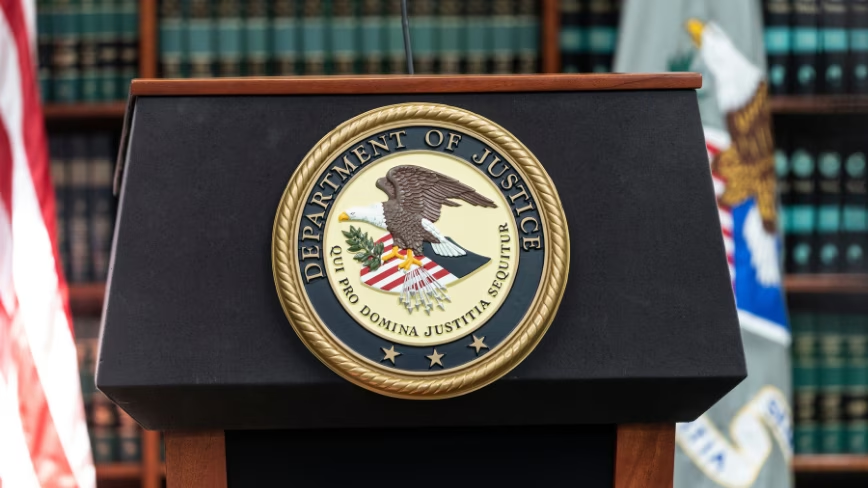
The US Justice Department quietly rewrote a press release that said Chinese hackers had claimed victims across the Senate, the Federal Reserve, NASA and half a dozen other federal bodies; the revised version says those organisations were targets and that only some were actually compromised, as Reuters reported.
The original text went out on 26 August alongside a set of domain seizures, and listed the Senate, the Federal Reserve, NASA, the Department of Energy, the Justice Department itself, Health and Human Services, the National Institutes of Health, defence contractors, financial institutions and universities as having been among the hackers' victims.
Two days later the word victims was gone: the agencies became "among the targets" of QTFY, the Chinese state-sponsored group named in the case.
The amended release added the line: "Edits have been made to ensure this press release accurately reflects the government's allegations in the affidavit in support of the domain seizures."
QTFY has been running against US targets since at least 2018, and the affidavit does describe confirmed intrusions, just fewer of them than the first announcement implied.
Investigators place intrusions at Department of Energy national laboratories, the NIH and Health and Human Services in September 2024, and successful data thefts from unnamed entities in May of the same year.
Distinct publishers with included, body-backed reporting in this cluster.
1 article · August 31, 2026
Follow any of these and your For You feed starts watching them — no settings page required.
build
AI-written snap7 scripts move the scarce resource in OT attacks from skill to exposure2 distinct publishers
security
FBI names Nanjing contractor behind 300-victim Check Point Quantum Gateway campaign1 distinct publisher
security
CISA orders Ray patched as RondoDox folds cluster software into a 174-exploit arsenal1 distinct publisher
security
Gunra Goes Franchise: Conti's Leaked Code Now Ships With a Builder and an Affiliate Panel2 distinct publishers
Evidence-backed comparisons of source perspectives and observed adoption signals. Read the methodology
Which Builder, Operator, and Investor concerns the observed source mix emphasized—not a truth score.
Evidence, demonstrated adoption, hype gap, incentives, and confidence are assessed independently, each on its own current evidence. How these are measured.
Quotable at the centre, bare at the edges
Two versions of one press release are the whole factual spine, and the amended line is quoted word for word — that much any reader can go and check. Past it, the support thins quickly: the affidavit is characterised but never quoted, Reuters' original catch reaches us only through The Next Web, and the sentence about private firms being cleared for offensive operations abroad carries no date, order or authority at all.
Real events under the wording fight
Strip the semantics and there is a concrete operational record: domains seized on 26 August by five US agencies, intrusions dated to September 2024 at Energy's laboratories, the NIH and HHS, data theft that May, attempts in March 2026 that failed. Dated, agency-attributed, consequential — and all of it reaching us through a single telling, which is the ceiling on this number.
The overstatement is the subject, not the sin
The exaggeration being measured belongs to the government, not to this reporting: four of seven named bodies — the Senate, the Federal Reserve, NASA and the department itself — moved out of the victim column while the headline they produced stayed in circulation. The Next Web's own prose is restrained about it. What keeps the reading positive rather than neutral is the story's confident claim that QTFY's specifics transfer to European defenders, immediately followed by no specifics.
Written to impress, corrected against interest
A release issued to accompany domain seizures had every reason to read as expansively as possible, and it did. The retraction cuts the other way — a department volunteering that its own announcement exceeded its affidavit gains nothing by it — which is precisely why the amended wording deserves more trust than the original. The open question is unflattering and unanswered: nobody will say whether the copy was drafted from the affidavit or from a summary of it, and no official is named.
Firm on what changed, soft on why
We can be near-certain about the mechanics — wording swapped, explanatory line added, two days elapsed — because they are documented and quoted. Confidence falls away on causation and consequence: how the error was made, whether corrections like this really are rare, and how many readers ever saw the fix. With one publisher in front of us and the affidavit unread, the middle of the range is honest.