Loading today’s stories
Invest1 distinct publisher3 min readUpdated
Champagne's ripening window fell from 100 days to 80, and the labour model has not caught up
The earliest recorded harvest opened Aug. 12 to Aug. 17, after spring frost took 43% of potential production. One 40-hectare house needs 120 pickers for nine days.
The Investor · Invest desk
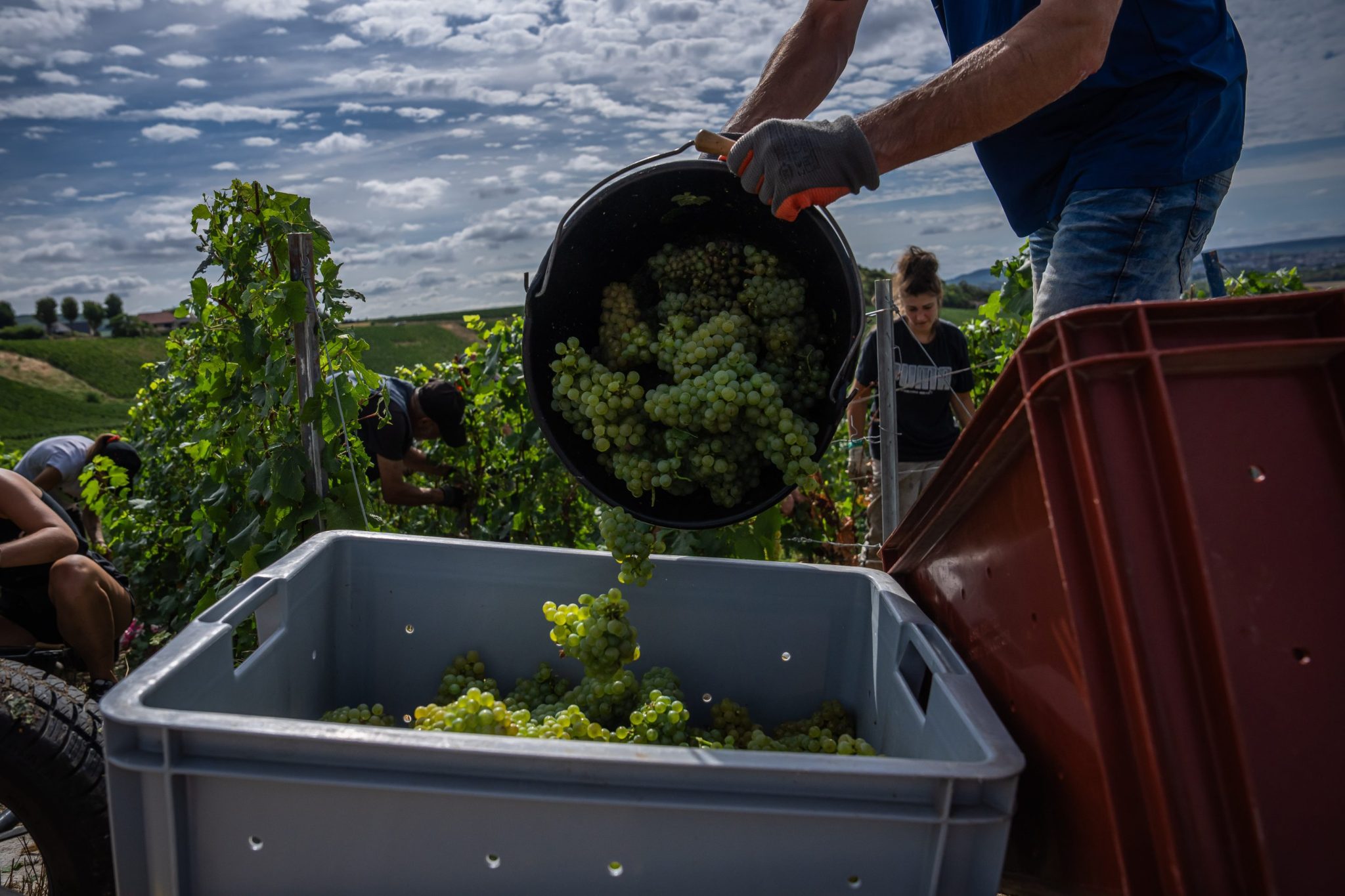
What happened
- Champagne's official harvest opened between Aug. 12 and Aug. 17 this year, depending on the area and grape variety, roughly a month earlier than what was once common in the region.
- Champagne producers are racing to pick grapes as the region's earliest harvest on record gets underway, after extreme heat and drought accelerated ripening and left growers a narrow window to preserve quality.
- Alexandre Gobillard, production director at Gobillard & Fils, said: "My grandfather's generation harvested 100 days after flowering, my father's 90 days, and today we're down to 80."
- The ripening window has shortened by 20 days, or 20% of the original 100-day period, across three generations.
- Gobillard said he has worked at the estate for 30 years and that his father used to tell him to go on vacation on Aug. 15; he said that on Aug. 18 the estate was in full harvest and that he had never seen anything like it.
Compiled by The InvestorSomething wrong?How this is made
Why it matters
Champagne's official harvest opened this year between Aug. 12 and Aug. 17, depending on the area and grape variety, the earliest on record and roughly a month ahead of what was once common in the region [1][2]. For anyone who owns or lends against agricultural assets, the interesting part is not the date but the arithmetic behind it: the picking window is shrinking faster than the labour model that fills it.
In a report published by Fortune, Alexandre Gobillard, production director at Gobillard & Fils, said his grandfather's generation harvested 100 days after flowering, his father's 90, and his own now picks at 80 [3]. That is a fifth of the ripening window gone across three generations [4]. Gobillard, who has worked at the estate for 30 years, said his father used to tell him to go on holiday on Aug. 15; he was in full harvest on Aug. 18 [5].
The compression came from both ends of the season. A late-March frost followed mild weather that had triggered early budburst, cutting the potential crop, and then came four heat waves, which Gobillard said had never happened before [6]. June temperatures reached 40C (104F) in parts of Champagne [7]. His explanation for the speed is mechanical rather than mysterious: water was drawn out of the grapes to keep the vine alive, concentrating the sugar [8].
Labour is where the constraint bites. Gobillard & Fils farms 40 hectares and produces about 1.5 million bottles a year [9], roughly 37,500 bottles per hectare [10]. Gobillard hopes to finish in about nine days with around 120 workers recruited mostly from across France and Poland [11], about three pickers per hectare and some 1,080 worker-days [12]. Pulling that crew forward by weeks means competing with summer holidays and transport delays [13]. Geoffrey Bonnet-Gobillard, the house's commercial director, said hand harvesting carries constraints in housing, feeding and recruiting people, and is very difficult with early harvests in August [14].
Volume is already impaired. David Chatillon, president of the Union of Champagne Houses, said this year's conditions will produce a clear decrease in yields, and that 43% of potential production was lost to spring frosts, with drought making the shortfall worse [15][16]. Gobillard put losses from sun-scorched grapes at roughly 10%, and said that is a volume loss rather than a quality one [17].
Quality control now runs on a shorter clock. Gobillard took a sample of the first juice to measure sugar, the indicator of potential alcohol and of whether the grapes were picked at the right moment, saying Champagne should not be too alcoholic and that the house is looking for delicacy [18]. With a faster ripening curve, the gap between the right day and the wrong week narrows.
What to watch is whether hand harvesting survives contact with August. Bonnet-Gobillard said more sophisticated agricultural machinery could eventually push producers to reconsider long-established practices [19]. Chatillon said the industry has been working on climate change for 25 years, including developing varieties that are more disease-resistant and ripen later [20], which is a decade-scale fix for an annual scheduling problem. In Italy, extreme heat has already pushed sparkling-wine producers to harvest sooner and pick at night [21]. Night picking, mechanisation and later-ripening plant material are the three available levers; the first two are capex and labour-contract decisions that can be made now, the third is not.
Loading topic controls
Loading related stories