Build1 distinct publisher2 min readPublished
The company defines a capability as a function an agent calls without opening the app. At a $13.3bn valuation on a $500m run rate, the second interface is the part being priced.
The Engineer · Build desk

Compiled by The EngineerSomething wrong?How this is made
Menlo Ventures led a $400 million Series C at a $13.3 billion valuation [8], against a run rate that Menlo partner Deedy Das puts above $500 million annualized [7]. That works out at roughly 27 times revenue [13], which is not the price of a code generator with visible competitors. Lovable's own account of its market puts it in the same water as Vercel and Cloudflare, and notes that Vercel's v0 already turns natural language into an app [10].
The growth numbers point the same way. More than 60 million projects created against more than 900 million monthly visits to Lovable-built apps [7] averages about 15 visits per project per month [14]. Most of that inventory is not an audience. It is functions sitting behind a login, which is the shape of thing worth calling from somewhere else.
Hedin's account of how the company got here explains the target. Users moved from prototypes to production products and then to the software that runs the company, including admin panels and customer-support consoles [6]. That is where the write actions live, and a capability by Lovable's own definition is a function an agent invokes with nobody opening the app [2].
Which makes one word the load-bearing part of the pitch: selected. Lovable exposes selected functions from a published app as tools through a hosted MCP server [3]. The Latent Space account does not say who authorises a call, how a capability is scoped, or whether calls are logged [15]. For an internal console at a company where, by Lovable's own claim, employees at nearly two-thirds of the Fortune 500 have used the platform [9], those are the questions that decide whether the feature ships to production or stays in a sandbox.
Hedin's framing is that application-layer releases and improving models compound on each other [11], and that the destination is a single entry point to all your work [4] in which everything you build is reusable in an agentic way [5]. Read as a product plan rather than a vision, that demotes the human UI to the optional half of a delivery. The company that hosts the app and the tool server also becomes the thing that describes your software to every model that asks. Getting that description wrong is not a rendering bug; it is a function called on real data by a client you do not administer.
Ranked by verification strength, evidence, and original report placement.
In a recent blog post, Lovable outlined a vision for "a digital brain for your team connecting your daily tools."
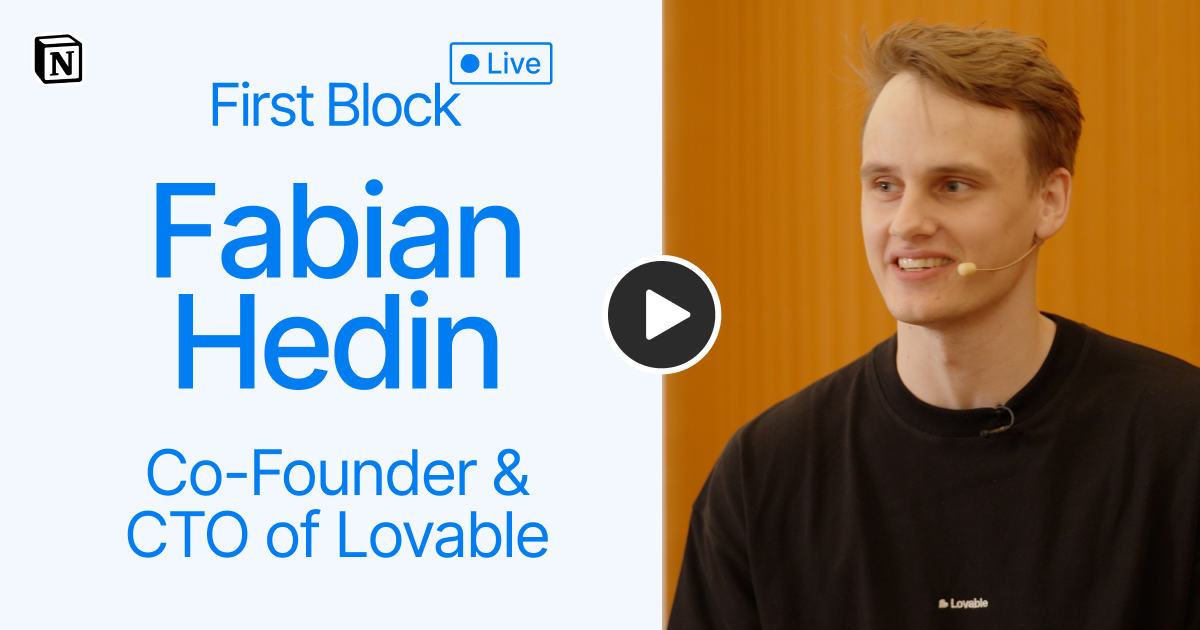
Lovable CTO Fabian Hedin told Latent Space, "you can get to a place where you're using one entry point to all the work that you're doing."
Hedin said the goal is that "everything that you're building can be reused in an agentic way."
Lovable now competes in the same market as Vercel and Cloudflare, though it is more focused on AI-generated software than infrastructure; Vercel's v0 also generates an app from natural language.
Lovable defines a capability as a useful part of an application that an agent can call directly, bypassing the need for a human user to open the app.
Lovable can turn a published application into agent-accessible capabilities by exposing selected functions from the app as tools through a hosted MCP server, producing one application with two interfaces: a human UI and an agent interface usable from ChatGPT, Claude and other MCP-compatible AI clients.
Follow any of these and your For You feed starts watching them — no settings page required.
Evidence-backed comparisons of source perspectives and observed adoption signals. Read the methodology
Which Builder, Operator, and Investor concerns the observed source mix emphasized—not a truth score.
Evidence, demonstrated adoption, hype gap, incentives, and confidence are assessed independently, each on its own current evidence. How these are measured.
One publisher, company-and-investor sourced
Everything rests on a single latent.space interview with Lovable's CTO plus an investor's social post. The product mechanics are described only in prose — no documentation, spec, changelog or third-party test — and the growth figures are secondhand and undefined. The operationally decisive details (authorisation, scoping, logging, metering of capability calls) are absent from the record entirely.
Large self-reported platform base, unmeasured agent surface
Platform-level adoption signals are substantial but self-reported: a $500m run rate, 60m+ projects, 900m+ monthly visits and Fortune 500 employee usage. Adoption of the thing this story is actually about — the hosted MCP capability interface — is evidenced only by Lovable's own internal use of its agent, with no external customer deployment, call volume or retention data.
Vision priced ahead of demonstrated agent usage
The framing — a company 'digital brain', one entry point to all work, applications dissolving into agent-callable capabilities — runs well ahead of what is shown: a described MCP exposure mechanism, one internal deployment, and no usage, reliability, security or monetisation data for the agent interface. A ~27x multiple on a secondhand run rate compounds the gap. It is overstatement of maturity rather than fabrication: the product mechanism itself is plausibly and specifically described.
Vendor and lead-investor voices, post-round
The narrative is supplied by Lovable's CTO in an interview published weeks after a $400m round, with the headline growth metrics sourced to a partner at the lead investor — a party whose $13.3bn mark benefits from the numbers circulating. Competitive positioning ('our wedge') and the 'company brain' language are also the company's own framing, and the publisher's format is an access interview.
Low — single access interview
One publisher, one interview, no documentation or independent measurement. The product description and funding facts are reasonably firm; the growth metrics, the durability of the capability model and anything about controls or pricing cannot be assessed at better than low confidence from this material.
invest
Scalable Capital puts ChatGPT, Claude and Grok inside the European order ticket1 distinct publisher
build
MCP's roadmap fast-tracks five priorities and quietly queues everything else1 distinct publisher
product
The personal agent is a folder, not a model: four files and less memory than you thought1 distinct publisher
product
PostHog de-bundled its own flagship, and only half of it survived1 distinct publisher
Distinct publishers with included, body-backed reporting in this cluster.
1 article · August 26, 2026