Build1 publisher3 min readPublished
Google constrains its classroom generative UI with progressively harder levels and scaffolded hints
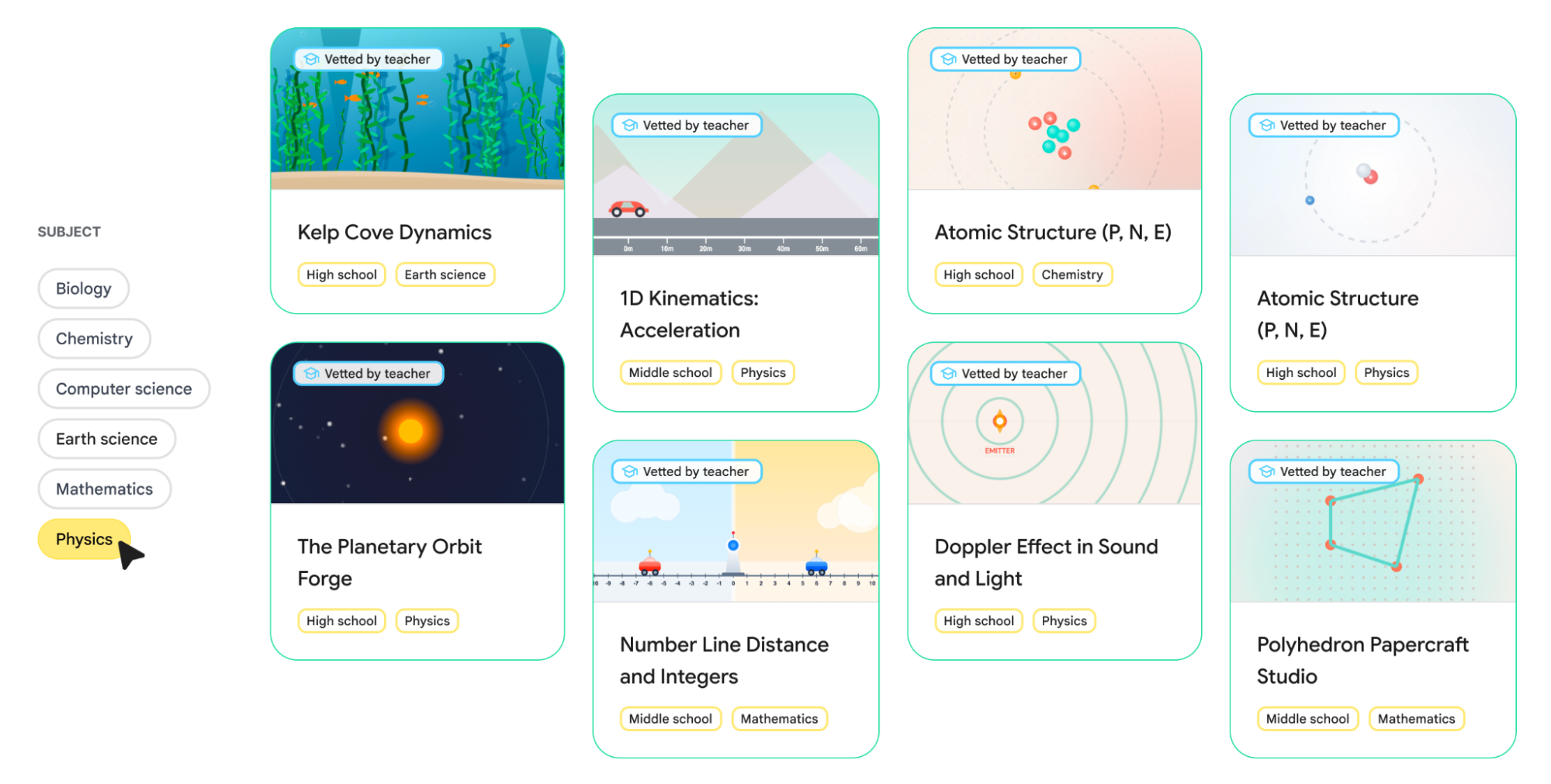
Google Research describes a model that assembles the interface as the request arrives, held to a game structure of progressively harder challenges, with more than 30 teacher-reviewed samples out for middle and high school STEM.
The Engineer · Build desk
What happened
- Google Research published the experiment on September 17, 2026, credited to research scientist Gal Elidan and product manager Yael Haramaty, letting teachers generate guided interactive simulations tied to their own curriculum.
- Access runs through the Google for Education Pilot Program, which schools on Google Workspace for Education can join to give feedback on the interactives.
- The evidence Google reports is initial positive teacher feedback from a trusted tester pool.
Compiled by The EngineerSomething wrong?How this is made
Why it matters
- capability A teacher can get an interactive for a topic no publisher ever built, because the interface is assembled when the request arrives instead of shipped as code.
- constraint The generator is bounded by whatever design theory was written down first, and Google had learning science and the LearnLM principles to point at; a domain without an equivalent has nothing to bound the output with.
- cost Someone qualified still has to reject a bad artifact, and in the sample library that reviewer was a teacher, so development cost saved on the interactive reappears as teacher time.
Generative UI means the model constructs the interface when the request arrives, instead of a developer coding it beforehand [3]. That relocates the work: building the simulation stops being the expensive step, and writing down what a correct simulation looks like becomes the expensive step.
Google's post describes one such specification in concrete terms. Each learning interactive is built as a series of progressively difficult challenges based on the stated learning objectives, and the earth science example starts on temperature before moving to harder challenges about rapid warming and storms [7]. Around that sits a suite of scaffolded hints, instructions and feedback, such as directing the learner to the relevant formula or explaining a specific term [8]. The wider set of pedagogical principles is described as drawn from established learning science and aligned with the principles behind LearnLM [9], the family of education-tuned models Google released in 2024 [10]. A 2025 experiment, Learn Your Way, applied the same line of work to the textbook [11], and this is the third year of it [17].
The released library is deliberately a sample: more than 30 interactives in English across physics, chemistry, biology and math, focused on middle and high school, all generated by AI and reviewed by teachers [4]. Across those four subjects that is an average of about 7.5 each [16]. Thirty items show the generator ran, and the case that matters is the thirty-first topic, the one a teacher asks for.
The argument for active learning is old, and the post makes it with a quotation from John Dewey in 1916: "give the pupils something to do" [13]. The retention claim comes from the ICAP framework, earlier cognitive research finding that interactive behaviors consistently yield deeper schema construction and long-term retention than passive listening or reading [12]. The reported evidence for these interactives is different in kind: initial positive teacher feedback from a trusted tester pool [6]. For the ICAP result to carry over, a generated simulation would have to put a student into the same interactive behaviors ICAP measured, with the scaffolded hints arriving at the point the student is actually stuck. Google does not report learning outcomes for the generated interactives.
What makes the guardrails real here is a written theory of what a good interaction is, which Google had before generating anything, in learning science, ICAP and the LearnLM principles [9][12]. It also had a population of reviewers who can reject a bad artifact on sight, which is what teacher review of the sample library supplied [4]. Neither condition is automatic elsewhere. In my view a team porting this pattern to clinical training or industrial procedure has to produce both first, or it has a longer prompt and calls it a guardrail. The design problem Google set out to solve is the one it names at the top: interactive practice is expensive to create, limited in number, and often requires a lot more effort from the teacher [15].
What to watch
- Whether the pilot produces measured student outcomes for the generated interactives rather than teacher feedback.
- Whether the library extends past English and past middle and high school STEM.
- Whether Google publishes the full pedagogical principle list and the checks that enforce it at generation time.