Science1 publisher2 min readPublished
The same warming chambers pushed Antarctica's two flowering plants in opposite directions
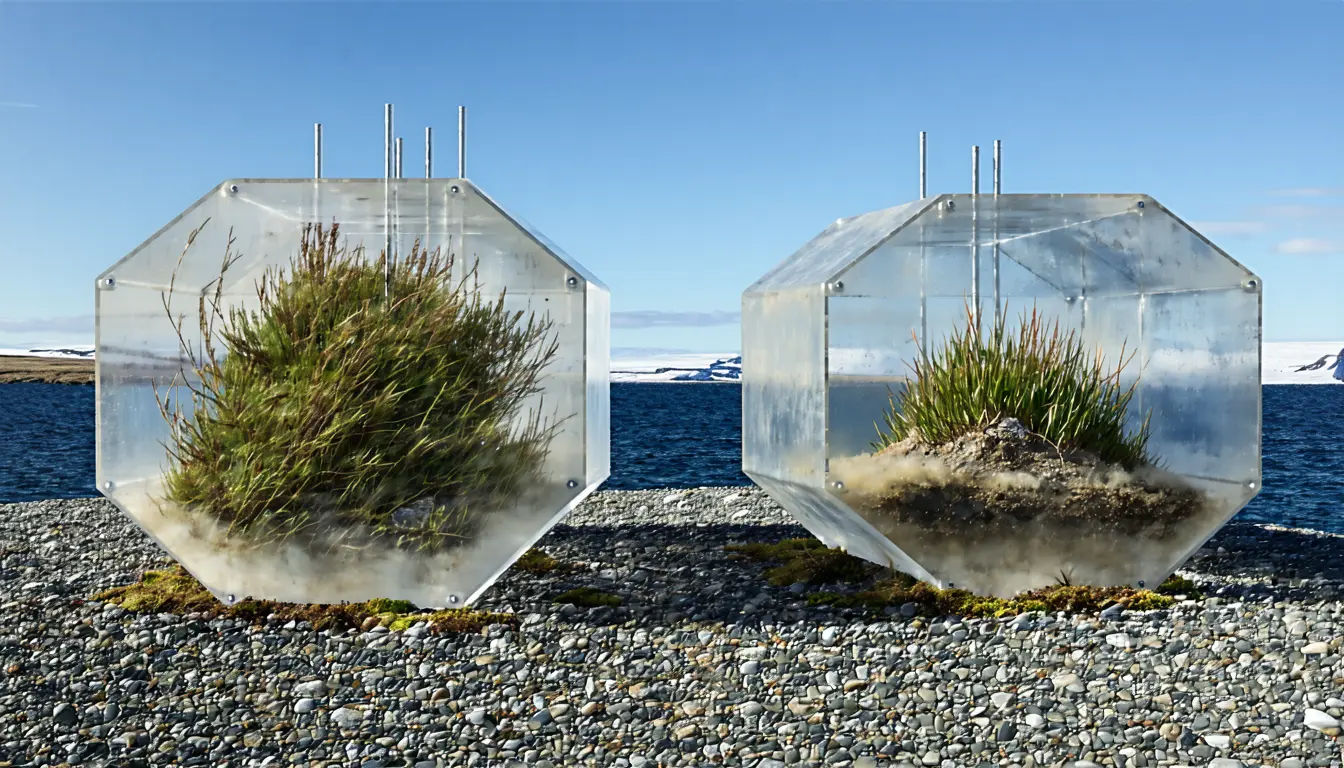
A seven-year open-top-chamber experiment on King George Island found Deschampsia throttling water transport and photosynthesis while Colobanthus increased both. A proxy built on one species gets the other's sign wrong.
The Scientist · Science desk
What happened
- A Chilean and Spanish team kept Antarctica's only two native vascular plants under passive open-top warming chambers for seven years, in plots established on King George Island in 2012.
- Deschampsia antarctica, the Antarctic hairgrass, came out with lower leaf hydraulic conductivity and a lower photosynthetic rate, which the authors read as a conservative water-use strategy.
- Colobanthus quitensis, the pearlwort, went the other way, raising hydraulic conductivity, photosynthetic capacity, cell-wall elasticity and its transport of both water and CO2.
Compiled by The ScientistSomething wrong?How this is made
Why it matters
- constraint A vegetation model that takes its warming response from one of these species has the wrong sign for the other half of the flora, and averaging the two erases both behaviours.
- decision Groups designing the next polar warming experiment now have to fund hydraulics, anatomy and gas exchange on both species at each site, or accept a result that cannot speak for the flora.
- capability Seven continuous years of passive chambers make it possible to ask how these plants handle more freeze-thaw cycles, a question a single-summer warming manipulation cannot reach.
The opposite signs are the problem. Fit a warming response function to either of these species and it predicts the wrong direction for the other. Both sets of traits came off plants in the same treatment at the same site [17]. Antarctica's entire native vascular flora is these two species [2].
The chambers warm passively, without heaters or power [2], and the authors say that design let them capture ecologically relevant aspects of climate change such as increases in freeze-thaw events, not only a rising mean temperature [8]. Leaf hydraulic traits, xylem anatomy and photosynthetic performance were assessed together, in both species, which the authors say had not been done in the field before [7].
The account of the Physiologia Plantarum paper [13] reports the direction of each change. It does not give the warming increment inside the chambers, the number of plots, or the size of the changes in conductivity and photosynthesis [16]. That limits extrapolation. Whether the warmed plots gain or lose carbon overall depends on the relative size of the hairgrass reduction and the pearlwort increase.
Patricia Sáez of Universidad de La Frontera is one of the study's authors. "These results show that coordination between hydraulic function and photosynthesis is key to the survival of Antarctic plants, but that each species has addressed this challenge differently: one prioritizing stability and hydraulic safety, the other plasticity and rapid acclimation," she said [9][12].
Lohengrin Cavieres of Universidad de Concepción took the contrast further, to why the two plants share the ground at all. "These two plants have coexisted in Antarctica for a long time," he said, "and this study shows us one possible reason why: they do not compete for resources in the same way because they respond to warming differently" [10][12]. The measurements described are plant traits, not interactions between species [7]. So the resource-partitioning account interprets the trait contrast; it does not test it.
Pearlwort's response also came with structure behind it: shifts in vascular anatomy, and a cushion growth form that helps conserve heat [5]. That is the kind of change a seven-year experiment can show and a single summer cannot.
The plots were established in 2012 and the warming ran seven years, which puts the exposure at roughly 2012 to 2019 [15]. Over recent decades, according to Cavieres, both species have managed to coexist and expand in Antarctica despite regional warming [14].
What to watch
- Whether the Physiologia Plantarum paper reports chamber warming offsets, plot counts and effect sizes, which would show whether the two opposite responses are comparable in size.
- Whether the same contrast appears away from King George Island, since every plot in this experiment sits at one maritime Antarctic site.
- Whether pearlwort's plastic response holds as freeze-thaw frequency keeps rising, or has a limit the seven-year record has not yet reached.