Product1 publisher3 min readPublished
Counting power, cooling and other infrastructure lifts Basel Action Network's AI e-waste estimate to 23 million containers
A nonprofit's projection of AI hardware waste to 2050 lands dozens of times above the estimates already on the record, and the difference comes from what its authors chose to count. The report states it per gigawatt of capacity.
The Product Desk · Product desk
What happened
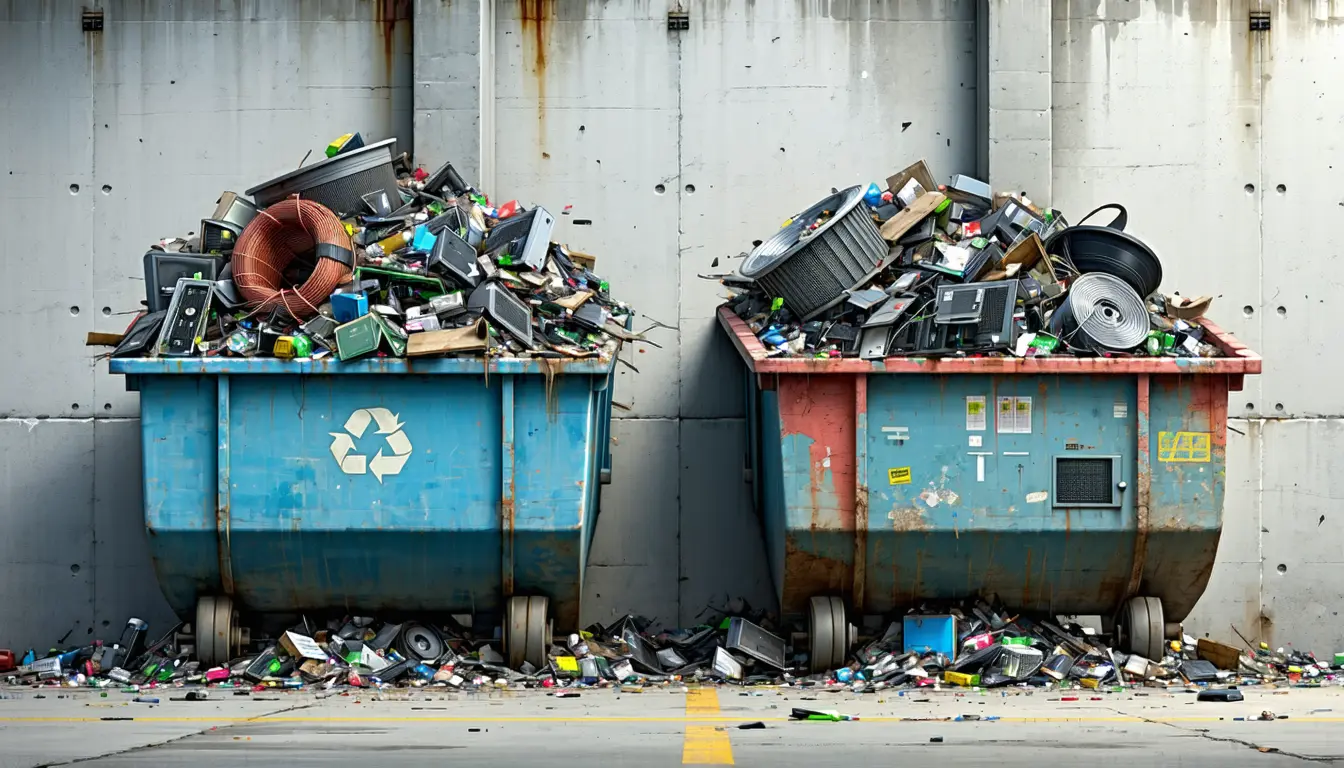
- Basel Action Network's new report says AI-related e-waste could fill 23 million shipping containers by 2050, which it likens to a line of 40-foot boxes circling the world six times.
- The higher figure comes from a wider count: alongside servers and GPUs, BAN includes power supply and distribution, cooling systems, backup power and networking equipment.
- For AI-related equipment retired between 2025 and 2050, BAN puts the total at 395 million to 617 million metric tons of e-waste by mid-century.
- A study published in February had put AI server e-waste at 131,000 to 225,000 tons a year by the end of the decade, comparable to the total output of a country the size of Denmark.
- Less than a quarter of the 68.3 million tons of e-waste the world produces each year is formally collected and recycled, according to figures in the report.
Compiled by The Product DeskSomething wrong?How this is made
Why it matters
- capability Stated per gigawatt, the estimate is usable inside a company: a site owner can put a tonnage against contracted megawatts now, without waiting for a rule that defines the scope for them.
- contradiction Two published estimates of the same waste stream disagree because they count different equipment, so what an end-of-life budget shows depends on which equipment it counts.
- decision If 87 percent of the retired mass is chillers, busway, UPS strings and switches, then whoever signs the facilities contracts owns most of the disposal estimate.
- exposure The US hosts far more data centers than any other country and sits outside the Basel Convention, so where a retired hall's hardware travels is set by the disposal contract an operator signs.
BAN's model puts 70,000 metric tons of eventual scrap behind each gigawatt of data center capacity [5]. Converted into the unit a site is actually contracted in, that is 70 tons per megawatt [7], so a 100MW campus is carrying about 7,000 tons of hardware that will need a destination [8]. Against the capacity projection BAN borrows from McKinsey, up to 219GW by 2030 [6], the coefficient gives 15.3 million tons [1]. A study published in 2024 put AI e-waste at 1.2 million to 5 million tons by 2030 [10]. BAN's implied number is about three times the top of that range [2]. The two are not counting the same thing: the coefficient covers everything a gigawatt will eventually retire, the 2024 study covers waste arising by 2030 [5][10].
The difference is scope. BAN says studies that stop at servers and accelerators miss about 87 percent of a data center's electro-mechanical infrastructure [9]. Read the other way, servers and accelerators are 13 percent of the mass, and counting the rest multiplies the retired tonnage by roughly eight [3]. On annual figures the distance is wider: BAN's low end is 38 times the high end of the study published in February, and its high end about 100 times that study's low end [4]. The loosest part of the count is what BAN calls "AI Waste Contagion", which covers telecommunications infrastructure and personal devices it expects AI to make obsolete earlier [4].
The report's two headline numbers do not close on each other. Its annual retirement rate of 8.6 million to 13.1 million tons [8], carried across the 26 years from 2025 to 2050, comes to 224 million to 341 million tons [5]. For that same window it gives 395 million to 617 million [7]. The cumulative figure runs about 1.8 times the annual rate multiplied out [6].
Jim Puckett, BAN's founder and chief of strategic direction, said in a press release that "AI may feel weightless, but every model depends on an enormous amount of highly specialized, cutting edge hardware" [14]. He also said: "If companies and governments do not begin planning for this new waste tsunami, today's AI buildout could become an even more cataclysmic toxic waste crisis than we are already experiencing" [15]. BAN works on hazardous waste exports, and the US, which has far more data centers than any other country, has not ratified the Basel Convention [13]. The Verge did not obtain comment from an operator or a regulator [17].
The split is what a refresh plan can use, and I would expect its two halves to sit with different budget owners. For that 100MW campus, that is about 910 tons of servers and accelerators and about 6,090 tons of power, cooling, backup and network plant [9].
What to watch
- Whether BAN publishes the derivation behind 70,000 tons per gigawatt so operators can test it against their own bills of materials.
- Whether the 395 to 617 million ton total and the 8.6 to 13.1 million ton annual rate get reconciled in a revised paper.
- Whether any operator starts publishing expected decommissioning tonnage next to its capacity announcements.