Build1 publisher3 min readPublished
Spark Capital leads $120M into factory-built power blocks that skip the interconnect queue
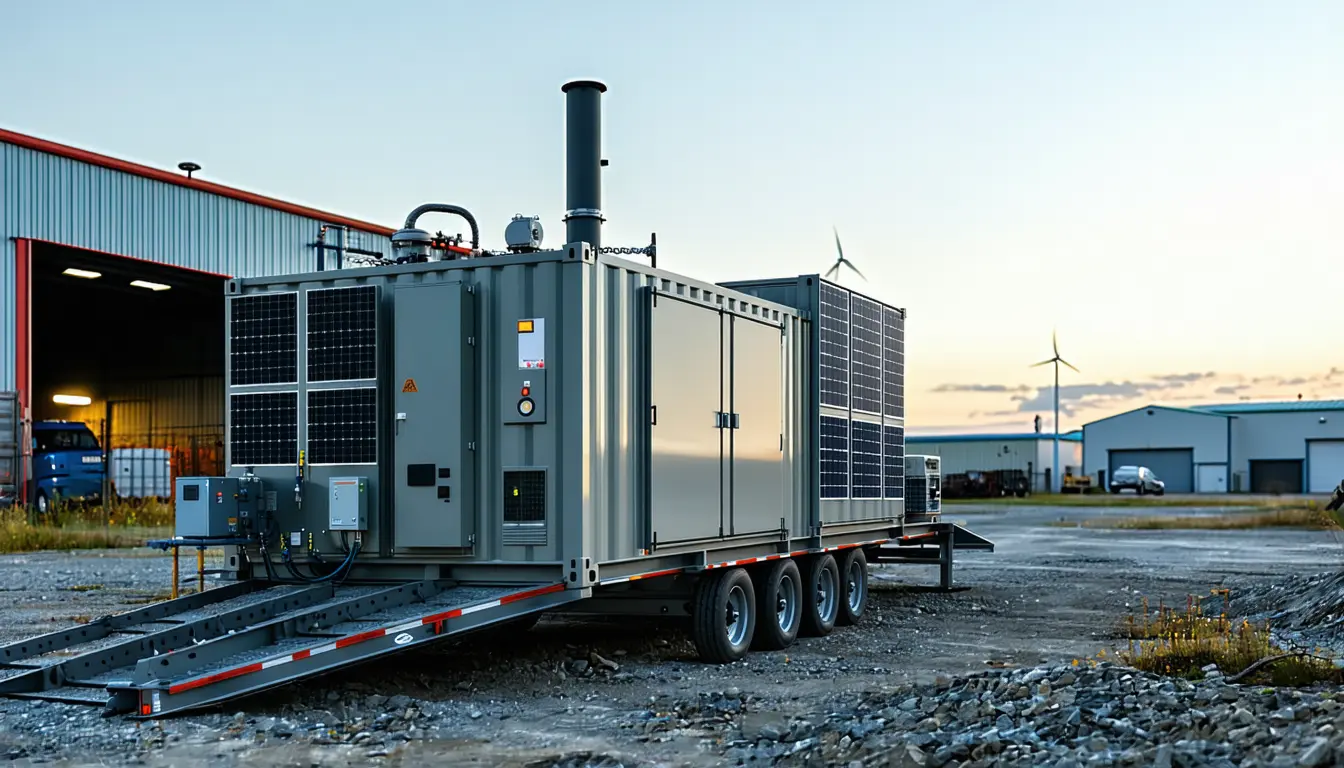
TAR's off-grid mix of solar, wind, batteries and gas turbines costs more than grid power. What it sells is an earlier start date. The round closed as its first 20 megawatts came due.
The Engineer · Build desk
What happened
- Bloomberg reported Thursday that Spark Capital led a $120 million Series A into TAR, with existing investors Buckley Ventures and Align Fund participating.
- The round values the off-grid power maker, founded by Patrice Becker and Leonhard Soenke, at roughly $1 billion for moving into turbines, batteries and construction sites.
- Becker has said plainly that TAR's power is not cheaper than grid electricity, and that the sale is starting servers while a conventional interconnection sits in a queue.
- TAR claims a pipeline exceeding 200 megawatts for 2027 and several gigawatts for 2028, figures that describe planned capacity rather than operating projects.
Compiled by The EngineerSomething wrong?How this is made
Why it matters
- cost A megawatt bought this way prices schedule, so the operator's power line stays above grid rates long after the interconnection it jumped would have arrived.
- constraint The product's value decays as utility queues shorten, which makes TAR's addressable window a function of somebody else's backlog rather than its own cost curve.
- exposure With the mark set before disclosed revenue or a broad customer list, a slipped commissioning date on one unnamed neocloud site becomes a valuation event.
- precedent Funding electricity delivery as a layer of the AI stack gives the next power-hardware startup a template: raise on a factory plan and a delivery date instead of an order book.
The word to watch in Becker's pitch is constant. Becker told Forbes in June that TAR was delivering roughly 20 megawatts of constant capacity to an unnamed large neocloud provider within three months, alongside a 10-megawatt continuous-power pilot on land the company owns [10]. The system doing that combines solar, wind, batteries and simple-cycle natural-gas turbines, and Becker describes the gas as backup for periods when renewable generation and stored energy cannot carry the load [6]. Under a flat around-the-clock load, the hours when neither generation nor state of charge covers demand are the hours that set nameplate, so the turbines have to be rated close to the full site load [3]. Solar, wind and batteries cut fuel burn and run hours without shrinking the machine you need on the worst night. What is being manufactured is a packaged gas plant with a fuel saver in front of it: a reasonable product built around gas, not one built around renewables.
The packaging is the part worth respecting. Pre-wiring, pre-assembling, pre-testing and pre-commissioning in a factory [7] moves work off a site with weather and craft-labour scheduling into a shop with fixtures and repeat units, which is how a cost curve starts. The scarce inputs sit outside that shop: RuntimeWire reports execution still depends on land, procurement, crews and permits, with the supply chain tightened around transformers and gas turbines [8]. Factory assembly compresses field hours, not order books.
The mark is ahead of the record. Publicly reported funding is $147 million across the seed and the Series A [4]; set against the roughly 20 megawatts due in three months, that is about $7.35 million of capital per megawatt of near-term firm capacity [1]. Take the roughly $1 billion valuation [2] against the stated floor of 200 megawatts of 2027 pipeline [11] and you get about $5 per watt of capacity that is planned rather than operating [2]. The announcement also lands around the delivery deadline Becker set for himself in June [16].
The IEA's number describes the market rather than TAR's order book: data-centre electricity demand rose 17% in 2025, with AI-focused facilities growing faster [13]. For that growth to reach TAR, the buyer at each specific parcel has to keep valuing months over cents [9], and TAR has to hold turbine slots to serve them.
Becker and Soenke came out of consumer software, a calendar application acquired in 2020 and a gifting platform for online creators [14]. The more informative detail is who they are hiring: mechanical, electrical and software engineering, procurement, financing and operations, with a logistics hub called Terminal One under development in West Texas [12]. Procurement and financing are the two chairs that decide whether the 2028 gigawatts exist, because the binding constraint here is buying long-lead iron and funding it before a customer pays.
What to watch
- Confirmation that the roughly 20 megawatts handed to the unnamed neocloud is running, and at what availability.
- Any disclosed turbine or transformer order slot, which would show whether the 2027 pipeline has iron behind it.
- A named customer for Terminal One in West Texas, which would move the pipeline from planned to contracted.