Loading today’s stories
Science1 distinct publisher2 min readUpdated
CMS reads the shape of oxygen and neon by the way their plasma flows
The elliptic signal says neon-20 is not spherical. The triangular signal runs the wrong way, and no number for the deformation survives that disagreement.
The Scientist · Science desk
What happened
- A study published in Physical Review Letters reports new details of the internal structure of oxygen and neon from the flow of particles coming out of oxygen-oxygen and neon-neon collisions at the LHC.
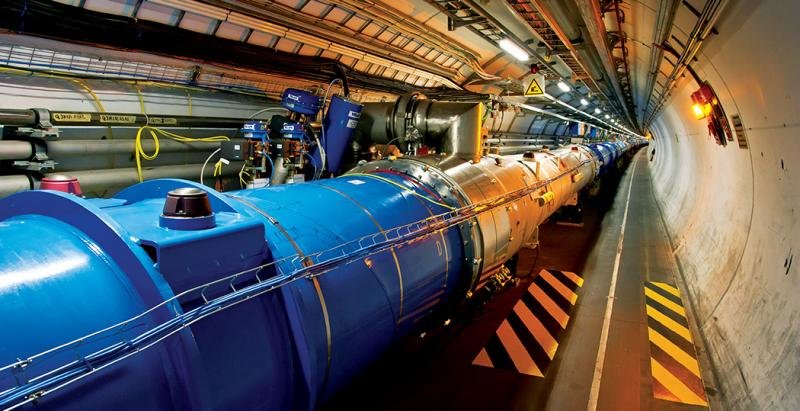
- The team analyzed the collisions with the CMS detector at the CERN Large Hadron Collider at 5.36 TeV per nucleon pair, and compared the measurements with fluid-dynamics simulations that include modern calculations of nuclear structure.
- Nuclear calculations in past studies proposed a tetrahedron-like internal arrangement for oxygen-16 and a more elongated, bowling-pin-like arrangement for neon-20.
- Previous high-energy collisions have been used to probe the shapes of heavier nuclei such as uranium, and similar flow-like signals were also seen in proton-proton and proton-nucleus collisions.
- Lighter nuclei such as oxygen and neon offer a cleaner test of this geometry than heavy nuclei or proton-based collisions.
Compiled by The ScientistSomething wrong?How this is made
Why it matters
The argument rests on a cancellation. Because oxygen-16 and neon-20 have similar mass numbers, the study treats their hot-stage hydrodynamic evolution as similar too, which leaves differences in the outgoing flow attributable mainly to the geometry the two nuclei presented at contact [6]. Divide neon's flow by oxygen's and the shared physics is meant to drop out, leaving shape. It is worth noticing that the two nuclei differ by four nucleons, 25 percent in nucleon count [14], so this is an approximation being asked to carry a structural conclusion.
The reason for using light ions at all is control. In proton-nucleus collisions the initial condition is dominated by event-by-event fluctuations and by the partonic structure of the proton; in symmetric light-ion collisions it is set primarily by where the nucleons sit, which the authors call ideal for studying the final-state collective response in small systems [5]. Heavier nuclei such as uranium have been read by high-energy collisions before, and flow-like signals turn up in proton-proton and proton-nucleus data as well [4], but oxygen and neon are the cleaner test of geometry [c4b].
The elliptic channel behaves. Both systems show significant elliptic and triangular flow that changes with how centrally the nuclei meet, as a fluid responding to the initial shape would [7]. Toward head-on collisions, neon's elliptic signal pulls ahead of oxygen's, the direction expected if neon-20 is less spherical than oxygen-16 [8], which is what low-energy calculations propose: a bowling-pin neon against a tetrahedral oxygen-16 [3].
The triangular channel does not. Its neon-to-oxygen ratio moves the opposite way toward central collisions from the prediction [9]. The authors say as much: both frameworks qualitatively capture the rise toward central events, but agreement with the data is not uniform across the measured centrality range, so a quantitative determination of the deformation needs further dedicated study [11]. Triangular flow is the harmonic most exposed to fluctuations rather than mean geometry, and that is where the paper points the repair work, toward improved theory of event-by-event fluctuations [10].
What has been demonstrated is thinner than a shape measurement and more useful than nothing. Collective flow out of a few-hundred-nucleon collision responds to light-nucleus geometry in the expected direction, with enough sensitivity to distinguish two nuclei four nucleons apart [15][14]. What has not been demonstrated is any value for neon's deformation; converting flow into an exact nuclear shape needs dedicated analysis the paper does not claim to have done [12]. The instrument works better than the ruler attached to it, and for now the ruler is the part being calibrated by the plasma rather than the other way round [13].
Loading topic controls
Loading related stories