Science1 publisher3 min readPublished
Four fossil beaks place Cretaceous squid 10,000 kilometres from every other known find
Squid fossils from the Western Interior Seaway push the group's known Cretaceous range to the other side of the globe, about a million years before the asteroid impact that has long been credited with spreading them.
The Scientist · Science desk
What happened
- Four structures identified as fossilized lower squid beaks, each about a centimetre across, came out of a basketball-sized nodule of South Dakota sediment reported on in Geology.
- The shapes of those beaks led the researchers to conclude they had identified two new species of squid.
- Every other known Cretaceous squid fossil comes from what was then the northwestern Pacific, more than 10,000 kilometres from the seaway that covered South Dakota.
- The sediments were laid down roughly a million years before the Chicxulub impact, which upended marine ecosystems more than 66 million years ago.
Compiled by The ScientistSomething wrong?How this is made
Why it matters
- constraint An impact-driven spread can no longer be the default explanation for squid reaching the whole ocean, and whatever moved them across the globe did so while the Western Interior Seaway was still open.
- capability Ammonite-bearing concretions already sitting in museum collections can be screened for soft-bodied animals that no amount of looking at the outside of a rock would find.
- decision A collection using this method has to accept that the nodule will not exist afterwards. The image stack is what anyone later has to work from.
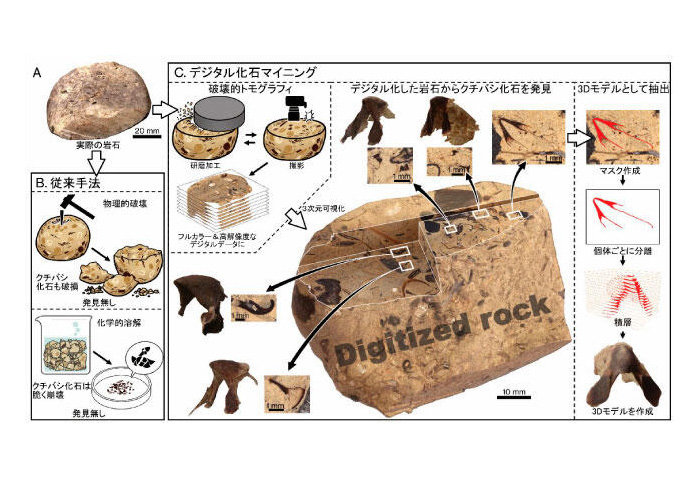
The picture of Cretaceous squid confined to the northwestern Pacific rested on where fossil-bearing rock had been split open [16]. A single fossil in the right rock establishes presence. Ikegami said finding any squid at all in these sediments surprised him more than the two new species did [15].
The search design follows from a preservation problem. Squid have no bones and no shells, and those are the parts that usually survive [4]. "Such large, robust parts account for most fossils known," said Shin Ikegami, a paleontologist at Hokkaido University in Japan [5]. Their tissue also retains ammonia, which keeps the animal buoyant and inhibits fossilization [6]. The beak survives because it is stiff and used for biting: "Each squid has an upper and a lower beak as a primary feeding organ used for biting," Ikegami said [7][8]. So the team went after a concretion from a stretch of the Western Interior Seaway where ammonites turn up in quantity [10][11].
The nodule had been collected by Neil Landman of the American Museum of Natural History [9]. The team ground it away in passes of hundredths of a millimetre, photographing the fresh surface more than 5,000 times, then rebuilt the interior as a digital volume [12]. The passes account for the size. Taking one photograph per pass, 5,000 slices at a hundredth of a millimetre is 50 millimetres of rock, and at five hundredths it is 250 millimetres, which brackets a basketball [24]. Grinding is subtractive, so the image stack is what a later worker would re-examine [26].
The beaks leave the timing of the dispersal open. Squid originated roughly 100 million years ago and these sediments are roughly 67 million years old, which leaves about 33 million years during which squid could have reached the seaway [3][9][23]. The firm constraint is that they were in it about a million years before the impact [18]. Thomas Clements, a paleobiologist at the University of Reading who was not involved in the work, said resolving the timing will take fossils from sites between the Pacific and the seaway [21]. "That will tell us how quickly these animals radiated," he said [22].
Ikegami connects the find to a change already under way before the extinction. "Our findings indicated that the rise of some modern-type animals occurred prior to the mass extinction," he said [19]. "The restructuring of marine ecosystems had already started" [20]. Eos, reporting the study, said the discovery highlights that the animals had adapted to a large range of habitats even before Chicxulub [1][27]. The evidence in hand is four lower beaks from one nodule plus the previously known Pacific material [13][16]. The beaks record two locations, and counting habitats would take other evidence.
What to watch
- Whether other ammonite-bearing concretions in museum collections, screened the same way, yield beaks outside the two known regions.
- Whether the two proposed species hold up once more lower beaks are described, since the assignment rests on shape alone.
- Whether upper beaks, missing from this set of four, turn up in the same South Dakota sediments.