Build1 publisher2 min readPublished
Inherent feeds Faraday the lab's own emails, meeting notes and instant messages
The New York Times reported that the record extends to researchers' own conversations with Faraday, and the public evidence for the wider self-improvement loop still sits on the lower rungs.
The Engineer · Build desk
What happened
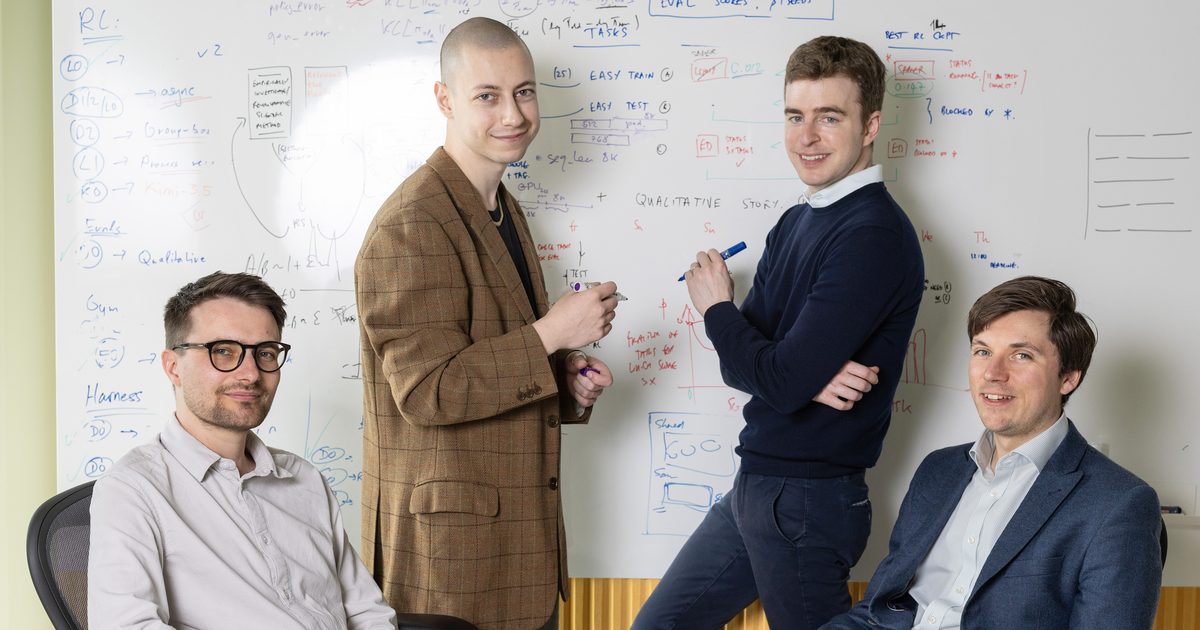
- Inherent, a London startup founded by former Google researchers Edward Hughes and Louis Kirsch, is building an AI system called Faraday.
- The New York Times reported that Faraday collects the lab's emails, instant messages, meeting notes and researchers' conversations with Faraday itself, and that Inherent uses that record to improve Faraday.
- Inherent's public manifesto puts the company inside a "recursive collective self-improvement" system whose pieces include research discussions, resource decisions, hardware, training data, experiments and AI systems.
- In an Anthropic experiment, Claude-powered agents recovered 97% of the gap between a weak and a stronger model on an open-ended AI safety problem, against roughly 23% for two human researchers.
Compiled by The EngineerSomething wrong?How this is made
Why it matters
- decision Copying this means choosing which channels are in scope before anything is trained, and that choice belongs to whoever owns the comms tooling.
- capability Process knowledge that normally walks out with departing staff becomes searchable and reusable without any new model research.
- constraint Anthropic's own caveat limits what its merged-code figures can justify inside another company's plan, because quantity of code is not evidence of delivered value.
- exposure Informal channels sit inside the training path once internal comms is the substrate, and everyone typing into them contributes whether or not they meant to.
Somebody decides which artifacts survive. theneuron.ai's summary of The New York Times reporting calls it "a remarkably intimate record of the lab's work" [19], and on that account Faraday does not only see the final code or the successful experiment; it sees traces of the process that produced them [4]. The record includes researchers' conversations with Faraday itself [2].
Collection comes before training here. A rejected hypothesis contains information, and so does a debugging trail, or a researcher explaining why an experiment failed [6]. In most organizations that material ends up in old Slack threads, undocumented decisions, forgotten experiments, and the heads of people who leave [7]. Capturing it means deciding in advance that the meeting is minuted and the direct message is in scope. That decision sits in a retention setting. theneuron.ai's account does not describe how Inherent ingests or retains the record [21].
Inherent says AI's role in science should involve collaboration instead of automating scientists away, and that it wants human-machine systems that keep people involved in discovery [8].
On the loop itself, theneuron.ai judges that public evidence supports the earlier rungs much more strongly than the last one, in which an AI autonomously designs, trains, evaluates and improves a successor system [9] [20]. The figures come from someone else's codebase. Anthropic's engineers merged roughly eight times as many lines of code per day in the second quarter of 2026 as they did in 2024 [11], and Anthropic attaches its own warning: more code is not eight times more productivity, and volume measures quantity, not necessarily value [12]. For that ratio to mean anything elsewhere, the binding constraint on the other team would have to be lines written. If review is what limits a team, more lines only lengthen the review queue.
The research result claims more, and it comes with conditions. Claude-powered agents recovered about 4.2 times the share of the model gap that the two human researchers did [14]. Humans chose the problem and created the scoring system, the agents consumed about 800 cumulative hours of work, and the result did not transfer [15] [16] [17].
theneuron.ai argues that one of the most valuable datasets in AI may eventually be something companies already own access to: the working memory of their own organizations [18].
What to watch
- Whether Inherent publishes the scope of the record: which channels are collected, for how long, and on what consent basis.
- Whether Anthropic's next analysis reports review time alongside merged lines, which is the figure its own caveat points at.
- Whether anyone reproduces the 97% recovery on a problem and a scorer the agents did not receive from humans.