Science1 distinct publisher3 min readPublished
Two UCLA-led papers report that cortical stem cells read their nutrient supply and contact from thalamic fibers when they choose what to build, which makes cortical output partly a function of conditions outside the cell.
The Scientist · Science desk

science
Testis-biased genes predict whether a gecko's new sex chromosome becomes a Z or an X1 distinct publisher
science
The self-driving lab's binding constraint is a century of footnotes, not the model1 distinct publisher
Compiled by The ScientistSomething wrong?How this is made
The Cell paper's weight rests on the intervention, not the map. An atlas tells you which pathways are busy where; it cannot tell you whether that activity does any work. Lowering the glucose supply and separately interfering with the pentose phosphate pathway did change the cells' output, and that ordering puts metabolism causally upstream of the fate decision in this system [6]. Aparna Bhaduri of UCLA put it as metabolism not being "just a passive thing that happens in the background" but something that "can really control how stem cells make decisions" [7].
Be careful about the direction of the shift. Producing cell types that normally arrive later in development is not the same as producing wrong cells. It is compatible with a developmental sequence that has been retimed, and equally compatible with one that has been redirected, and the account released by UCLA does not separate those readings [6].
The thalamic half is thinner as reported. The summary is that direct physical contact from thalamic projections changes which neurons radial glia make, including the upper-layer neurons that are proportionally prominent in humans [9]. "Physical contact" covers adhesion molecules, contact-dependent presentation of a ligand, and actual mechanical force. Which of those is doing the work decides whether this is a result about mechanics or about a signal that happens to require touching, and the material does not say.
Both studies work in donated human tissue and in brain organoids grown from stem cells [4]. That is the right material for this question, and a pregnancy is a different thing. Glucose in a dish can be dialed to a number; glucose reaching a fetal cortex passes through placenta, maternal physiology, and time. UCLA points to maternal nutrition and metabolic disorders as things the atlas could help investigate [11], which UCLA describes as a research direction; the atlas has not produced a finding about either.
Magnitude is what the supplied material leaves out. No proportion of cells shifted, no donor or organoid counts, no glucose concentrations, no duration of restriction [12]. Until the papers put those on the table, the defensible claim is directional: the fate decision has metabolic inputs, and one of them can be moved.
Whether that displaces an intrinsic timer is a different question, and neither study as described pits a clock against an environment. What the perturbations establish is weaker and more useful than a replacement: a cell-intrinsic program with inputs. That matters past embryology, because radial glia mostly disappear before birth while cells resembling them reappear in brain cancers for reasons still unclear [3], and a fate decision that answers to glucose is a fate decision with a lever attached.
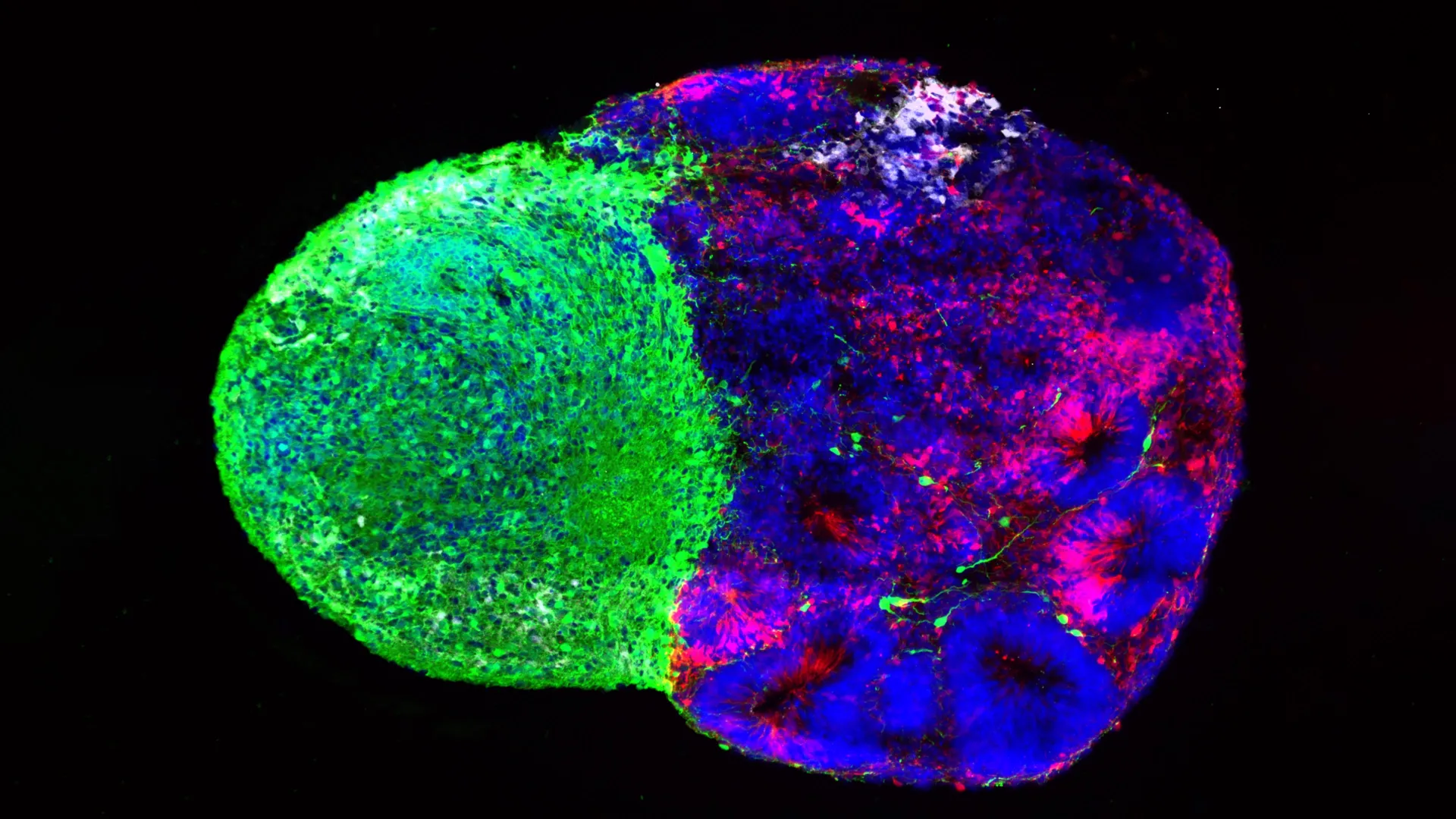
Ranked by verification strength, evidence, and original report placement.
When the scientists lowered the amount of available glucose or interfered with the pentose phosphate pathway, the stem cells changed what they produced, generating more inhibitory neurons and other cell types that normally appear later in development.
According to the UCLA summary, radial glia change their behavior depending on physical contact with signals arriving from the thalamus, and those signals can alter which types of neurons are produced, including upper-layer neurons that are especially prominent in humans.
UCLA researchers reported two studies, one published in Cell and one in Science, on how radial glia make developmental choices in the forming human cortex; the announcement from University of California - Los Angeles Health Sciences is dated September 4, 2026.
Radial glia are stem cells that produce large numbers of the neurons and support cells making up the cerebral cortex, and are believed to contribute to the unusually large expansion of the human cortex compared with other species.
Most radial glia disappear before birth, but similar cells can later appear in brain cancers for reasons scientists do not fully understand.
The Cell study built a detailed metabolic atlas of the developing human cortex by analyzing donated human tissue along with brain organoids grown from stem cells; it was a collaboration between the labs of Aparna Bhaduri and Heather Christofk, led by co-first authors Jessenya Mil and Jose Soto.
Distinct publishers with included, body-backed reporting in this cluster.
1 article · September 3, 2026
Follow any of these and your For You feed starts watching them — no settings page required.
Evidence-backed comparisons of source perspectives and observed adoption signals. Read the methodology
Which Builder, Operator, and Investor concerns the observed source mix emphasized—not a truth score.
Evidence, demonstrated adoption, hype gap, incentives, and confidence are assessed independently, each on its own current evidence. How these are measured.
Top-tier venues, single narrator
Peer review at Cell and Science is real vetting, and it happened out of our sight: what reaches the reader is one university announcement, relayed once. The mechanistic claims are internally coherent and specific about direction — more inhibitory cells when glucose falls, more upper-layer excitatory cells on thalamic contact — and entirely silent about magnitude. A finding described only in comparatives cannot be weighed.
Nothing to count yet
Two papers appearing is publication, not uptake. Our coverage names no other lab using the metabolic atlas, no repository or release date for it, and no group reproducing the assembloid contact result. There is no honest number to put here.
Dish-scale result, brain-scale headline
The gap opens between what was manipulated and what is invoked. Glucose was cut in tissue and organoids; the framing reaches for maternal nutrition and 'the hidden instructions that build the human brain'. Bhaduri's own claims are the disciplined part of this story — metabolism is instructive, the contact point is new, it probably isn't in rodents. The unearned inches come from the packaging around them, including a superlative about the atlas that nobody outside UCLA has assessed.
The university tells its own story
The chain of custody is short and one-directional: UCLA's communications office writes, an aggregator reproduces, no one asks. That arrangement rewards the flourishes visible in the text — 'the coolest cells that have ever existed', a resource billed as among the most detailed yet, two journals in one dateline — and it does not require any funding line or competing-interest note, which is why none appears. Nothing suggests distortion of the findings; the pressure is on emphasis.
Believable direction, unverifiable size
We would bet on the qualitative shape of both results — the journals are demanding and the described mechanisms are specific enough to be falsifiable. We would not bet on anything quantitative, on the atlas's claimed standing, or on the autism connection, which this reporting introduces and then cuts off before delivering. One publisher, one institutional voice, zero numbers: that caps how far confidence can go.