Invest1 distinct publisher2 min readPublished
The higher marginal rate reaches only clients joining Schwab Wealth Advisory from October 1, which puts the increase where a consolidated client is hardest to move and leaves the entry price alone.
The Investor · Invest desk

Compiled by The InvestorSomething wrong?How this is made
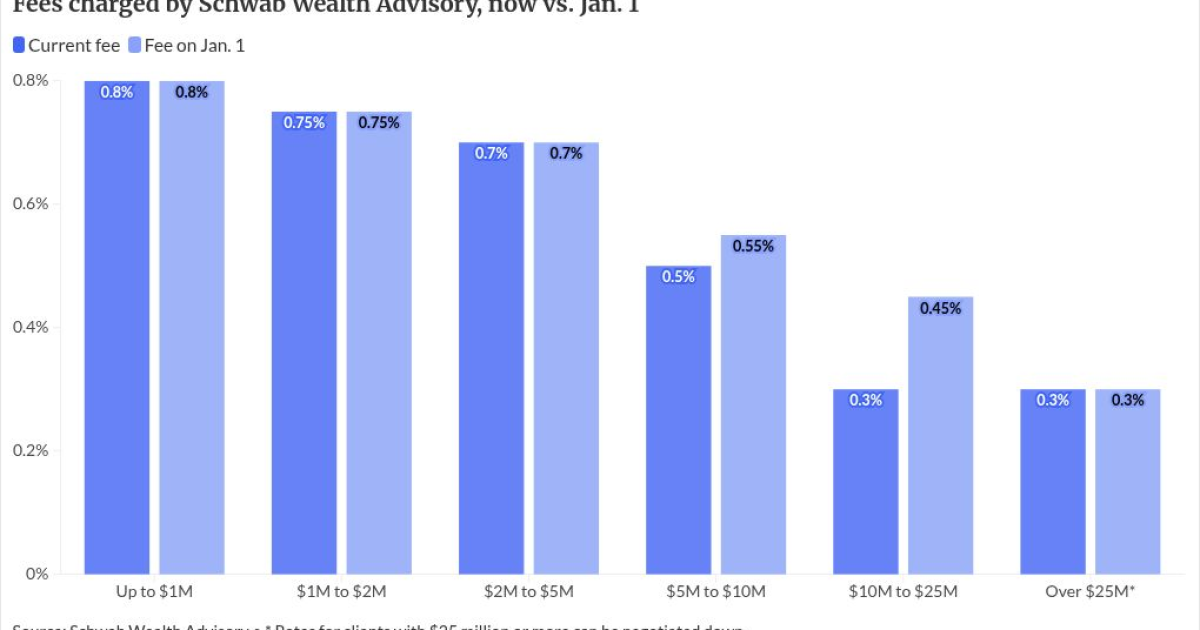
Twenty basis points is the whole of Schwab's low-cost position at the front door: 0.8% on the first million against an industry standard closer to 1% [3][4], or $2,000 a year on a $1m account that Schwab has chosen not to collect [1]. Because the tiers are marginal and declining, a client in the $5m to $10m band pays the higher rate on assets below $5m and less on the balance above [5], so the repriced money is money already sitting in the account rather than the next dollar in. How much higher is unstated; American Banker describes the move as inching up and publishes no new tier rates [19].
A client with $5m to $25m inside Schwab Wealth Advisory has usually consolidated, and in this case carries an SMA relationship being folded in from Managed Account Select, Managed Account Connection or Schwab Managed Portfolios [2], which makes the account expensive to move and cheap to reprice -- and that is exactly the tier Schwab chose to raise. Elasticity gets tested where it is lowest, and the answer is legible before anything is applied further down the book.
The number that decides whether independent advisors should care sits in the funnel: Wurster's 5% of retail brokerage clients paying for advice against internal polling at 31% willing [10] is a 6.2-fold gap [2]. Wealth Advisory held just over $218bn at the end of December [11], about $72.7m per consultant across the current 3,000 [3]; adding 2,000 more, a conservative reading of "thousands", means sourcing roughly $145bn of new advised assets, a 67% increase on the book, merely to hold that per-head figure [4]. Set $218bn against the $37tn of US retail wealth Wurster cites [13] and it is 0.59% [5], which is why the line about there being room for everyone [18] costs him nothing.
Read one way, this is bookkeeping: a single product needs a single schedule, and the increase plugs revenue leaks, which is what industry experts told American Banker [16]. Read another way, it is a deliberate price probe run at the point of least resistance. Read a third way, and the more interesting one, 31% is stated willingness, not paid willingness, and the consultants get hired against an attach rate that never grows to match it.
The probe reading fits best, because a firm retreating from cheap does not delete the quarterly minimum at the bottom of its book in the same announcement [6]. What would prove it wrong: a rate change below $5m, a minimum reappearing under another name, or an attach rate still near 5% once the new consultants are seated.
Ranked by verification strength, evidence, and original report placement.
Schwab CEO Rick Wurster has said only 5% of the retail investors using Schwab's brokerage services pay for financial advice, while internal polling suggests as many as 31% are willing to do so.
Schwab Wealth Advisory, an RIA within Schwab, had just over $218 billion in client assets by the end of December.
Schwab took out an advertisement in the Wall Street Journal saying it planned to add thousands of financial consultants to its current stable of roughly 3,000.
Wurster has noted that there is $37 trillion in retail wealth to be managed in the U.S.
Charles Schwab is inching up its marginal fees for clients with between $5 million and $25 million in assets, even as it takes steps to woo more high net worth clients.
The fee changes are part of a move to pull separately managed accounts into Schwab Wealth Advisory; some of those accounts were formerly managed under business lines named Managed Account Select, Managed Account Connection and Schwab Managed Portfolios.
Distinct publishers with included, body-backed reporting in this cluster.
1 article · September 4, 2026
Follow any of these and your For You feed starts watching them — no settings page required.
invest
Schwab lifts its referral floor to $5M, and referral-fed RIAs get a dated model1 distinct publisher
invest
Schwab starts phoning Altruist's advisors a week into Vanguard's deal1 distinct publisher
invest
Robinhood's custodian negotiates a separate custody price with every RIA it recruits1 distinct publisher
invest
Schwab moves Solana, Avalanche and Chainlink onto its retail shelf at 75 basis points a trade1 distinct publisher
Evidence-backed comparisons of source perspectives and observed adoption signals. Read the methodology
Which Builder, Operator, and Investor concerns the observed source mix emphasized—not a truth score.
Evidence, demonstrated adoption, hype gap, incentives, and confidence are assessed independently, each on its own current evidence. How these are measured.
One outlet, the issuer's own numbers
Every load-carrying detail traces to American Banker, and inside that story to Schwab's written statement: the schedule change, the 5% billing-group ceiling, the promise that most clients see no change. Welsh, Papedis and Trout interpret the move rather than verify any part of it. The new rate on the tiers between $5 million and $25 million, the single number that would settle how large the increase actually is, remains unpublished.
In force from October 1, and only then
What exists today is a dated schedule rather than a book of repriced clients: higher marginal rates reach only accounts opened into Schwab Wealth Advisory from October 1, the small-account minimum disappears at some point in the fourth quarter, and the division's $218 billion is a December mark cited in September. Client counts, a revenue figure, and the number of the roughly 150 network RIAs losing referrals under the new rules are all still undisclosed.
Headline runs ahead of the rate card
"Raises fees on wealthy clients" is fair but front-loaded. The disclosed change lifts marginal rates above $5 million for people who join from October, caps transitioning clients at 5%, holds 0.8% on the first million and removes the minimum at the bottom. Against Schwab's framing of consistency and transparency, the story's pricing-power reading is the better one; against an unpublished rate card, calling it an increase on wealthy clients is a claim taken partly on trust.
Everyone quoted has a stake in the answer
Schwab's statement is speaking to two audiences at once: clients told most fees will not move, and the RIAs whose assets it custodies, told there is $37 trillion to share. The consultants who read the move sell into those same RIAs, and Welsh's own history at Schwab from 1999 to 2006 is disclosed in the piece. The referral network sharpens it further, since those roughly 150 firms pay Schwab for leads that Schwab is now steering to its own advisors.
Firm on timing, thin on magnitude
Schwab's statement and the timing of the change are well established, while how much anyone will pay and whether the change moves revenue remain open questions. A second outlet publishing the tier rates, or a Schwab spokesperson speaking to them on the record, would settle most of the doubt in a paragraph.