Product1 distinct publisher3 min readUpdated
On Rosatom's own numbers the RITM-200 is the closest thing to a serial small reactor anyone has. It is also marine propulsion, rated in thermal megawatts, with its civilian versions still being built.
The Product Desk · Product desk
Compiled by The Product DeskSomething wrong?How this is made
Two of the figures Rosatom quotes for this reactor are the same figure. Putting the core and steam generators inside a single pressure vessel, instead of plumbing generators and pumps outside it through large pipes, is credited with cutting the system footprint by about a third, and separately with delivering about 1.5 times the power for its physical size [7][8]. Remove a third of the volume and power per unit volume rises by 1/(1-1/3), which is 1.5 [3]. One engineering result, stated twice, and the whole programme rests on it.
The envelope is at least checkable. At 7.3 metres tall and 3.3 across [5], the bounding cylinder works out at roughly 62 cubic metres [4], which puts 175 thermal megawatts at about 2.8 MWt per cubic metre of enclosing volume [5]. The 15 finished units come to some 2,625 MWt of built thermal capacity, and the 13 in progress take the programme to 28 vessels [1][2].
Thermal is the operative word. Rosatom rates the unit at 175 MWt with a service life of at least 40 years [4], and no electrical figure for any variant appears in the material [6]. Without one, the tally cannot be set against designs marketed in megawatts electric without someone inventing an efficiency.
What the compactness actually bought was a hull. The weight and internal space it freed let the Project 22220 designers adopt a dual draft [9]: ballast in to sit deep and crush ice up to three metres thick, ballast out to cross the shallows at the mouths of Siberian rivers [10]. That is a naval requirement met by a naval reactor on a state icebreaker budget, and it explains why a production run exists at all.
The civilian claim is a derivative of that run. Both grid variants are adaptations of the same marine reactor, and on the source's own account one has reached the construction stage while the other is still being assembled into a fleet [11][12]. Nothing described here is yet generating for a mine or a settlement.
The count, the dimensions and the exclusivity claim all come from one party. The last of them was delivered by Rosatom's chief executive at a government meeting on nuclear infrastructure [2][6], which is a vendor briefing its owner, and the material offers no independent check and no comparison with anyone else's build record.
Below the RITM line sit the Shelf micro-reactor and the Kurchatov Institute's Elena, which makes heat and electricity thermoelectrically rather than through a steam turbine and is said to run autonomously for decades without routine maintenance [13][14]. That is the most interesting item in the catalogue and the least evidenced in it.
Follow any of these and your For You feed starts watching them — no settings page required.
Ranked by verification strength, evidence, and original report placement.
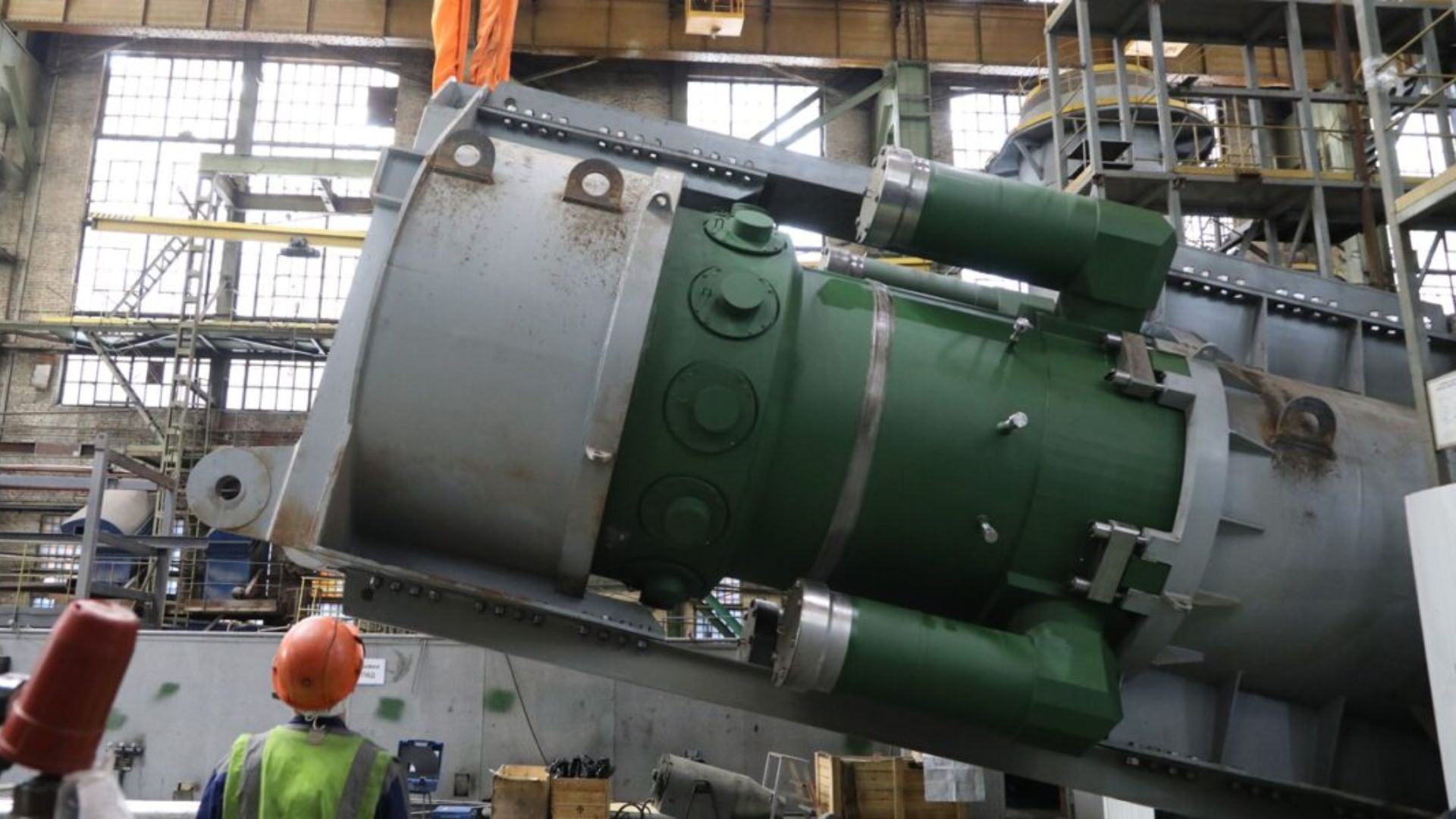
Russia has completed the first RITM-200 reactor unit for its new nuclear icebreaker, the Leningrad.
Rosatom chief Alexey Likhachev outlined plans to use these small-scale systems for broader energy needs during a government meeting on nuclear infrastructure.
Likhachev reported that Russian factories have manufactured 15 RITM-200 reactors so far, while workers are building 13 more.
According to Rosatom, each RITM-200 unit produces 175 megawatts of thermal power and offers an operational lifespan of at least 40 years.
The RITM-200 system measures 7.3 metres in height and 3.3 metres in diameter.
In the RITM-200, engineers placed the core and steam generators inside a single pressure vessel; traditional marine reactors place steam generators and coolant pumps outside the main vessel, linked by large pipes.
Evidence-backed comparisons of source perspectives and observed adoption signals. Read the methodology
Which Builder, Operator, and Investor concerns the observed source mix emphasized—not a truth score.
Evidence, demonstrated adoption, hype gap, incentives, and confidence are assessed independently, each on its own current evidence. How these are measured.
One outlet relaying vendor and state figures
Every number, from the 15/13 unit counts to the 175 MWt rating, dimensions, and footprint gains, is attributed to Rosatom or its chief executive and relayed by a single publisher with no independent source, primary document, or third-party measurement. The specifics are internally consistent and checkable by arithmetic, which lifts the score above the floor, but two headline assertions (only-Russia mass production, Elena's decades of maintenance-free autonomy) are unverifiable as supplied and one key parameter, electrical output, is absent entirely.
Real serial hardware, but civilian units pre-operational
Adoption is genuine and physical on the marine side: 15 units built, 13 in build, a completed unit for the icebreaker Leningrad, and a hull design that already depends on the reactor's compactness. It is close to zero on the side that the story's wider framing implies, since the land-based RITM-200N in Yakutia and the RITM-200S barges for Baimsky are only under construction or assembly, micro-reactors are in testing, and the Uzbek export project is asserted with no stage detail. Serial production of a captive-fleet propulsion unit is not the same as deployed small modular power.
Serial-reactor framing outruns what is deployed and disclosed
The publisher's framing treats a marine propulsion programme as a general-purpose small reactor line: it repeats a footprint gain twice as if it were two separate advantages, carries an unchecked claim that only Russia mass-produces such units, reports maintenance-free operation for decades for a unit still in test, and never states an electrical output, which is the figure any energy comparison requires. Against that, the underlying hardware counts are concrete and the article does label the land and barge versions as under construction, so the overstatement is one of framing and missing denominators rather than fabricated substance.
State vendor briefing government on its own programme
The disclosure setting is explicitly promotional: the head of a state-owned nuclear corporation presenting unit counts and export prospects at a government meeting on nuclear infrastructure, plus a company press release announcing international market entry. Rosatom benefits from both continued state funding for Arctic and remote-site projects and from an exclusivity narrative that positions it ahead of Western SMR vendors. The publisher adds an aggregation incentive toward superlative engineering framing, and no adversarial or independent voice is present to discount either.
Moderate-low: specific but wholly single-sourced
Confidence in the hardware milestones and unit counts is reasonable because they are specific, dated to a named meeting, and consistent with a known icebreaker programme, and the derived arithmetic follows directly from the quoted figures. It is capped well below high by the absence of any second publisher, any primary document, and any electrical rating, and by the fact that the forward-looking parts of the story (civilian grid supply, export to Uzbekistan, maintenance-free micro-reactors) are assertions rather than observed outcomes.
invest
Rosatom prices its return to Bushehr at 42 people, six percent of the crew it pulled out1 distinct publisher
product
A barge, a berth lease and a standards deal: how nuclear gets back into California1 distinct publisher
invest
Apollo Atomics raised $31M betting the NRC, not the physics, is the hard part1 distinct publisher
product
A Texas plant puts dates on the gas-first, nuclear-later data center template1 distinct publisher
Distinct publishers with included, body-backed reporting in this cluster.