Science1 publisher3 min readPublished
A robotic arm in MIT's optics lab built a working laser cavity from randomly placed parts
MIT researchers report a robot that picks standard optics out of labelled housings, places them and tunes mirrors at micron scale until a laser works, then takes the setup apart and builds a different one.
The Scientist · Science desk
What happened
- MIT scientists say their reconfigurable robotic optics laboratory autonomously assembles standard optical components into the configurations an experiment calls for, with no person laying out the bench.
- The system built and fine-tuned a tabletop laser cavity on its own, an element the team describes as central to most optics experiments.
- It can also take an experiment apart safely and reassemble the same components into an entirely different setup.
- The paper is on the arXiv preprint server, and the team will present the system at the IROS 2026 robotics conference in Pittsburgh from Sept. 27 to Oct. 1.
Compiled by The ScientistSomething wrong?How this is made
Why it matters
- capability A table that rebuilds itself from the same inventory can serve successive experiment geometries without a person relaying the optics between runs.
- constraint Adoption starts with re-housing hardware: existing lenses and mirrors have to be mounted in gripper-friendly housings and labelled before the arm can handle them at all.
- decision Soljacic's stated payoff is scientist time returned to theory, so a group weighing the retrofit has to judge how much of its calendar alignment actually consumes.
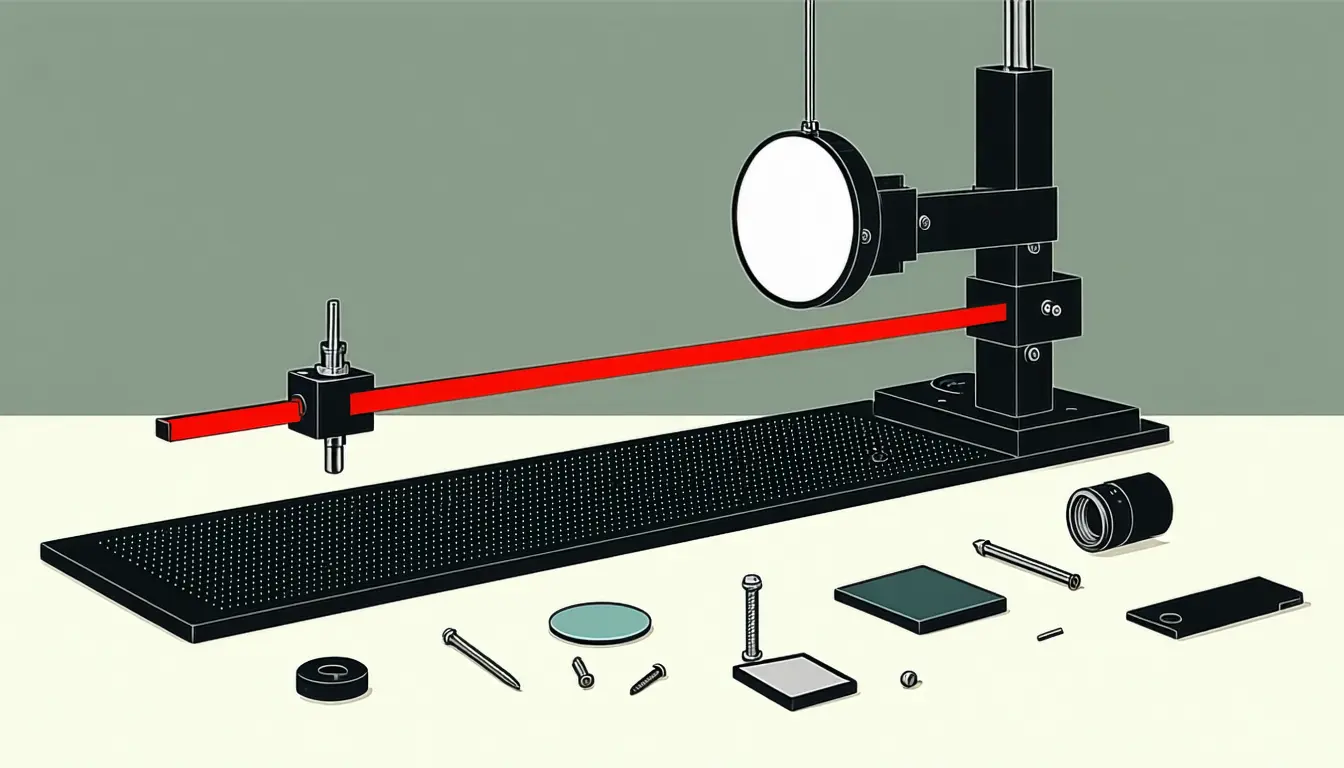
Each lens and mirror sits in its own 3D-printed plastic housing, shaped so the robot can grip and move the part safely [7]. The top of every housing is etched with a QR code carrying information about the component inside [8]. That converts a drawer of loose optics into a set of objects a machine can identify and hold. The arm has seven movable joints and is attached to a metallic tabletop [6].
Then comes the alignment. The team reports tuning the angle and position of mirrors and lenses with micron-scale precision until the beam has the properties asked of it [2], and the demonstrated tasks include centering a laser beam, aligning multiple beams and automatically stabilizing beams in response to physical disturbances [5]. "A robot isn't going to get bored. It can work 365 days a year, 24 hours a day, on very boring things," Marin Soljacic, a professor of physics at MIT, said [12].
Motorized tuners that mechanically turn knobs to angle a mirror are already common in optics labs [18]. "But no one has built a full system that goes from no setup to a completely aligned setup in one tool," said Sachin Vaidya, a postdoc in MIT's Research Laboratory of Electronics [10]. "We start with randomly placed components," Vaidya said. "At the end, we have a fully functioning laser that the robot has built." [9]
The paper does not report how much time the robot saves. "Sometimes this manual setup takes days or months depending on the complexity of the experiment," Soljacic said [11]. That figure describes manual practice, and no one timed it against the machine. The account of the demonstration is silent on the robot's build time, the number of attempts behind a successful build, and the same cavity assembled by a person for comparison [20]. The full sequence can run without hands. Hours saved per experiment would need its own measurement.
The motivation given is materials work, since precision optics experiments use lasers and other light sources to measure the optical properties of candidate materials for phone displays, television screens and solar panels [13]. The demonstrations, though, were optics builds. The account does not compare hours spent on setup with hours spent on analysis, so which of the two limits a characterization group's output is still open.
The group is also building a cloud-based application that would give users virtual access to the physical robot, with the aim that scientists elsewhere submit protocols the lab then sets up and runs on its own [14]. Seven people are named on the work: five at MIT, including Soljacic and co-lead Seou Choi, plus Shiekh Uddin of Nokia Bell Labs and Sajib Shuvo of Arizona State University [16][17].
What to watch
- Whether the arXiv paper or the IROS talk reports build times and success rates over repeated assemblies of the same cavity.
- Whether the cloud front end opens to users outside MIT, and what kinds of protocols it accepts.
- Whether the housing library grows past lenses and mirrors to detectors and sample mounts.