Invest3 publishers3 min readPublished Updated
Revolut offers 0% fees on face-scan payments to sell its Register terminal to UK hospitality
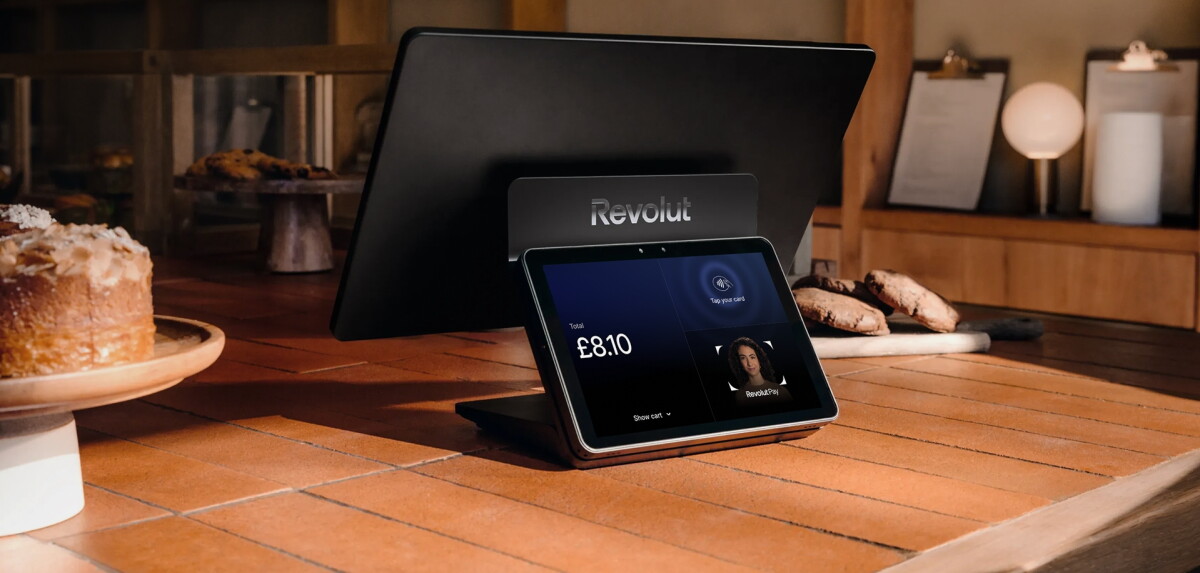
Revolut charges merchants 0% processing fees on face-scan payments in a UK pilot built around Revolut Register, its point-of-sale device for hospitality. The waiver costs Revolut only as much as shoppers pay by face, a demand one Celent analyst calls unproven.
The Investor · Invest desk
What happened
- Revolut said merchants using the facial recognition feature will pay 0% processing fees on those transactions.
- The scan is matched against the selfie identity check customers complete when registering for the Revolut app, and merchants do not store the data.
- Revolut's press office called Revolut Business, which runs the terminal and the biometric checkout, a major strategic bet and one of its fastest growing areas.
Compiled by The InvestorSomething wrong?How this is made
Why it matters
- decision A hospitality merchant weighing Register saves fees only on customers who use the Revolut app and enroll their face, so the device has to justify its purchase through its till and management software.
- contradiction Celent's Bareisis treats consumer demand as unproven, while Datos Insights' Shipper expects security worries to fade and the free rate to drive growth, so the two analysts disagree on whether shoppers are the obstacle.
- constraint With no timeline for Europe or other markets, Register's biometric pitch applies only to UK venues for now.
Zero percent is an easy price to offer on a payment method that went into a pilot this week [1]. The waiver covers only transactions paid with a face [4]. So the processing revenue Revolut gives up is its normal fee multiplied by Smile volume, and the merchant's saving is the same number seen from the other side of the counter [1]. In a pilot, that number is small. It grows only if shoppers start paying by face. American Banker reported that Revolut is using the pilot to draw merchants and consumers to its new point-of-sale system [17], and the terms fit that account. What a restaurant or bar takes delivery of is Revolut Register. It is a two-screen device that bundles payments, financial services and store management, with an eSIM backup meant to keep it online when the connection fails [3]. Revolut pitches the hardware and multi-location software at enterprise hospitality operators, retail chains and high-volume venues [7]. Its press office told American Banker that Revolut Business, the unit behind both the terminal and the biometric checkout, is a major strategic bet and one of the company's fastest growing areas [5]. "When we look to build, we do so focusing on specific sectors, understand their daily pressure points, and innovate around what they actually need to succeed," Revolut said [6]. Zil Bareisis, a director at Celent, doubts the consumer half. "Biometric payments can offer further convenience to customers, but they have had many false starts in various different markets and customer demand remains unproven," he told American Banker [9]. His sharper point concerns the phone already in the customer's pocket: "If you already have the latest phone which unlocks with your face, is looking at the terminal that much more convenient than taking the phone out?" [10] He also argued that some friction is useful, because taking the phone out reassures people that they are paying deliberately [11]. David Shipper, an advisor at Datos Insights, said face payment needs a special terminal and a consumer setup process, and that acceptance is spotty because providers' systems do not communicate with each other [13]. "I could go through the process of adding my face at one merchant, but the merchant next door may use a different vendor, so it's not universal," Shipper told American Banker [14]. Revolut's version of that network is its own enrolled app users paying at its own Register merchants [2]. Each face is matched against the selfie identity check done when the customer signed up for the app [2]. Shipper is less worried about shoppers. "Consumer security concerns are also a factor, but that concern will decrease over time, especially if the option reduces friction," he said [15]. He added that the 0% fee is what will help Smile grow quickly [16]. The fee structure allows three outcomes. Register could sell on its till and software while Smile stays a novelty, in which case the waiver costs Revolut close to nothing [1]. Face payments could catch on at Register merchants, leaving Revolut to forgo fees on a growing share of volume until it decides whether zero is permanent. Or both could stall, and the product stays where it is today: Revolut said Pay with Smile is UK-only and that it has no current timelines for Europe or other markets [8]. I think the first outcome is the likeliest. The terminal has a merchant case without the face scanner, and the face scanner, which needs a special terminal, has none without it [c3, c13]. The counter-case is Shipper's: if the free rate pulls merchants in while security worries fade, Revolut ends up with a closed network where its customers' faces work at its merchants' tills [c16, d2]. Smile rising as a share of Register payment volume would prove the first reading wrong. Bareisis set the same test.
What to watch
- Whether Revolut attaches an end date, a volume cap or other conditions to the 0% processing fee on Smile transactions.
- Whether Revolut names hospitality chains or venue counts running Register as the pilot moves toward wider deployment.