Science1 publisher3 min readPublished
A 100-culture survey traces collectivism to duties inside close relationships
An international team argues that the specific obligations people owe parents, coworkers and strangers are what separate East Asian from Western cultures, and it has built a survey to measure them.
The Scientist · Science desk
What happened
- Social psychologists have argued for three decades over how to compare cultures, and the surveys they used to measure collectivism kept producing contradictory and nonsensical rankings.
- A team publishing in Nature Human Behavior on Sept. 15 argues that the responsibilities people hold inside close relationships, which they call responsibilism, are what differentiate Eastern and Western cultures.
- The survey was translated into 45 languages and answered by 12,247 people across 100 cultures, in countries that together hold 90 percent of the world's population.
- Countries in Africa, the Middle East and Asia scored higher on the new measure than countries in North America, Europe and Australia.
- High-scoring countries had fewer policies favoring immigrants, such as the right to work and family reunification, along with fewer patents and lower sales of creative goods.
Compiled by The ScientistSomething wrong?How this is made
Why it matters
- decision A field that has run on abstract value items now has a 45-language alternative in the record, so the next cross-cultural paper has to say which instrument it chose and why.
- constraint The corruption and democracy associations are measured between countries, so a hospital or school district cannot use them to argue that family obligation produced any local outcome.
- capability Because the scores also track behavior at the level of a person, the measure can be applied to individuals instead of only to national averages.
- precedent Cross-cultural instruments will now be judged partly on whether they reproduce this East Asia and West split, a criterion that rewards measures matching what researchers already expect.
The change is in how the questions are worded. Instead of asking whether the group comes before the individual, the items name the person and the situation: whether you would reorganize your life so your aging parents could live with you, whether you would talk to people you do not know at a party to make new friends [6]. Each item fixed the closeness of the other party, parent or coworker or stranger [6]. A separate block asked how people felt about those close to them and about members of a larger group [7].
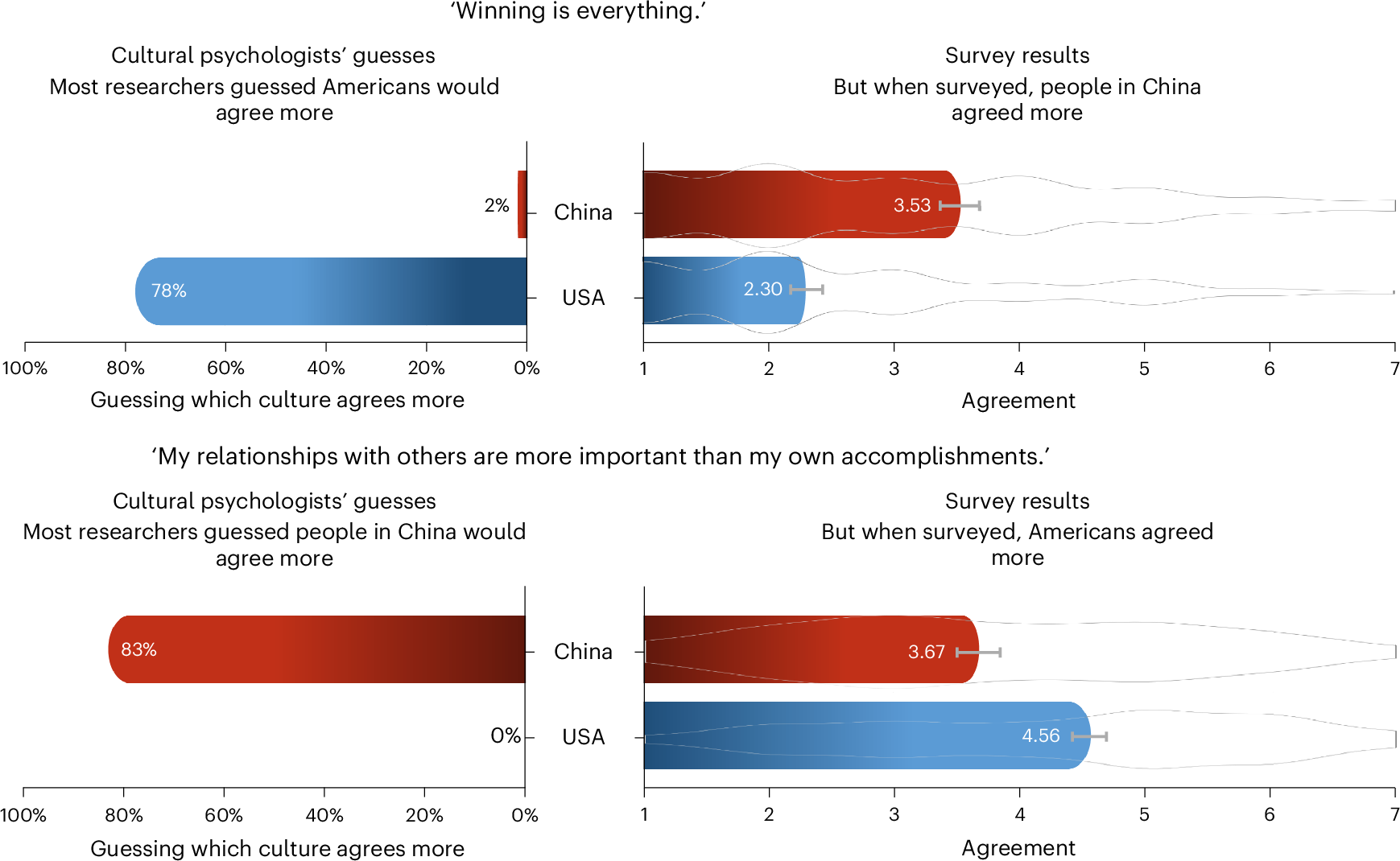
That design came out of seven years in China by the lead author, Thomas Talhelm, now the Robert Cialdini Endowed Professor in Social Influence at Arizona State University [10][11]. He got jostled on the Beijing subway and drew suspicious frowns when he smiled at people on the street, behavior that did not fit a culture classified as collectivist, until he noticed that all of it happened between people with no close relationship to each other [11][12]. A scale that folds family and strangers into one abstract group grades a culture partly on how it treats strangers. Run that scale across countries and the ordering can inverPt [3].
Divide the respondents by the number of cultures and the average is about 122 people per culture [20]. That is enough for the analyses that work at the level of a person, which use the full sample [16]. The country-level results have a much smaller denominator: the associations with democracy scores, corruption, immigration policy and patents rest on at most 100 units, one per culture [23].
The phys.org account gives the direction of each association and not its size, and it does not say which individual behaviors the scores predicted [21]. A comparison between countries cannot separate a culture's obligations from its income or its state capacity, so none of this shows that duty to family suppresses patent counts. Talhelm said collectivist cultures tend to do well on measures of social order, and that those gains come at the cost of individual rights and openness [19].
The claim that the old surveys measured the wrong thing rests, in this account, on the anomalous rankings they produced and on the new items sorting East Asia from the West. The second test is graded against an ordering researchers expected before they ran anything, which is a weaker check than predicting something nobody had ranked yet.
Talhelm said the work "has the potential to give insight to people who straddle cultures, including children of immigrants navigating conflicting expectations at home and in school, teachers who adjust their instruction based on students with different value sets, or doctors who have to help people make decisions for sick family members" [17].
One line in the release is hard to square with the paper it describes. "Individualism versus collectivism explains differences between continents, nations and even groups within nations," Talhelm said [18]. The study he leads was built because those measures kept labeling the United States and the United Kingdom as more interdependent than Japan [3].
What to watch
- Whether an independent team, with its own translations, reproduces the East Asia and West separation in a fresh sample.
- Whether the published paper reports controls for national income, age structure and state capacity behind the country-level associations.
- Whether the individual-level behavioral predictions hold up in preregistered tests rather than in the same dataset that built the scale.