Science1 distinct publisher2 min readPublished
A Nature Communications group swaps guaranteed bandit theory for a heuristic an Ising machine can run over a combinatorial action space, then demonstrates it on a wireless system with moving users, without an effect size in the abstract.
The Scientist · Science desk

Compiled by The ScientistSomething wrong?How this is made
Bandit theory runs out at the count. Suppose a controller sets 30 binary switches. That is 2^30, or 1,073,741,824 distinct actions [14], and the arithmetic is the whole problem: a conventional multi-armed bandit treats each combination as an arm to be pulled and scored, which is the authors' stated reason those algorithms cannot effectively optimize dynamic discrete environments [6].
The bandit literature offers ways around that count, and the paper's own introduction prices them. One is to demand richer observations, either a reward attributable to each individual variable or rewards for all possible action patterns, rather than the single scalar a real system hands back [7]. The other is to restrict the shape of the reward function, for instance assuming it decomposes into a linear combination of predefined functions [8]. Zimmert and Seldin's Factored Bandits asks less: single-scalar rewards, plus an identifiability condition under which each variable's optimal atomic action stays the same whatever the other variables do [9]. Interactions may move the reward only inside the range where that condition still holds [10]. In a wireless system, where what you assign to one user changes the interference another sees, that invariance is a demanding thing to assume, and it is the assumption the Ising-machine route declines to make [3].
In exchange, the method is what the abstract calls itself: a heuristic [3]. Black-box optimization's appeal was never a bound but its indifference to functional form, since it applies to arbitrary black-box functions of many variables [11]. The formulation also keeps the memoryless framing, in which each cycle's reward depends on the action taken in that cycle and not on previous ones [12]; with users in motion, the mapping from action to reward is itself drifting, which is precisely the dynamic part the method claims to absorb by accounting for environmental change alongside variable interactions [3].
What is missing is whether any of that clears a real control loop. The supplied text reports no numbers for the wireless demonstration, including the number of users or the gain over whatever baseline was run [15]. Nor does it settle the hardware argument the title gestures at with "embedded" [1]. The comparison the paper actually draws is between algorithm classes, black-box optimization against multi-armed bandits [5], not between an annealer and a general-purpose learner on the compute already sitting in a base station. That comparison would turn on solve latency measured against the rate at which the channel changes, and on nothing in the abstract. Only the full paper can address whether the demonstrated adaptation is enough for a controller to close its loop inside the coherence window.
Ranked by verification strength, evidence, and original report placement.
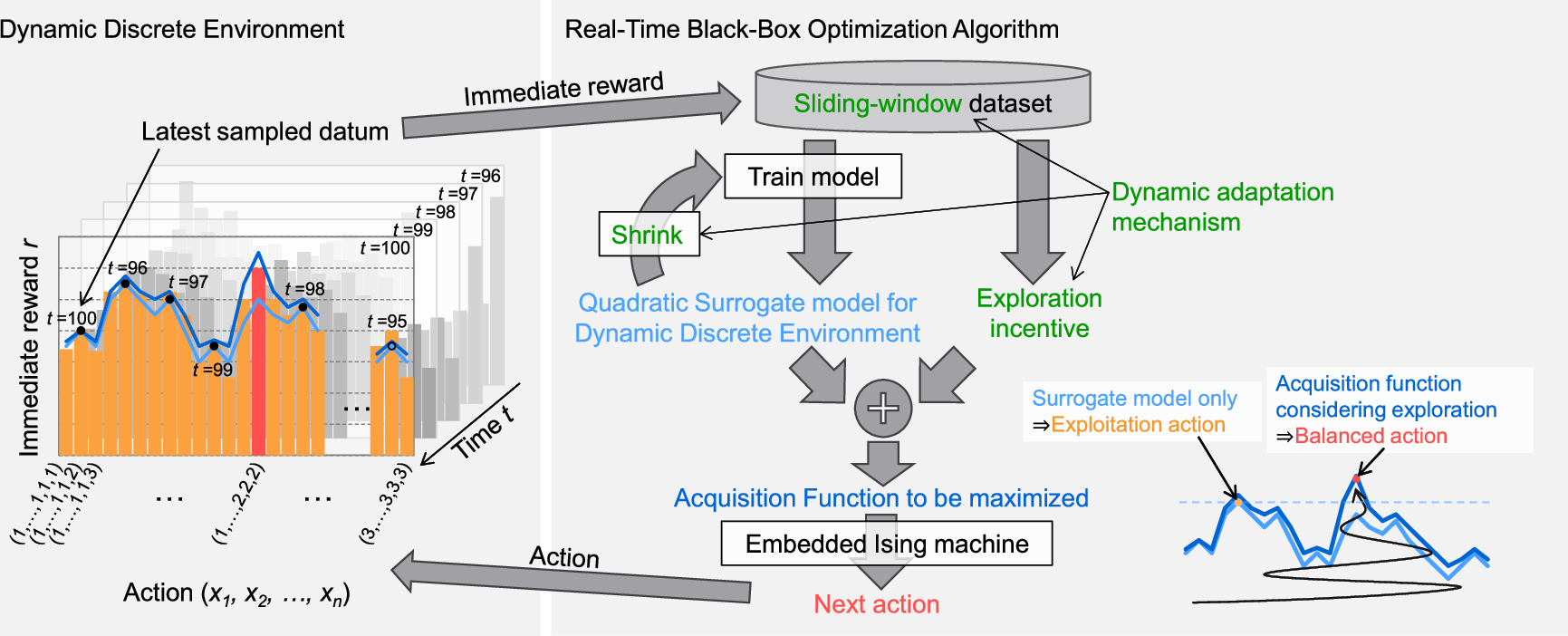
Nature Communications published a paper titled "Real-time black-box optimization for dynamic discrete environments using embedded Ising machines".
A black-box optimization method using an Ising machine had recently been proposed to find the best action, represented by a combination of discrete values, and maximize the immediate reward in static environments.
The authors show a heuristic method to maximize the average reward for dynamic discrete environments by extending the black-box optimization method, in which an Ising machine efficiently explores actions while accounting for interactions between variables and environmental changes.
The paper demonstrates the proposed method's adaptability to dynamic environments in a wireless communication system with moving users.
Black-box optimization algorithms correspond to immediate reward maximization problems and multi-armed bandit algorithms to average reward maximization problems; the immediate reward is that of an individual action, the average reward is the mean of immediate rewards over all repetitions.
Because of the enormous number of actions resulting from the combinatorial nature of discrete optimization, conventional multi-armed bandit algorithms cannot effectively optimize actions for dynamic, discrete environments.
Distinct publishers with included, body-backed reporting in this cluster.
1 article · September 2, 2026
Follow any of these and your For You feed starts watching them — no settings page required.
science
Narwhal tusks hide two spirals twisting against each other, and the mismatch is the point3 distinct publishers
science
Mount Sinai puts a youth protein on aging microglia, and the mice answer1 distinct publisher
science
Half the resistance genes in livestock manure also show up in 875 wild farm mice1 distinct publisher
science
Transcription caught mid-act in fly embryos, and it does not match the test tube1 distinct publisher
Evidence-backed comparisons of source perspectives and observed adoption signals. Read the methodology
Which Builder, Operator, and Investor concerns the observed source mix emphasized—not a truth score.
Evidence, demonstrated adoption, hype gap, incentives, and confidence are assessed independently, each on its own current evidence. How these are measured.
Peer-reviewed venue, results section still out of view
The strongest thing going for this story is where it appeared: a Nature Communications paper, which puts the method's framing and its comparison against Factored Bandits and other multi-variable formulations through review. The weakest thing is how much of it we can actually see. Every load-carrying statement about performance lives in one sentence of the abstract saying adaptability was demonstrated, and the text we have stops mid-taxonomy before a single number appears.
One demonstration, nothing in service
Publication day is the whole of it. The wireless system with moving users is a demonstration reported by the authors, not a deployment, and the only third-party usage in view belongs to the predecessor method — Factorization Machine with Quantum Annealing turning up in materials discovery, simulation tuning, matrix compression and engineering work. Inheriting a lineage is not the same as being adopted.
Modest, and mostly a gap in what is shown
Give the authors credit: they call their method heuristic in the abstract, which is rarer than it should be in this corner of the literature, and they do not claim optimality they cannot prove. The overhang is narrower than usual and comes from one word — "real-time" in the title, paired with a demonstration whose speed, scale and baseline are nowhere in view. A reader who stops at the abstract will assume an effect size that the abstract never supplies.
Affiliations and funding not in view
Who paid, who built the machine, and who benefits if embedded Ising hardware finds a real-time market are all questions this story cannot touch. The portion available names no institution, no funder and no hardware vendor, and guessing at annealer-industry motive from a citation list would be invention rather than analysis.
One document, and not all of it
Confidence is capped by arithmetic: a single publisher, a single document, and roughly an abstract plus part of an introduction of that document. The taxonomy and the positioning against Factored Bandits are reliable at that depth. Whether the method works, and how well, is a judgement we are not yet equipped to make.