Loading today’s stories
Product1 distinct publisher3 min readUpdated
Magnum's glowing lolly is a cost-shock hedge with a vitamin B2 label
A vitamin-B2 lolly that glows under UV lights is the visible end of a defence against five years of dairy, flavour and cold-chain cost volatility.
The Product Desk · Product desk
What happened
- The BBC reported from the research and development centre of Magnum, described as the world's biggest publicly listed ice-cream maker, near Bedford in the UK, where researchers develop new recipes and production processes.
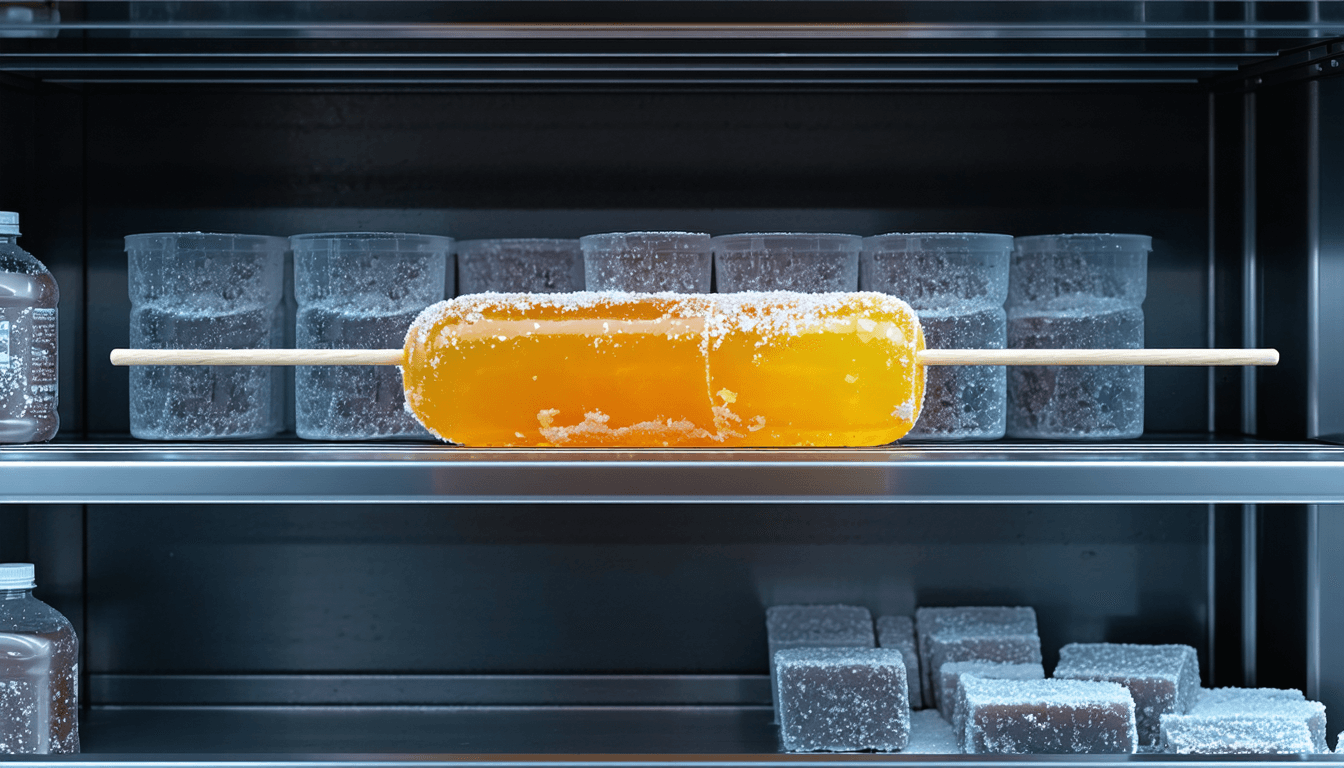
- A pale yellow glow in the corner of the R&D room came from a glow-in-the-dark ice lolly.
- The lolly was launched in Ibiza, is targeted at clubbers and festival-goers, and one of its ingredients, vitamin B2, is naturally luminescent and glows under UV club lights.
- The BBC states that while a luminescent product may seem a gimmick, ice cream is a serious business and innovation is crucial to staying ahead.
- Magnum faces competition from Froneri, owner of Haagen-Dazs, from Baskin-Robbins, the world's largest chain of ice cream specialty shops, and from smaller artisan ice cream makers appearing all the time.
Compiled by The Product DeskSomething wrong?How this is made
Why it matters
At Magnum's research and development centre near Bedford, the BBC found a pale yellow glow coming from an ice lolly, launched in Ibiza and aimed at clubbers and festival-goers, that lights up under UV because one of its ingredients, vitamin B2, is naturally luminescent [1][2][3]. The interesting part is not the glow: it is that continuous format change is one of the few levers a frozen-dessert business still controls after five years in which almost every input price moved against it [7][8].
Georgia Rose, principal analyst at Kantar Retail IQ, told the BBC the sector has had "five years of price volatility impacted by war in Ukraine, Covid, the cost of living crisis" and now the Strait of Hormuz, describing a constant state of pricing instability [7]. Her breakdown of where that lands is the useful bit for anyone running a physical product: dairy, cream and eggs in the base, then vanilla, chocolate, sugar and fruit in the flavours, then the cold-chain energy and storage costs that she says often get forgotten [8]. Those are three separate cost curves, none of them owned by the manufacturer.
The company doing this now has to answer for it publicly. The Magnum Ice Cream Company was spun off from Unilever last year, owns Cornetto, Twister, Solero and Magnum, and is described as the largest stock market-listed ice cream company in the world at a market capitalisation of around 8bn pounds, which the BBC notes gives it the funds to innovate [9][10]. It competes with Froneri, owner of Haagen-Dazs, with Baskin-Robbins, the world's largest chain of ice cream specialty shops, and with a steady supply of artisan entrants [5].
The less photogenic half of the programme is refrigeration. Magnum owns three million fridges globally, built by a third party, and some carry cameras that upload images to data centres where AI identifies each product and uses depth recognition to estimate how many units have sold and when a restock is due, which the company frames as less empty space and more targeted supply [11][12]. Zbigniew Lewicki, Magnum's chief research, design and innovation officer, says the freezers now in the field are 40% more efficient than the 2010 units, and that he cannot say whether the business will ever absorb every shock, but that this is "definitely one way of making the business long-term resilient" [14]. He argues such work is not a nice-to-have but material to the bottom line [15].
On the product side, Lewicki says the trends now come from the East, citing the intensity of innovation in Japan, Korea and China [16]. One result is Volcanics, launched in the UK and Europe with a chocolate shell, biscuit pieces, chocolate and vanilla layers and a caramel lava centre he calls "four dimensional" [17]. Neil Yan, a Shanghai-based trends researcher at consumer and sensory specialists MMR, told the BBC that ice cream in China is "no longer a niche story" and has become a part of everyday lifestyle rather than a summer or Instagram product [18], in an era of experimentation with both flavour and format [19]. The flavour list she gives includes ham, pickled garlic, tahini, and stinky tofu with liquor [20].
Worth noting: the reporting contains no margin, price-point or novelty-format revenue figures, so the pricing benefit is asserted rather than shown [21]. Watch whether the Asian flavour experiments actually cross into Western ranges, and whether the fridge camera data starts driving assortment rather than just replenishment [12][20].
Loading topic controls
Loading related stories