Loading today’s stories
Build1 distinct publisher3 min readUpdated
Roblox's Prompt to Prod: typing was the easy part, trust is a retrofit on a 20-year codebase
Andrew Swerdlow says Roblox spent about six months moving from autocomplete to agents, and that the binding constraint is trust and review infrastructure rather than model choice.
The Engineer · Build desk
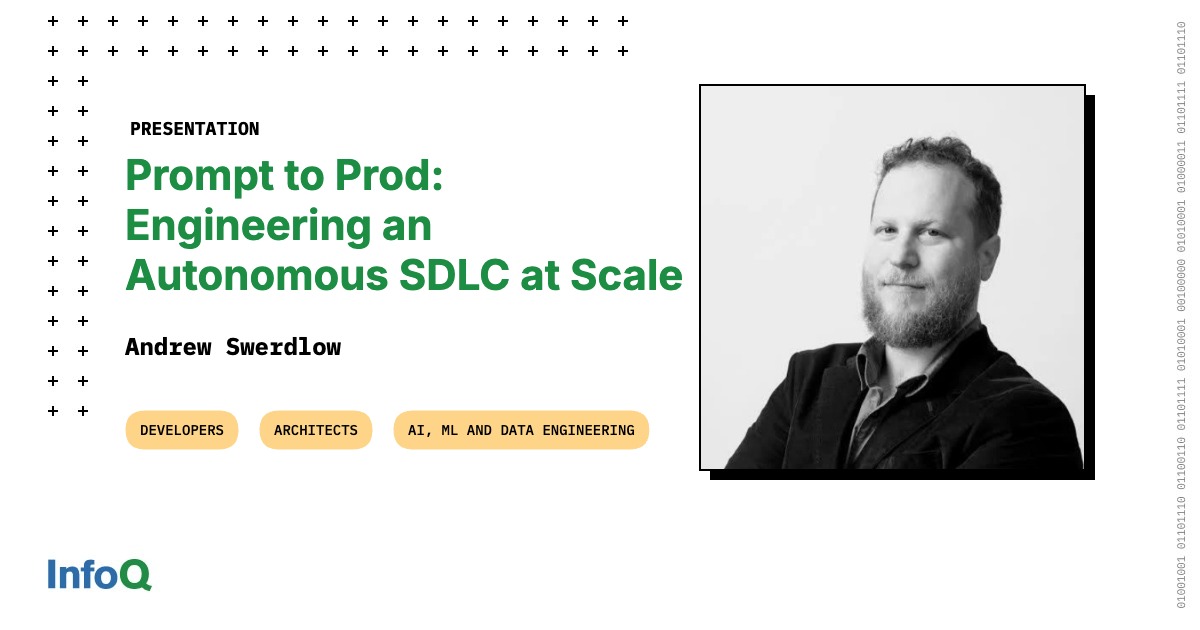
What happened
- Andrew Swerdlow is a manager at Roblox who supports the engineering acceleration team and the core services and platforms group.
- Roblox is a 20-year-old company that had been developing software in a very classic way, and more recently decided it needed to accelerate with the rest of the industry.
- Before Roblox, Swerdlow spent a couple of years at Instagram supporting safety and AI fairness, and almost 16 years at Google working on products including Google Assistant, YouTube and the Android ecosystem, mostly on developer tooling, privacy and security.
- Roblox's effort was called Prompt to Prod, because the aim was to reach a point where work goes purely from a prompt all the way into production without any human intervention.
- Swerdlow says the industry has got really good at generating code but not at digesting and trusting it: "we've solved typing but we haven't solved trust".
Compiled by The EngineerSomething wrong?How this is made
Why it matters
The gap Swerdlow puts at the centre of the talk is that generating code got good while digesting and trusting it did not, which he sums up as having solved typing but not trust [5]. What makes the framing useful is what he counts as the resulting debt: not untidy code, but an absence of people who understand how the code behaves in production, and the security incidents that follow [9]. Debt measured that way never appears in a diff. It appears in headcount and on-call.
Set that beside the stated destination. The programme was named Prompt to Prod because the goal was going from a prompt into production with no human intervention [4]. Remove the reader and the comprehension has to live somewhere else, which is why the first of his three areas is described as encapsulating expert judgment and building operational systems rather than as reviewing more carefully [11]. Review stops being an act someone performs and becomes a thing you build, own and keep running.
The age of the codebase is the part most AI productivity accounts leave out. Roblox is 20 years old and had been building in a very classic way until it decided to move with the industry [2]. The agent transition covers roughly the last six months [7]. That is about 2.5 percent of the company's life, and the code those agents can re-architect predates the tooling by some 19.5 years [15]. Guardrails here are a retrofit onto a system whose only writer, for nearly two decades, was a person.
Notice what is missing from the three areas he names: alignment and guardrails, security and access, and measuring productivity [11][12][13]. None of them is model selection or harness choice, which Swerdlow says directly is not where the change lives; he puts it in the infrastructure used to build the applications [8][16]. For anyone budgeting this, that moves the spend off the assistant and into the build and deploy path.
The soft spot is the third area. He calls measurement the most nascent of the three and asks the audience to discuss it [13], while also arguing that generating code without running the full end-to-end lifecycle means never reaching the productivity the industry has priced into company valuations [10]. The instrument that would say whether Prompt to Prod paid off is the piece he admits is least developed. Swerdlow has worked at this scale before, at Google for almost 16 years and then Instagram [3], which makes the admission harder to read as modesty.
The supplied transcript stops as the guardrails section opens [17], so the mechanics of the gates are not in it. What is in it is an ordering: alignment first, access second, and the scoreboard last.
Loading topic controls
Loading related stories