Invest1 distinct publisher3 min readPublished
Farmers and the Sierra Club packed a firehouse in a village of 275. The county then paused data center development for a year, and no acreage premium undoes that.
The Investor · Invest desk

Compiled by The InvestorSomething wrong?How this is made
Land is the cheapest input in this business, which is why the fight has moved to permission.
Farmland around Murdock trades at roughly $10,000 an acre by residents' account, and developers have offered four times that or more [12]. Tenaska's prospective option covers more than 1,300 acres along Highway 75 [8]. CyrusOne separately controls nearly 400 acres outside Plattsmouth, with nothing built and nothing announced [11]. Take the whole 1,700-acre footprint [1] at the top of the reported offer range and the land bill comes to about $68 million [2]. Set that against the $165 billion attached to Project Jupiter in New Mexico [18] and it is roughly four hundredths of one percent [3]. A developer can pay whatever number a farmer names. It cannot buy back the twelve months Cass County just removed from the schedule [1].
The composition of the opposition is the part underwriters should read twice. Conservative farmers lined up with the state Sierra Club chapter, and both lined up against labor leaders [3]. The standard mitigation instruments each address one wing: corporate donations to municipal programs, as in Lincoln [16], and the jobs-and-China argument advanced by President Trump and some union leaders who normally back Democrats [6]. When the grievance set is lost farmland, thinning water supplies and rising electricity bills [4], a payment to a city program does not reach a farmer and a construction payroll does not reach a ratepayer.
Ken Winston, the Nebraska Sierra Club's attorney, concedes the projects will land somewhere and argues only that communities should be able to refuse them [17]. That is the honest ceiling on this story: it is a routing and timing risk, not a cap on compute. New Mexico is the control case, with no moratorium available to stop a complex of that size [18]. The veto exists where a county has bothered to write one.
Working the other way is the balance sheet of the people best placed to say no. Farming costs have risen with diesel while soybean exports fell during President Trump's tariff fight with China [15], and Judy Stroy, a fifth-generation farmer who warned that the ground being consumed each year puts the food supply at risk [13], also said $40,000 an acre would be hard to turn down [14]. The trade policy running alongside the buildout is eroding the resistance the buildout has to clear.
Geography narrows the alternatives further. Highway 75 was widened, which puts these parcels within reach of Omaha and Lincoln, and the Missouri River sits close by as a major water source [19]. A moratorium in one county does not manufacture a comparable site in the next one. And the clock is political: hostility to fast-moving projects has surged ahead of November's midterms, spanning Nebraska, Texas and Wyoming through Pennsylvania to New Mexico [5], which means the officials who grant or withhold these approvals are being selected in the same cycle [7].
Ranked by verification strength, evidence, and original report placement.
Officials in Cass County, Nebraska recently approved a 12-month moratorium on allowing data center development.
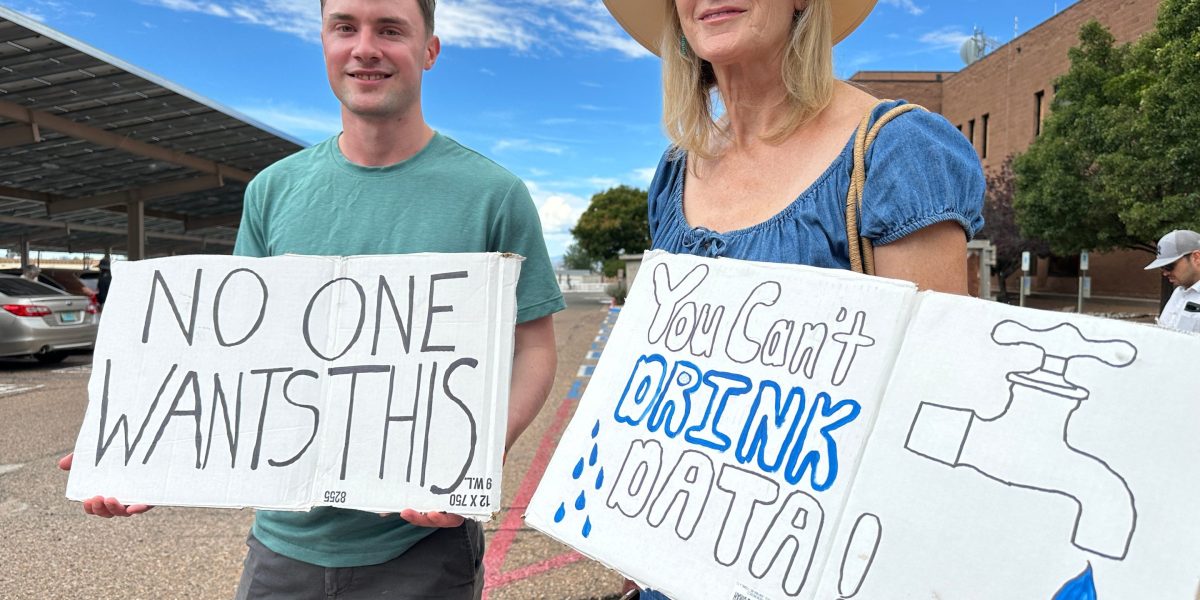
Residents filled the firehouse in Murdock, Nebraska, a village of around 275 people in Cass County, to share concerns that data center development was moving too quickly.
At the Murdock meeting, conservative farmers and the Nebraska Sierra Club chapter found common cause against labor leaders.
The coalition opposing data centers worries about dwindling farmland, declining water supplies and rising electricity bills, as well as how large corporations could reshape small-town America.
The data center debate cuts across party lines, demographics and geography, from Republican-dominated Nebraska, Texas and Wyoming to swing-state Pennsylvania to Democratic-leaning New Mexico.
Supporters of data centers, including Republican President Donald Trump and some union leaders who usually back Democrats, praise a potential jobs and economic bonanza and say the projects help the U.S. thwart China in the race for technological supremacy.
Follow any of these and your For You feed starts watching them — no settings page required.
Evidence-backed comparisons of source perspectives and observed adoption signals. Read the methodology
Which Builder, Operator, and Investor concerns the observed source mix emphasized—not a truth score.
Evidence, demonstrated adoption, hype gap, incentives, and confidence are assessed independently, each on its own current evidence. How these are measured.
Named specifics, single outlet
The core factual spine is concrete and attributable: a 12-month county moratorium, acreage figures for two land positions, named spokespeople for Tenaska and CyrusOne, and named local voices. But everything rests on one publisher's reporting with no primary documents (ordinance text, option filings, utility load studies), and the broad national framing is generalized from a few local scenes.
Land assembled, nothing built
Measured against actual buildout in the reported geography, adoption is minimal: roughly 1,700 acres are under option or control in Cass County with no development and no announced project, and the county has now paused approvals for a year. Adoption of the opposing behavior — local moratoria — is what is actually observed, alongside one very large planned project elsewhere that faces no such pause.
National framing outruns local evidence
The reported particulars are modest and well grounded, but the packaging is expansive — a headline asserting a polarized America 'united around one issue' and a sweep across five states, built from one firehouse meeting, one county vote and a handful of interviews. The dollar-scale anchors ($165 billion, $40,000-an-acre offers) also read larger than the committed activity described, since the biggest local footprints remain unbuilt and unannounced.
Interested parties on every side
Nearly every voice has a disclosed stake: developers (Tenaska, CyrusOne, Oracle) seeking siting and generation approvals; landowners weighing offers at multiples of market value amid squeezed farm economics; tech giants making donations to municipal programs in Lincoln that the Sierra Club attorney flags as impact mitigation; labor leaders backing jobs; a Republican candidate for county commission campaigning partly on the project; and a president tying the buildout to competition with China. The article surfaces these stakes rather than hiding them, which is a plus for reader calibration.
Single-publisher, mostly verifiable locally
Confidence is limited by the one-source cluster and absence of primary records, but the load-bearing facts — a county moratorium, acreage under option or control, on-record company statements — are the kind that are locally checkable and unlikely to be wrong. The softer national and electoral claims carry materially less confidence than the Cass County particulars.
build
Death threats are now a siting input, and 500-plus towns are the output1 distinct publisher
leadership
EPA's data center permit rewrite moves siting risk from the hearing room to the courthouse2 distinct publishers
product
The data center backlash is now a siting risk, and the GOP's own memo says so in writing1 distinct publisher
product
Siting Is Now a Schedule Risk: 75 Data Centre Projects, $130bn, One Quarter1 distinct publisher
Distinct publishers with included, body-backed reporting in this cluster.