Loading today’s stories
Science1 distinct publisher3 min readUpdated
Chester Zoo adapted a human cancer protocol to a 15-foot python; the case report is the deliverable
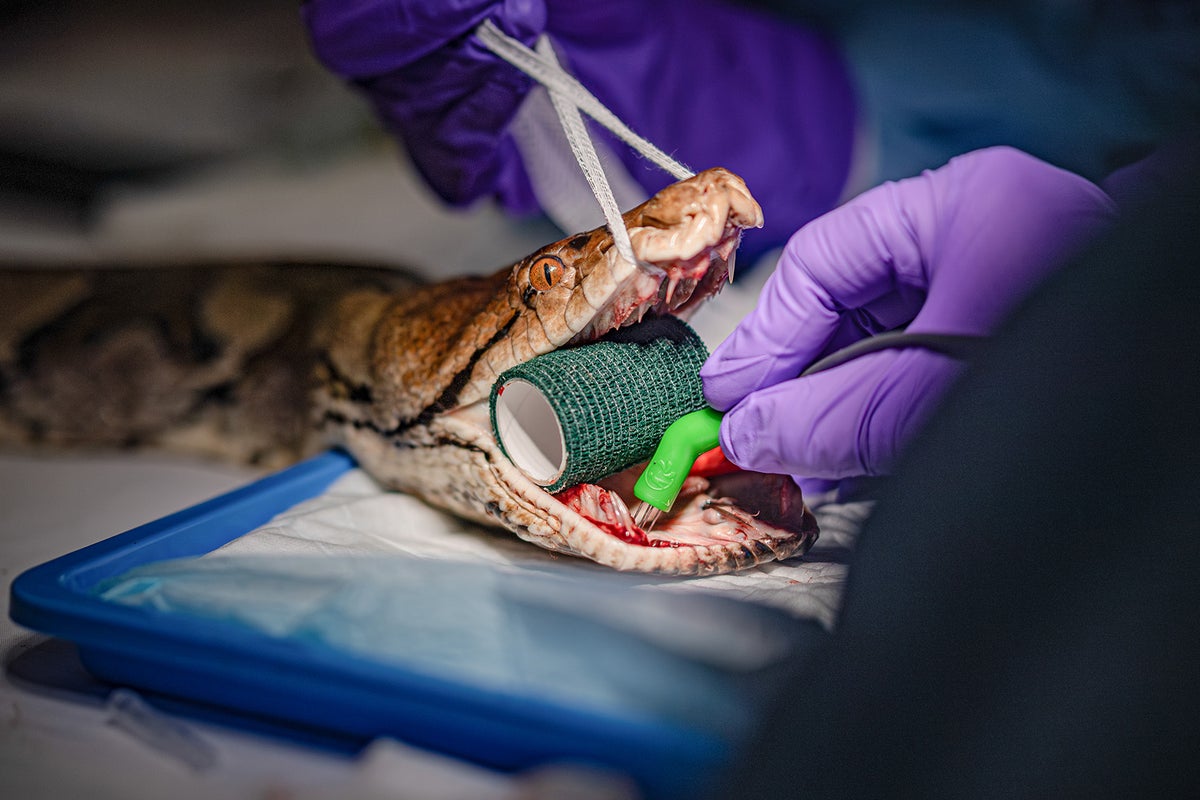
Chester Zoo and University of Liverpool specialists used electrochemotherapy on a snake for what they believe is the first time. The technique is old. The patient class is new.
The Scientist · Science desk
What happened
- Chester Zoo, in northwest England, said on Friday that a python named after Jodie Foster became the first snake to receive a treatment combining surgery and electrochemotherapy (ECT).
- The 4.5-meter (15-foot) reticulated python had fully recovered after first undergoing surgery and then receiving ECT following the return of a cancerous tumor in her jawbone.
- Other creatures, including a turtle and a lizard, have received ECT previously, according to case reports posted on medical science databases.
- Chester Zoo's veterinary team, which worked alongside University of Liverpool cancer specialists to adapt the treatment, believes it is a first for a snake.
- Chester Zoo vet Ian Ashpole said: "We were facing the possibility of losing her as the tumor made it more and more difficult for her to eat."
Compiled by The ScientistSomething wrong?How this is made
Why it matters
Chester Zoo said on Friday that a 4.5-meter (15-foot) reticulated python named Jodie Foster has fully recovered after surgery followed by electrochemotherapy for a tumor in her jawbone [1][2]. The zoo's veterinary team, working with University of Liverpool cancer specialists, believes it is the first time the technique has been used in a snake [4].
The procedure itself is not new. Electrochemotherapy pairs the cancer drug bleomycin with electrical pulses delivered directly at the tumor site, temporarily making cancer cells more permeable so the drug enters more effectively [9]. It has been used in animals before, including a turtle and a lizard, according to case reports on medical science databases cited by AFP [3]. What Chester Zoo did was port an existing protocol into a patient class nobody had documented, which is a different kind of work from inventing something.
The clinical path was ordinary oncology. Keepers noticed the 23-year-old python, resident at the zoo for two decades, eating less and spending more time inactive [7]. Tests confirmed a malignant jaw tumor, which was removed surgically; it came back, prompting a second operation during which electrochemotherapy was deployed against any remaining cancerous cells [8]. Part of the jawbone was removed [10]. Zoo vet Ian Ashpole said the team faced the possibility of losing her because the tumor was making it progressively harder for her to eat [5], and that "as far as we're aware, this is the first time it's ever been used in one" [6].
The adaptation, as described, was mostly physical and thermal rather than pharmacological. Two operating tables were pushed together to make a surface roughly the size of a double bed [10]. Heated blankets and warmed air held the animal's body temperature stable through 90 minutes of surgery, after which Ashpole said she recovered quickly [11]. That is the transferable content of this case: not a new drug, but the handling, positioning and temperature management that let a standard human oncology tool be applied to an animal that does not fit on a standard table.
Two caveats matter for anyone tempted to read this as a general result. This is a single patient, and the outcome statement is the zoo's own: after a checkup this week, Chester Zoo said Jodie is cancer-free, eating normally and back to her usual "bright and feisty" self [12]. And the details are not yet in the literature. Jose Alvarez Picornell of Liverpool's small animal and clinical science department, who called the case "a testament to the power of collaboration," said the team will formally publish the procedure so veterinary colleagues elsewhere can learn from and build on it [13][14]. Until that publication exists, other clinics have a press release, not a method.
The wider pattern is that drugs and therapies once reserved for humans are increasingly reaching animal patients [16]. The bottleneck in those transfers is rarely the chemistry; it is anesthesia, dosing and physical logistics for a body plan the equipment was never designed around.
Watch for the published case report, and specifically for the electrode placement, pulse parameters and bleomycin dose in a species that arrived with a name derived from paperwork marked "JF" for juvenile female, at roughly three years old [15][17].
Loading topic controls
Loading related stories