Invest1 distinct publisher2 min readPublished
That is roughly 28% of a year's defense budget and about $407,000 of deferred work per building, and none of it becomes revenue for a repair contractor until someone appropriates against it.
The Investor · Invest desk

Compiled by The InvestorSomething wrong?How this is made
Divide the backlog across the portfolio and it comes to roughly $407,000 of deferred work per facility [14], which buys a roof and a fire panel rather than a program of record, and that is precisely why the total survives from year to year: no single line inside it is loud enough to beat a shipbuilding request in a markup. Set it against the department's roughly $1 trillion budget and it is about 28.5% of one year's appropriation [13]. Price it in the hull that made it visible and it is about 21.9 carriers at the $13 billion Linda Bilmes of the Harvard Kennedy School attaches to the Gerald R. Ford [15][7].
The reflex is to treat $285 billion as addressable market and go long the depots and the ship-repair yards. But a backlog is a liability disclosure, and a purchase order is a different document. The parking lots at Minot Air Force Base have been in disrepair since at least 2018 [4], which is at least seven fiscal years of a repair cheap enough to keep postponing [18], and the quarters at Twentynine Palms are still too narrow to service Marine Corps vehicles [4]. Deferred maintenance mostly competes with itself, and it usually loses.
This is probably wrong on timing, but the allocation view here is that the next marginal defense dollar has a better claim from sustainment than from any new platform, because the availability problem is already showing up in operations rather than in a budget request, which is the expensive place to discover it. The counter-thesis sits in the same audit file. An institution that has never passed an audit [9], that lost track of $3 billion of equipment over three years, about $1 billion a year [10][16], and that let 122,000 items go unprocessed at one naval distribution center to the point of buying supplies it did not need [10], is not obviously capable of executing a $285 billion repair program if handed the cash, and Bilmes told Fortune the pattern is unlikely to reverse soon [12]. The Pentagon did not respond to Fortune's request for comment [17]. So the honest version of the trade is narrow: you are betting on appropriation lines and hiring authorities, not on the size of the repair list, and the way you learn you were wrong is that fiscal 2026 produces another careful inventory of the same $285 billion.
Ranked by verification strength, evidence, and original report placement.
A U.S. Government Accountability Office report published in the week before August 27, 2026 found that across the Department of Defense's real estate portfolio of more than 700,000 facilities worldwide, the department faced a $285 billion maintenance backlog in fiscal 2025 as a result of insufficient funding and personnel.
Some of the Department of Defense's more than 700,000 facilities are at least 50 years old or date back to the Cold War.
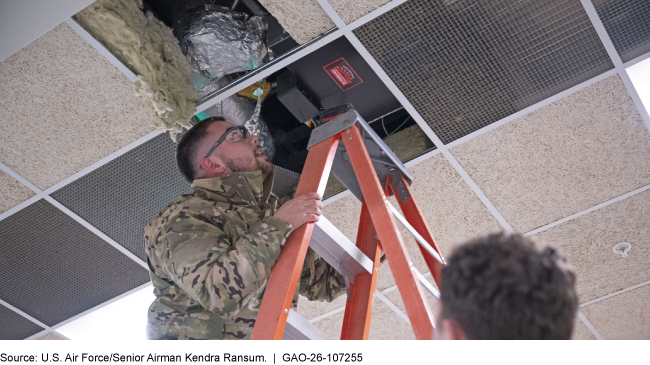
The GAO report found 'chronically neglected' maintenance of some barracks that adversely affected the quality of life of enlisted service members and posed safety risks from mold and broken fire systems, and said this poses a risk to missions and to the quality of life of personnel.
The GAO report cited crumbling parking lots at Minot Air Force Base in North Dakota, in disrepair since at least 2018, and narrow quarters at the Twentynine Palms Marine Corps Air Ground Combat Center in California that could not accommodate maintenance of Marine Corps vehicles.
In March the USS Gerald R. Ford, described as the world's largest aircraft carrier, pulled into port at Souda Bay, Greece, scheduled for more than a week of repairs, with more than 200 of its sailors receiving treatment for smoke inhalation after a laundry room fire spread through the ventilation system into the carrier's sleeping quarters.
The USS Gerald R. Ford had been at sea for 10 months, long past its deployment length, and was reportedly dealing with electrical problems and delayed maintenance that led to overworked equipment, on top of sewage problems that left its crew unable to use its toilets.
Distinct publishers with included, body-backed reporting in this cluster.
Follow any of these and your For You feed starts watching them — no settings page required.
build
Developer habit, priced at $965B: what Anthropic's run actually proves1 distinct publisher
product
Pentagon impatience is the roadmap now: $61m for Smack, $500m for Scale AI1 distinct publisher
invest
The Lincoln's 250 Days Put A Sustainment Number On The Hormuz Standoff1 distinct publisher
leadership
The chain of command survives AI; the judgment inside it may not1 distinct publisher
Evidence-backed comparisons of source perspectives and observed adoption signals. Read the methodology
Which Builder, Operator, and Investor concerns the observed source mix emphasized—not a truth score.
Evidence, demonstrated adoption, hype gap, incentives, and confidence are assessed independently, each on its own current evidence. How these are measured.
Named audit relayed by one outlet
The core numbers are attributed to a specific GAO report with internally consistent supporting detail (funding requested at about 80% of recommendation, the 90% goal unmet since fiscal 2021, workforce shortfalls of 68%-97%), and a named expert is quoted directly. But there is only one publisher, the report is neither titled nor linked, the Ford maintenance details are hedged as 'reportedly,' and the Pentagon did not respond, so nothing is independently corroborated.
Backlog measured, remediation not funded
There is real measured activity on the problem side - a fiscal 2025 backlog figure, per-installation examples spanning at least seven fiscal years, a documented shipboard incident, and quantified funding and staffing shortfalls. What is absent is uptake of any fix: the services requested only about 80% of recommended sustainment funding, no surveyed office met the 90% goal since fiscal 2021, approved repair projects went unfunded while new construction averaged $14.6 billion a year, and no appropriation, program, or contract award is disclosed.
Audit numbers solid, framing rhetorical
The headline quantities come straight from a federal audit and are not inflated. The overstatement is in the surrounding narrative: a Soviet-collapse comparison that the article itself then dismantles (3% of GDP versus 15%-30%), a carrier fire used as synecdoche for a 700,000-facility portfolio, and per-facility and per-carrier ratios that are arithmetic on rounded inputs rather than report findings. Slightly overstated rather than materially hyped.
Reform advocate and author-source framing
Disclosed incentives are visible on every side: the Secretary of War is quoted advancing an acquisition-reform agenda by naming Pentagon bureaucracy the adversary; the sole expert source is the author of a book on U.S. war spending and fiscal transparency, whose thesis the article adopts; the Pentagon, which has an interest in contesting the framing, did not respond; and the outlet gains from a Soviet-decline hook. None of this is hidden, which keeps the score mid-range rather than high.
Credible but single-sourced
Confidence is limited by cluster structure rather than by the plausibility of the findings: one publisher, one expert, an unlinked audit report, a hedged incident account, an incident date given only as a month, and no department response. The internal consistency of the funding and staffing figures and the attribution to GAO keep confidence moderate rather than low.