Science1 distinct publisher3 min readPublished
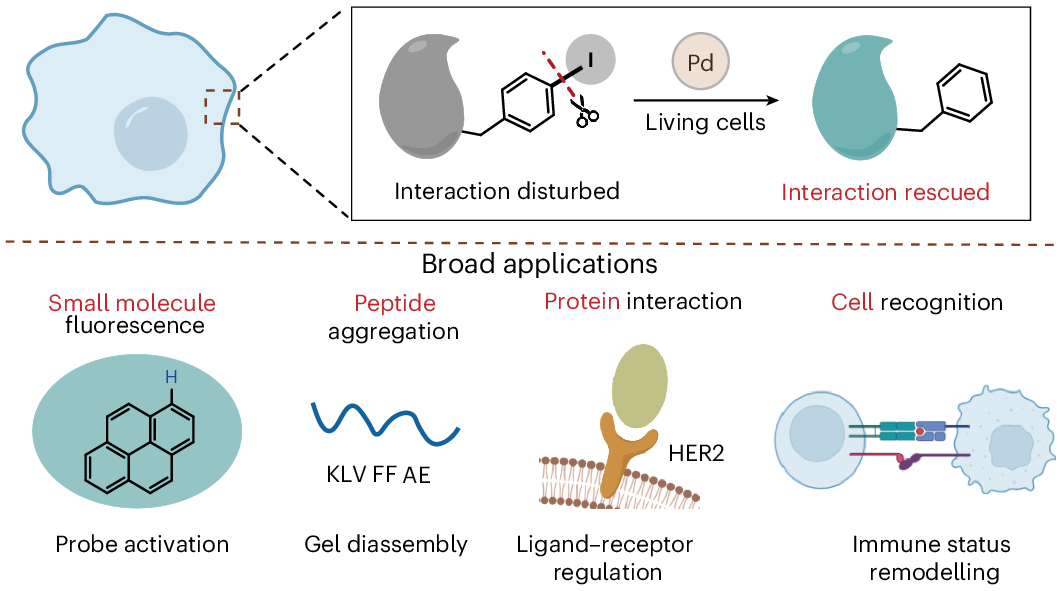
Caging chemistry needs a heteroatom to grab hold of, and phenylalanine offers none. So the authors hung an iodine on its ring, then used palladium to strip it off and switch a HER2 affibody's binding back on.
The Scientist · Science desk

Compiled by The ScientistSomething wrong?How this is made
Follow any of these and your For You feed starts watching them — no settings page required.
science
An electrode switches on a cyclopropanol handle that labels glutamate and aspartate1 distinct publisher
science
Nature Perspective: autonomous agents need internal states they must keep in range1 distinct publisher
science
Ammonia from untreated seawater and air at room temperature, with the numbers attached1 distinct publisher
science
Reasoning models spend extra tokens when a prompt cuts against a stereotype1 distinct publisher
Traditional caging reactions depend on a heteroatom to attack, which is precisely what phenylalanine's nonpolar side chain lacks, and the authors name that as the reason its manipulation in living systems has stayed unresolved [2]. Their answer was to bring the heteroatom along: candidate cages built on oxygen, nitrogen, boron and iodine, all tested under physiological conditions [3]. Only the halogen held up; the other three families failed [4][16]. The abstract does not say why, and that is the first thing I would want from the full text.
The choice matters more than it sounds. Because the mask is a substituent on the aromatic ring rather than a group hung off a linker, the rescue the authors call traceless returns the protein as ordinary phenylalanine, with no residual chemistry to explain away in a binding assay [5][17].
The demonstration ladder is built in the order a careful chemist would build it. A fluorophore first, because an optical readout tells you whether the reaction fires at all; then peptide disassembly, which asks whether removing one atom changes a supramolecular property, and phenylalanine's aromaticity is known from work the paper cites to be essential to amyloid-beta assembly [14]; then reactivation of protein-protein interactions and rewiring of cell-cell recognition [6]. Only after that do they use genetic code expansion to place iodinated phenylalanine at chosen positions in HER2-targeting affibodies, which means the masked residue is decided in advance rather than found by luck [7], and reshape an antigenic peptide's immunogenicity on tumour cells on a timetable [8].
The thing the abstract does not tell you is any number. It gives no decaging rate, no palladium concentration, no incorporation efficiency, no figure for the fraction of cells that responded, and no viability data [18]. Optimisation in cell lysates and then inside living cells is asserted [9], and the method sits behind a 39.95 dollar paywall [10], so the public record is a list of capabilities without denominators. It is also entirely cellular work, run in lysates, on cell surfaces and in living cells, with no animal experiment described [19].
Palladium as a bioorthogonal trigger is not the new part. It was cleaving a propargyl group off a fluorouracil prodrug in 2014 [11], ruthenium was cutting allylcarbamates in living cells as early as 2006 [12], and gold-triggered uncaging followed in 2017 [13]. What is new is the target: a residue with nothing on it to attack. My view, with its condition attached, is that if iodo-phenylalanine goes in efficiently and decaging runs fast at metal loads cells tolerate, this becomes a general on-switch for hydrophobic interfaces, which is roughly what the authors claim in saying it opens up nonpolar groups generally [15]. If either of those is marginal, it stays an elegant result on cultured cells, which is all the abstract asserts anyway.
Ranked by verification strength, evidence, and original report placement.
Phenylalanine orchestrates protein interfacial hydrophobicity and pi-driven interactions that are critical for diverse biological processes.
Phenylalanine's nonpolar architecture precludes traditional heteroatom-dependent reactions, leaving its functional manipulation in living systems unresolved.
Work cited by the paper (Genji et al., Chem. Pharm. Bull. 65, 668, 2017) reports that the aromaticity of phenylalanine residues is essential for amyloid formation by Alzheimer's amyloid-beta peptide.
The authors systematically evaluated exogenous heteroatom-based caging groups (X = O, N, B or I) under physiological conditions.
They present a haloatom-assisted decaging strategy that uses iodine to cage the phenylalanine side chain.
The iodine blockade can be tracelessly rescued through palladium-triggered bioorthogonal decaging.
Distinct publishers with included, body-backed reporting in this cluster.
1 article · September 1, 2026
Evidence-backed comparisons of source perspectives and observed adoption signals. Read the methodology
Which Builder, Operator, and Investor concerns the observed source mix emphasized—not a truth score.
Evidence, demonstrated adoption, hype gap, incentives, and confidence are assessed independently, each on its own current evidence. How these are measured.
Peer-reviewed, but only the abstract is readable
The provenance is good and the disclosure is thin — a peer-reviewed Nature paper, of which the public can read eleven sentences and a bibliography. Everything the story turns on, the iodine cage, the palladium trigger, the HER2 switch and the tumour-T cell result, comes from the authors' own summary of data nobody outside peer review has seen. The missing numbers are not an assumption on our part; the abstract simply reports its outcomes qualitatively and the rest is for sale.
Publication is not uptake
The only event on the record is the paper going up on nature.com. No second laboratory has run the chemistry, no reagent or plasmid distribution is described, and nothing indicates anyone beyond the authors has installed an iodinated phenylalanine. Scoring uptake here would mean inventing it.
Sober chemistry, one sentence that reaches
Most of the abstract stays within what it shows. The overreach is concentrated in the closing clause, which promises the chemical manipulation of ubiquitous nonpolar groups in living systems when every demonstration is a phenylalanine, and in the framing of tumour-T cell rewiring — real, but asserted in cells with no magnitude attached. Our own headline calls this a switch that palladium flips, which is accurate to the mechanism and silent, as the source is, on how well it flips.
The only account is sold by its publisher
Two pressures point the same way. The authors describe their own result and choose which sentences the public sees, and the venue that vouches for it also charges USD 39.95 to read past the summary — so the freely available text is, structurally, the most favourable eleven sentences. That is ordinary journal economics rather than anything untoward, but it means the persuasive layer is free and the checkable layer is not.
Confident about the design, blind to the performance
We can say with little doubt what the authors built and what they claim it did, because a Nature abstract is a precise document about design. We can say almost nothing about how well any of it works, and with one publisher and no replication there is no second angle to triangulate from. That asymmetry, not doubt about the chemistry's plausibility, is what holds the number down.