Build1 distinct publisher3 min readPublished
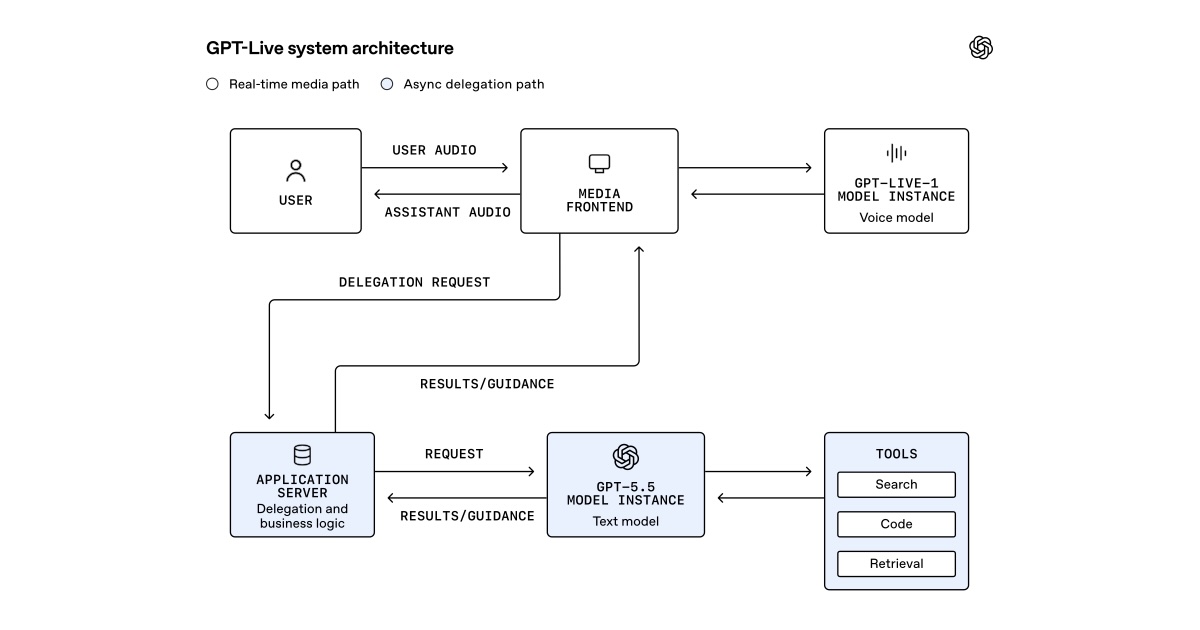
The live path runs only the media pipeline and the inference loop, which buys isolated optimization but forces per-session capacity reservation and a context migration that has to work during ordinary drains.
The Engineer · Build desk

Compiled by The EngineerSomething wrong?How this is made
The boundary's job is to enforce a deadline. Media frames have to keep arriving on schedule, so anything sharing that path inherits the schedule. Justin Uberti, OpenAI's Head of Realtime AI, gave InfoQ the rule as a slogan: "the voice must flow" [3]. Count what that buys. Two subsystems sit inside the deadline, and four named categories of application work sit outside it [17]. Uberti says the split let them concentrate optimization on the critical components and stop less time-sensitive work from causing regressions there [4].
The cost shows up in the product, not the plumbing. An asynchronous tool call means the model still holds the floor while the call is outstanding, and somebody has to decide what it says during that window. OpenAI's account names the two pieces that were hardest to pull off the critical path: delegation to frontier models, and the route that feeds voice data to the safety systems [5]. Both are cases where the answer has to land inside the conversation rather than after it. If your tool calls cannot be made non-blocking without the assistant stalling, the boundary does not help you yet.
Session affinity is the other bill. Each session gets dedicated stateful inference and reserves capacity on its assigned instance [6], which means you cannot round-robin voice traffic across a stateless pool. The release valve is migration, and the detail worth noticing is that it fires on two different events: an instance being drained, and a session nearing its context limit [7]. The second happens in ordinary use, so the risky path runs continuously instead of only during a deploy. That means the migration gets exercised in everyday operation, not just when something has already gone wrong, so its failure modes have to surface under routine load rather than waiting for a rare incident to expose them.
The transport decision is the conservative part. It is argued from the spec rather than the roadmap. Uberti's objection to RTP over QUIC is that it supplies a transport and not a media pipeline, and that even at the transport layer it lacks GCC congestion control and RTT-aware path selection [10]. So they simplified the handshake instead of replacing the transport on both client and server [11]. SPED, DTLS 1.3 and SNAP each ship independently, so each one's effect can be measured on its own [12], and existing WebRTC applications pick up the benefit without code changes [13]. Uberti expects the two stacks to converge anyway [14].
The silent test is the piece I would steal and the piece hardest to copy [15]. It requires enough spare capacity to run production voice traffic through an unlaunched system, plus the authority to process real user audio while throwing the output away.
OpenAI has not published latency figures for the live path, WARP or Instant Connect [18]. What is on offer is a boundary placement, and it transfers on two conditions. Your latency-critical loop has to be small enough that two subsystems can hold it. And per-session capacity reservation has to be cheaper for you than rehydrating context on every turn.
Ranked by verification strength, evidence, and original report placement.
OpenAI published an engineering account of GPT-Live describing how the system maintains continuous voice interaction while separating latency-sensitive media processing from broader application work.
In GPT-Live the live path contains the media pipeline and inference loop, while delegation, tool use, persistence and other application logic run behind an asynchronous RPC boundary.
Uberti said achieving the target latency required consistent media delivery, described by the principle "the voice must flow".
Uberti said the architectural choice allowed OpenAI to focus optimization efforts on the most critical components and avoid regressions from less time-sensitive work.
Uberti said OpenAI was concerned about how fast delegation to its frontier models could be made and had to rethink how to feed voice data to its safety systems, but found it easier to optimize those pieces in isolation than as part of the critical path.
GPT-Live uses dedicated, stateful inference for each session, and each session reserves capacity on its assigned instance.
Distinct publishers with included, body-backed reporting in this cluster.
1 article · September 2, 2026
Follow any of these and your For You feed starts watching them — no settings page required.
build
The AI-training bans live on the big infrastructure blogs, not the small publications1 distinct publisher
build
Live video is two protocol decisions, not one, and your CDN is fighting your latency target1 distinct publisher
build
SemiAnalysis to software teams: your token cost starts at the fab, not the price list1 distinct publisher
build
The DNS check passed. Chromium can still connect somewhere else.1 distinct publisher
Evidence-backed comparisons of source perspectives and observed adoption signals. Read the methodology
Which Builder, Operator, and Investor concerns the observed source mix emphasized—not a truth score.
Evidence, demonstrated adoption, hype gap, incentives, and confidence are assessed independently, each on its own current evidence. How these are measured.
One interview, no measurements
The technical detail is unusually concrete — named WARP components, the drain-and-migrate trigger, a GPU/CPU colocation defect — and it is all on the record from the engineer responsible. But it is one publisher relaying one company's account of its own system, and the quantities that would let anyone check it are absent: latency is described only as a target, a reduction or an unexpected cost, never as a number.
Shipped and carrying real traffic, scale undisclosed
This is past the demo stage: GPT-Live is live, WARP and Instant Connect are deployed, and the pre-launch rehearsal ran on authentic Voice sessions rather than canned speech. What is missing is any magnitude — no concurrency, no region list, no evidence that a second party has taken up WARP even though the claimed benefit is ecosystem-wide.
Sober telling, uncheckable payoffs
The prose is not selling anything: no records claimed, no superlatives, and Uberti volunteers the components that gave him trouble. The overhang is narrower than usual — three benefit claims that read as settled and are not, namely that the boundary prevents regressions, that migration delivers elastic capacity, and that every existing WebRTC app gets WARP's gains for nothing. Absent numbers, those sit slightly ahead of what the reporting can show.
Vendor telling its own architecture story
OpenAI chose what to publish, chose the interviewee, and has two reasons to like the framing: engineering recruitment and standing in the WebRTC ecosystem it is now extending. Uberti's forecast that WebRTC and QUIC converge is exactly the position an implementer who has just bet on WebRTC would hold. InfoQ's questions push on design trade-offs, which tempers this, but no one in the story has an interest in finding the architecture wanting.
Certain what was said, less so what it delivers
We can be confident about the architecture as described — the boundary, the reserved capacity, the migration triggers and the silent-test method are stated plainly and consistently by a named engineer. Confidence drops on effects: whether the isolation actually prevented regressions, whether migration is invisible to users, and whether WARP's benefits generalise are all beyond what a single vendor interview without measurements can settle.