Science1 publisher3 min readPublished
Thailand polices its online wildlife trade with a three-person intelligence unit
Social media is where Thailand's illegal animal trade now runs, so the state's Wildlife Crime Intelligence Unit spends its days there and its evenings climbing poles for the physical evidence a court warrant requires.
The Scientist · Science desk
What happened
- Thailand's national parks department created a Wildlife Crime Intelligence Unit in 2023 with three permanent staff, tasked with tracking and intercepting illegal purchases of protected animals.
- The unit's director, Polawee Buchakiet, says social media is now the key channel for buying and selling illegal animals, and much of the team's working time goes to trawling it.
- Sellers advertise animals as needing to be "rehomed" rather than offering them for sale, and crop their photographs tightly so the images give away no location.
Compiled by The ScientistSomething wrong?How this is made
Why it matters
- constraint Because a warrant needs physical evidence, every online lead has to be re-acquired offline before a seizure is possible, so surveillance hours rather than detection speed cap how many sellers the unit reaches.
- exposure When undercover purchases run on officers' personal cash, the financial risk of an operation sits with individual staff and the size of any buy is bounded by what they can personally afford to lose.
- decision Without published caseload or seizure counts, anyone deciding the unit's budget has no basis for sizing it, and outside claims about under-resourcing cannot be checked either way.
- contradiction The remedy the raid unit's own head names is an end to exotic pet demand, which no amount of Thai interdiction capacity can deliver when the buyers in the case described sit in another country.
Finding a seller is the cheap part. A post offering a young monkey for "rehoming" rather than for sale, with the background cropped away, is a lead with no address attached [3]. Turning it into something a court will act on is manual: the officer known by the pseudonym Tee has gone up electricity poles dressed as a repairman to photograph courtyards, and posed as a land surveyor to look into windows on neighbouring plots [5]. The unit needs that material to obtain a warrant before it can seize anything [4]. Capacity is therefore set by hours of physical surveillance, not by how fast anyone can read a feed.
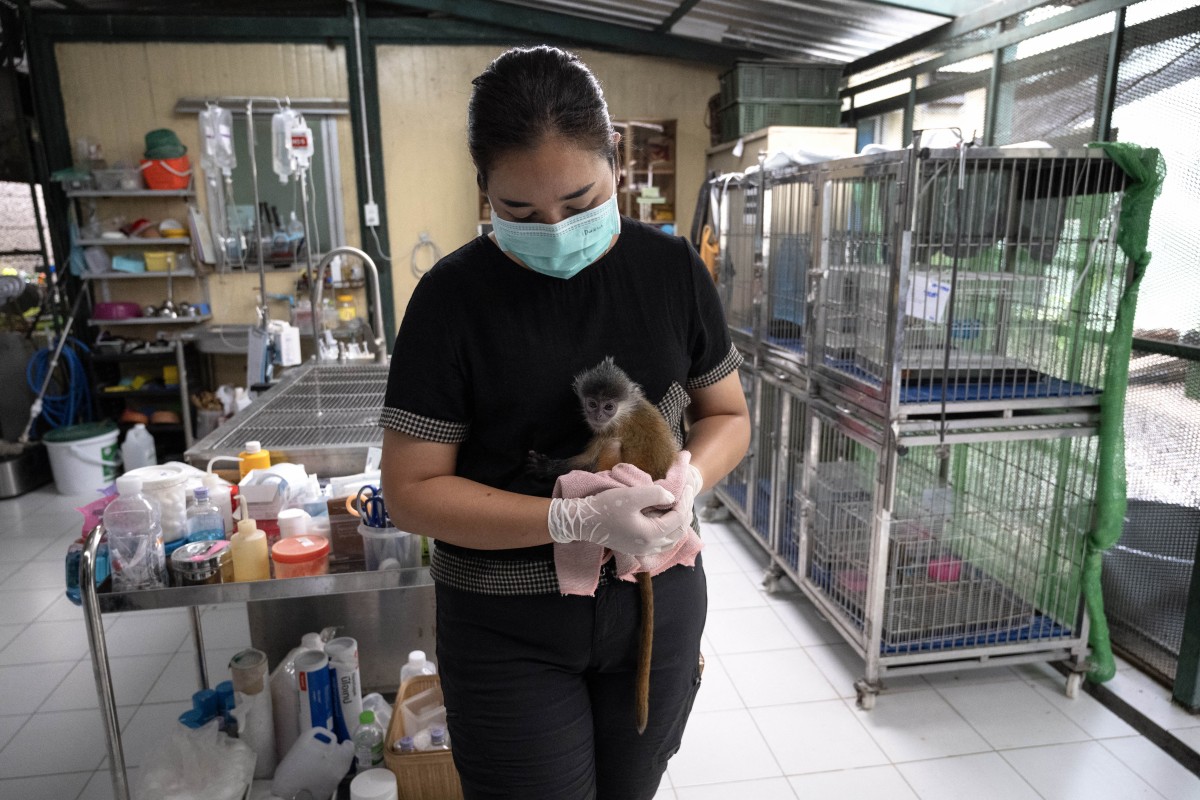
The delay has a biological cost. Tee, 43, told AFP he is haunted by cases where the seller was never located, or the team arrived to find animals dead or so sickly they died shortly after rescue [6]. Thanawadee Phaichana, a DNP vet, says most smuggled animals arrive in weak condition, some dosed with sedatives or a mild anaesthetic to stop them moving or making noise [8]. Smuggling itself weakens them, and they meet diseases they have no experience of [7]. Days spent establishing an address come out of an animal's odds.
AFP's account gives no listing volume, caseload, or seizure total for the unit [19]. Three permanent staff since 2023 is a vivid number with nothing underneath it [1]: no reader can work out what share of Thailand's online trade gets touched, and roughly three years of operation by the time of the 2026 report does not fill that gap [18]. The evidence available is the unit's own description of its limits, which is stonewalling by social media sites and chronic shortages of staff and funds, with officers posing as undercover buyers sometimes spending their own money [12].
Whether more investigators would raise seizures in proportion isn't something this establishes. Headcount is only one bottleneck; platform access to seller data is the other. If platforms withhold the account data that would place a seller at an address, additional officers still end up on the pole.
Thailand sits where it does for reasons that will not change: abundant local wildlife, rare species available in neighbouring countries, and access by sea, air and land [15]. Recent arrests include a July raid that recovered a leaf monkey, a gibbon and hundreds of turtles, alongside multiple interceptions at airports [16]. Statute allows up to 10 years in prison for crimes involving protected species and 15 for endangered ones [10]. Enforcement, not what a seller weighs, is what actually sets that ceiling. A Thai court dismissed the case against suspected trafficking kingpin Boonchai Bach in 2019, and although the Supreme Court later sentenced him to prison, he remains at large [11], which is the more honest measure of what a prosecution is worth from first lead to served sentence.
Nawee Changpirom, who heads a DNP raid unit, names the remedy he wants: an end to the exotic pet trade, rather than more surveillance [13]. The case AFP describes in most detail points the same way. The six-month-old leaf monkey was in luggage at Suvarnabhumi Airport bound for India, where demand for exotic pets has been growing, and a second monkey from the same bag died after rescue [9]. An airport interception is the last chance to disrupt a transaction whose buyer sits outside Thai jurisdiction altogether.
What to watch
- Whether the DNP publishes WCU caseload or seizure figures, which would let three permanent staff be scored against actual volume.
- Any Thai legal route that compels social media platforms to hand over seller account data rather than leaving officers to locate addresses on foot.
- Whether Boonchai Bach is arrested to serve the sentence the Supreme Court imposed.