Build1 publisher3 min readPublished
Odyssey's simulation-trained policy went 77% as far between interventions as its real-footage policy
Odyssey-3 keeps one visual world model frozen and trains small action decoders on top of it for arms, humanoids, drones, cars and game agents. Driving is the only test it ran in closed loop on public roads.
The Engineer · Build desk
What happened
- Oliver Cameron and Jeff Hawke unveiled Odyssey-3 on September 15th, a single foundation world model Odyssey says can underpin control systems for robot arms, humanoids, cars, drones and video-game agents.
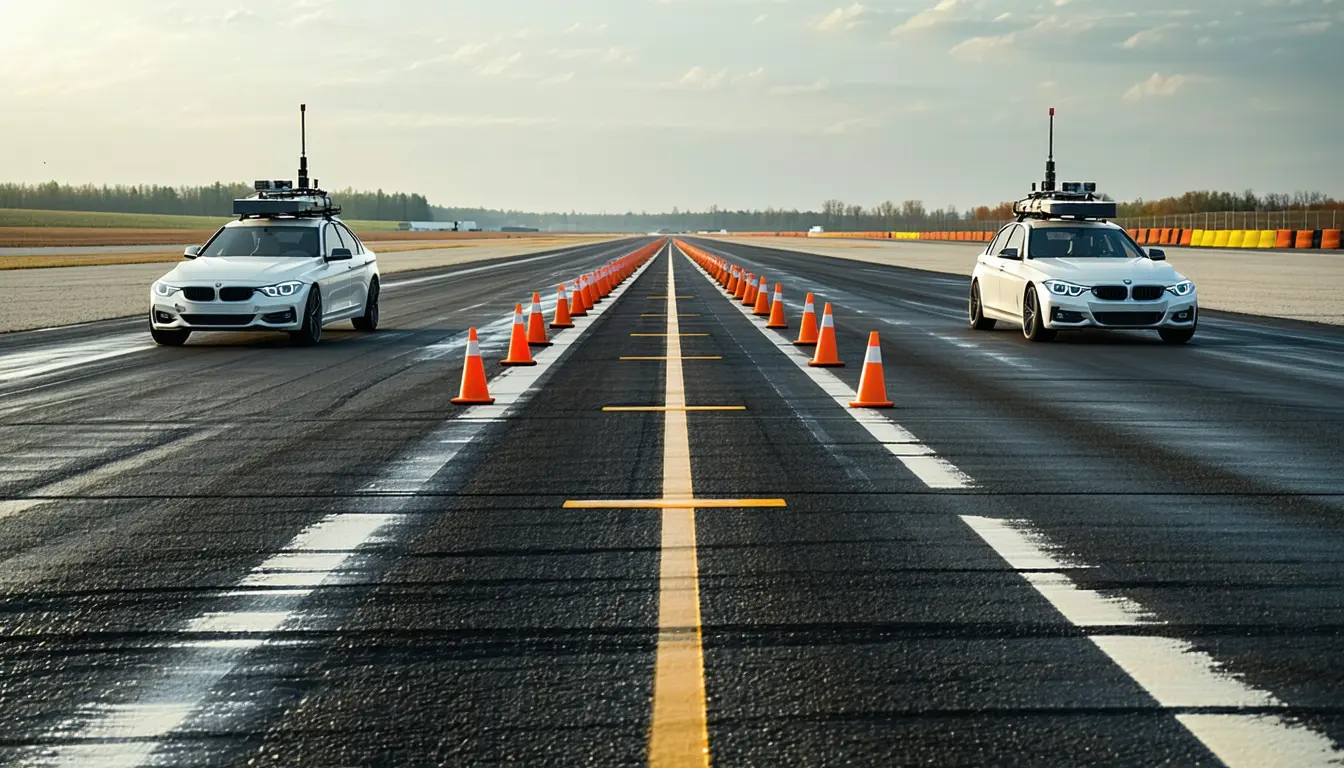
- Odyssey trained a driving policy on 20 hours of simulated data with the world model frozen, then ran it in closed-loop driving on public roads in India, generating waypoints in real time.
- Flexion, led by co-founder and CEO Nikita Rudin, built humanoid control policies on Odyssey-3 from tens of hours of teleoperation data.
Compiled by The EngineerSomething wrong?How this is made
Why it matters
- cost Odyssey carries the expensive pretraining; an adopter's bill shows up as decoder data plus integration engineering of the kind Flexion brought to the humanoid policies.
- constraint A team whose task needs a visual feature the frozen model does not encode cannot buy its way out with more demonstrations, because the decoder is the only part it gets to train.
- decision Without a shared benchmark, a buyer weighing Odyssey-3 against collecting per-robot demonstration data has to run the transfer test on its own hardware to get a number it can trust.
- precedent Arm policies recovering from missed grasps that never appeared in the demonstrations is the specific result other world-model labs will now be asked to reproduce.
Odyssey-3 is an autoregressive diffusion transformer trained on visual observations, and Odyssey attaches smaller action decoders to the frozen model, training those to turn its internal representations into controls for a particular machine or software environment [5][6]. Odyssey describes this as its product bet: expensive broad pretraining at the center, then relatively small amounts of specialized experience per application [7]. The interesting claim in the release is about generalization. Odyssey says arm policies trained with tens of hours of demonstrations recovered from missed grasps and from objects dropped in unusual positions, including behaviors absent from the demonstrations [4].
Invert the driving ratio and the real-footage policy covers about 1.3 times the distance per safety-driver intervention, so the simulation-trained policy needs roughly 30% more takeovers over the same route [1]. Both sets of policies were tested on busy roads involving overtaking vehicles, bends and junctions, according to Odyssey [10]. For 77% to carry to another road program, three things have to hold: the same route mix, the same rule for when a safety driver takes over, and a real-footage baseline that was trained to actual competence.
The comparison is between two Odyssey-trained policies. Odyssey did not publish a common benchmark that would make the result directly comparable with other labs' work, runtimewire reports [11]. The same account frames public access as the test of whether the demonstrations transfer beyond company-run conditions [19]. It does not say what that access includes or when it opens.
The humanoid work came with a partner. Flexion, led by co-founder and CEO Nikita Rudin, built humanoid control policies on Odyssey-3 from tens of hours of teleoperation data, and Odyssey published demonstrations of a humanoid opening containers and moving household objects [13][14]. Odyssey says those policies kept working through lighting changes that caused the vision-language-action baselines it tested to fail; it named none of those baselines and gave no detail that would let the comparison be reproduced [15]. Flexion supplied substantial robot-learning and control engineering. runtimewire takes that as evidence for Odyssey-3 as a useful backbone, not for a robot controller that works without adaptation [16].
The drone policy showed obstacle avoidance and stable flight in a simulated indoor environment, and no drone flew in a physical room [12]. Simulation is a good place to test obstacle avoidance, and nothing breaks there when a policy crashes. Game-control policies were trained on recordings paired with keyboard and mouse inputs, and policies trained in Grand Theft Auto V produced movement in Red Dead Redemption 2 and motorcycle riding in Sleeping Dogs [17]. Driving is the only application Odyssey attached an exact data figure to, at 20 hours; the arm, drone and humanoid budgets are all given as tens of hours [2].
The founding premise, from 2023, was that a model trained to predict how the world changes could supply reusable physical knowledge across machines instead of each robot learning mainly from task-specific demonstrations [3]. One closed-loop road test at 20 hours of simulated data supports the premise. What it has not yet shown is the same frozen features working for a decoder on a body and a camera placement Odyssey never trained a decoder for. The Poke & Wiggle evaluation is set up to measure that, across bodies, camera viewpoints and control systems [18].
What to watch
- Poke & Wiggle's numbers on how performance transfers across bodies, camera viewpoints and control systems.
- An absolute figure for distance per safety-driver intervention on the India route, or a benchmark another lab has already run.
- Identification of the vision-language-action baselines that failed under lighting change, with enough detail to rerun the comparison.