Invest1 distinct publisher3 min readPublished
Six asset managers, capital raised mostly from third-party investors, and a residual-value backstop of up to 25%. The guarantee is the part that has to be priced, and its size is undisclosed.
The Investor · Invest desk

Compiled by The InvestorSomething wrong?How this is made
The clause that will actually be priced here is the residual-value support, not the headline capacity. Jensen Huang said Nvidia may stand behind up to 25% of some projects, protecting lenders if the chips backing a financing turn out to be worth far less than underwritten [4]. Attach that rate to the whole program and Nvidia would be writing protection on $125 billion of used-GPU value [1]. It will not be the whole program, because "up to" and "some projects" are both doing work, and Nvidia has not disclosed the extent of any individual deal [3]. Ben Thompson reads the backstop as a price cut in a certain sense, Nvidia spending its own margin to lower customers' cost of capital [5].
The cushion exists because of who is on the other side. The paper ends up with insurers and pension funds that carry obligations running decades and therefore hunt for long-duration assets to match them, with private-credit managers doing the conversion work [9]. The collateral underneath is a chip whose depreciation schedule is the most contested number in the trade; the fear analysts have been voicing is a depleting pile of GPUs that swallows ever more capital [10]. Debt service comes from an AI tenant's lease or usage commitment rather than resale value [8], but the residual assumption is what determines recovery if the tenant stops paying. Bank of America's Vivek Arya argues GPUs are unusually financeable because they can be moved between operators and because CUDA stretches useful life [12]. That is a redeployment argument, and it holds only while there is a queue of buyers for last generation's silicon.
On size: more than $500 billion of intended mobilization [1] against AI investment approaching $600 billion this year [7] is roughly 0.83 of a single year at the current pace [2]. Which is the point. Goldman Sachs already puts AI-related financing at close to a quarter of all gross US investment-grade issuance [6], so the public bond channel is crowded. Insurance floats and retirement savings are the next pool, and Matt Levine's three-step version of the strategy says so without decoration: more private assets in ordinary retirement accounts, enormous private-credit and infrastructure funds, data centers built for AI to rent [14].
Morgan Stanley's Joseph Moore says the structure defuses the circular-financing worry, since third parties supply most of the money and Nvidia participates only to a limited degree [11]. On cash flows that is correct, and the stated design keeps the exposure off Nvidia's balance sheet [2]. But the residual guarantee means the vendor is insuring the future price of its own product while controlling supply and product cadence. Huang's framing, that AI factories can now be financed as productive infrastructure and that in AI compute is revenue [13], is the credit story a rating committee needs. What a note holder needs is narrower: where the 25% sits in the waterfall relative to the tenant's credit, and on what assumed useful life. Neither has been published [3].
Ranked by verification strength, evidence, and original report placement.
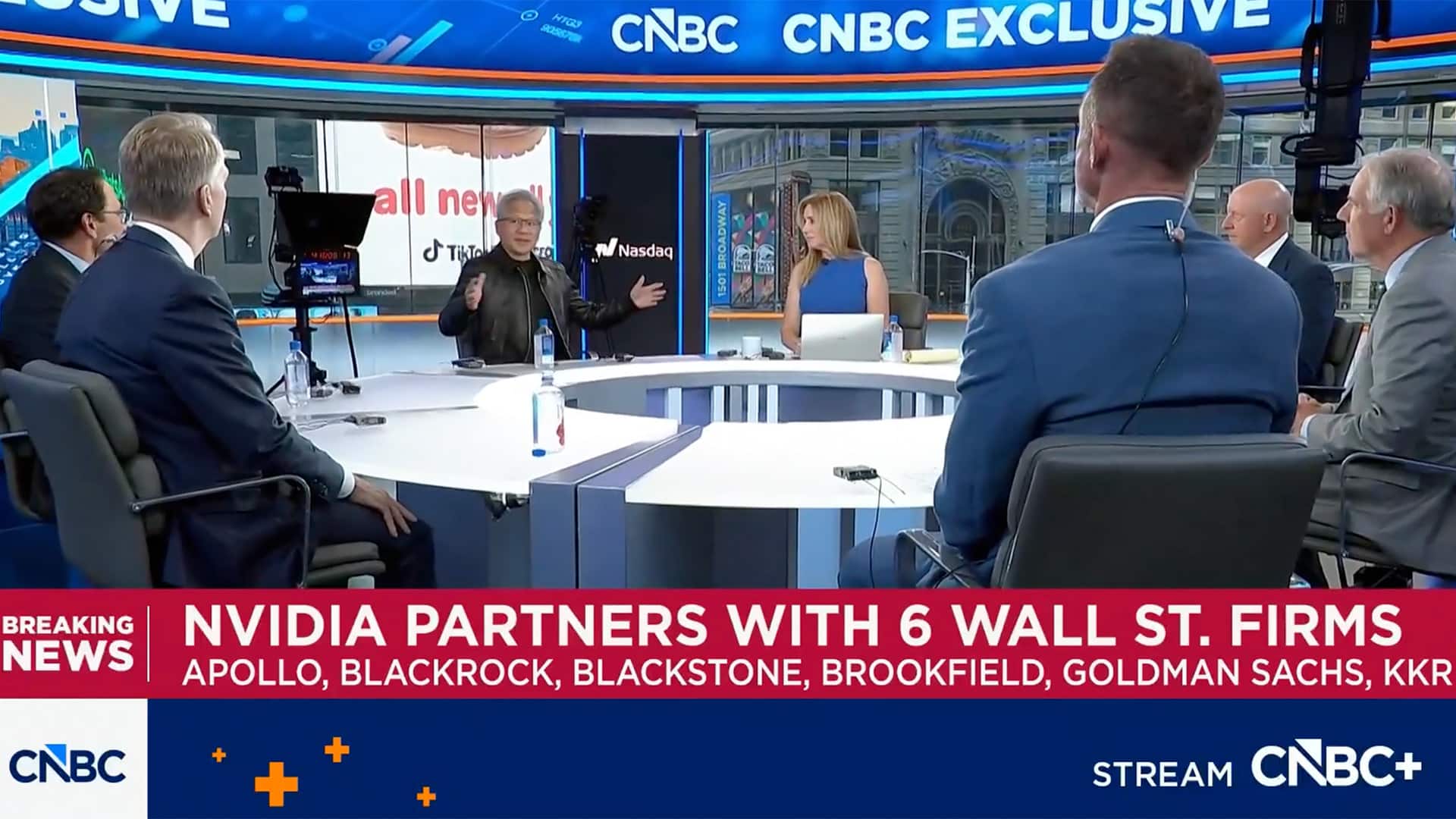
On Monday, Nvidia announced partnerships with Apollo, BlackRock, Blackstone, Brookfield, Goldman Sachs and KKR to create financing platforms intended to mobilize more than $500 billion for AI infrastructure.
Details of the arrangements, including the extent of each deal, are still unknown.
Jensen Huang said Nvidia may provide residual-value support of up to 25% for some projects, effectively promising some protection against the possibility that the chips backing a financing are worth much less in future than lenders expected.
Ben Thompson, who writes Stratechery, calls the residual-value support "in a certain sense, a price cut": Nvidia using its own profits to reduce customers' cost of capital and make Nvidia-based data centers easier to finance.
Goldman Sachs estimates AI-related financing now accounts for nearly one-quarter of all gross U.S. investment-grade issuance.
Follow any of these and your For You feed starts watching them — no settings page required.
Evidence-backed comparisons of source perspectives and observed adoption signals. Read the methodology
Which Builder, Operator, and Investor concerns the observed source mix emphasized—not a truth score.
Evidence, demonstrated adoption, hype gap, incentives, and confidence are assessed independently, each on its own current evidence. How these are measured.
Single-outlet synthesis; primary deal terms undisclosed
One publisher, no primary documents. The load-bearing facts are attributed statements (Huang on residual-value support, Moore, Arya, Thompson, Levine) and a Goldman estimate relayed without a linked note. The article itself concedes that the extent of each deal is unknown, and the residual-support notional is therefore unresolvable.
Platforms announced; debt-funded AI capex already large, deals not yet evidenced
Adoption evidence is an announcement with six named managers and a target, not documented closings, committed capital or executed leases. The one hard adoption-adjacent datapoint is market-level: AI-related financing already near a quarter of gross U.S. investment-grade issuance, which shows debt-funded AI capex is real but is not evidence that these platforms have deployed.
Headline $500B outruns disclosed terms and the unpriced backstop
The $500B mobilization figure and the 'compute is revenue' infrastructure framing are stated as accomplished structural change, while the mechanism that makes it work — a residual-value guarantee of undisclosed coverage — is unpriced and unsized, and the off-balance-sheet claim is qualified by that same guarantee. The reporting does carry the countervailing voices, which limits the overstatement.
Vendor, asset-manager and sell-side incentives all point toward the deal
Every named advocate benefits from the structure: Nvidia converts a financing bottleneck into demand and, per Stratechery, effectively discounts via its own profits; the six managers earn fees on new private-credit and infrastructure AUM sourced from insurance and retirement pools; the reassuring assessments come from sell-side analysts at Morgan Stanley and Bank of America who cover Nvidia. The ultimate risk holders — insurers, pension beneficiaries — are described but not quoted.
Direction credible, magnitude and risk allocation unverified
Confidence is limited by a single publisher, no primary filings or term sheets, and internal disagreement the source leaves unresolved (depreciation fear versus financeability; circularity alleviated versus safety-seeking capital exposed). The existence and broad shape of the announcement are well attributed; the economics that determine who bears loss are not. The cluster also carries a date inconsistency between the source URL path and the recorded publication timestamp, which slightly weakens provenance.
invest
Nvidia's pre-earnings re-rating is a credit story, not a chip story1 distinct publisher
product
The $500bn compute asset class rests on a depreciation curve Nvidia once denied1 distinct publisher
invest
Nvidia's $500bn GPU pool makes the seller the guarantor of its own demand1 distinct publisher
leadership
Nvidia's $500B financing club puts the chip supplier inside the buyer's capital stack1 distinct publisher
Distinct publishers with included, body-backed reporting in this cluster.
1 article · August 25, 2026