Product1 publisher3 min readPublished
Novelis moves battery enclosure corrosion protection onto the coil before stamping
Novelis says a water-based coating applied to aluminum coil survives the press, so enclosure and bus bar makers may be able to drop lubrication and e-coat stages. Whether that pencils out is a sum each buyer has to do on its own line.
The Product Desk · Product desk
What happened
- Novelis is expanding its coated aluminum portfolio for battery applications, targeting enclosures, casings and the electrical connectors known as bus bars.
- The water-based coating goes onto aluminum coil before forming and is designed to remain effective after stamping, which Novelis says could let manufacturers remove some processing steps.
- Novelis put no numbers to the cost savings, the production-time reductions or the battery-performance improvements.
Compiled by The Product DeskSomething wrong?How this is made
Why it matters
- decision An enclosure or pack maker deciding whether to delete a stage has to qualify corrosion and insulation performance on its own formed part, at its own draw depth.
- constraint Once insulation and corrosion protection are specified at the coil, changing them becomes a new material order with a lead time attached.
- cost The buyer pays for the evaluation: the savings have to be priced off the buyer's line before the business case exists.
- exposure A single qualified coating line concentrates supply for any program that wants enclosures stamped in more than one region.
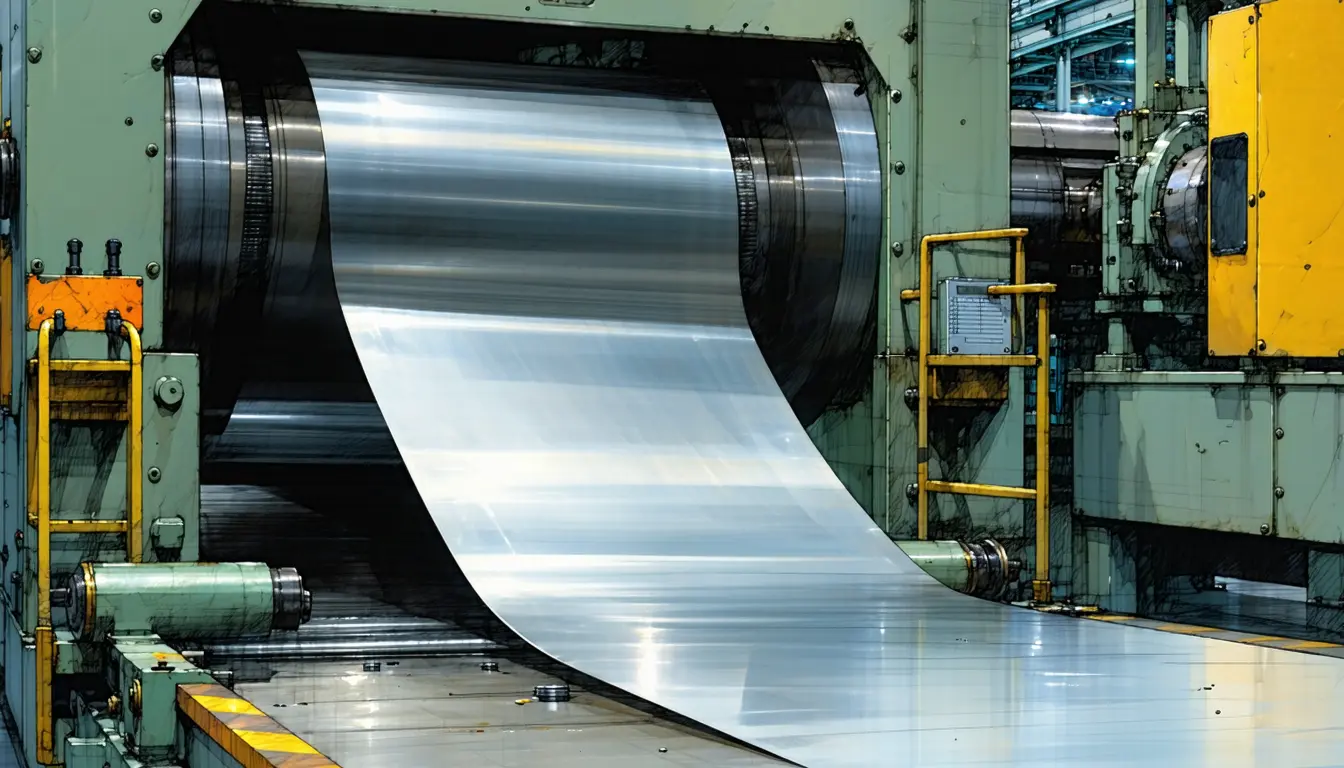
The person who has to act on this is a process engineer with a line layout in front of her, deciding whether the lubricant applicator and the e-coat tank stay in the plan. Novelis is offering coil that arrives with the protective layer already applied. Because the coating is on the coil, the company says, manufacturers may be able to reduce their reliance on external lubrication and additional e-coating [4]. Two stations on her layout [12].
The film has to do two different jobs on one pass. Going into the die it has to help the blank move, which is the lubricant's job today. Coming out it has to still be the corrosion barrier and, where the customer asks for it, the electrical insulation layer [2][3]. Novelis says the ability to withstand stamping matters because battery components often need to be shaped into complex forms after the coating is applied [7].
"Leveraging decades of automotive expertise, we have developed aluminum solutions that combine advanced surface technologies with high-performance sheet products for demanding battery applications," said Milan Felberbaum, Director R&D at Novelis Europe [8]. "By integrating these capabilities, we help customers improve manufacturing efficiency while supporting battery performance and durability," he said [9]. The announcement does not provide quantified figures for cost savings, production-time reductions or improvements in battery performance [6]. Anyone evaluating it has to build the efficiency case out of their own bath chemistry, labour standard and floor space.
A line review counts a deleted station as deleted cost, but the certification behind that station stays on somebody's desk. Corrosion resistance and insulation are product properties. They get measured on the formed part, after the coil has left Germany. The coating is designed to remain effective after stamping [3], which is a design intent; the data a pack maker needs comes off its own press, at its own draw depth.
So the sorting question for each downstream station is which property it delivers and who signs for that property after forming. Stations that deliver a process property go away with the coil change, because the press either runs the blank or it does not. Stations that deliver a product property only go away when the supplier's qualification data covers the part you actually stamp. Without that data, the cost moves to incoming inspection.
Two other things belong in the same evaluation. Novelis says the coating is already proven and in use on its advanced coating line in Germany [5]. A program buying enclosures in more than one region has to ask where a second coil source comes from. The material is aimed at stationary energy storage as well as electric mobility [10]. There the enclosure spec is written by a different set of people than the ones who sign off a vehicle pack. The company also says high-recycled-content, low-carbon aluminum can support efforts to reduce the environmental impact of battery supply chains [11].
What to watch
- Whether Novelis or a named customer publishes corrosion and dielectric results measured on a stamped part.
- Whether any enclosure or pack maker states how many process stations it removed after switching to the pre-coated coil.
- Whether the coating gets a second production line outside Germany, for programs sourcing in more than one region.