Science1 publisher3 min readPublished
Hertfordshire researchers want new towns' transport funded before the homes are built
Stephen Joseph and Sue Walsh compared Freiburg with Cambridge and Harlow, and concluded that the UK's 1.5 million new homes need public transport, footways and cycle routes funded before construction starts.
The Scientist · Science desk
What happened
- The University of Hertfordshire's Smart Mobility Unit published "Better places: new settlements with transport that works" as the government prepares its response to last year's New Towns Task Force report.
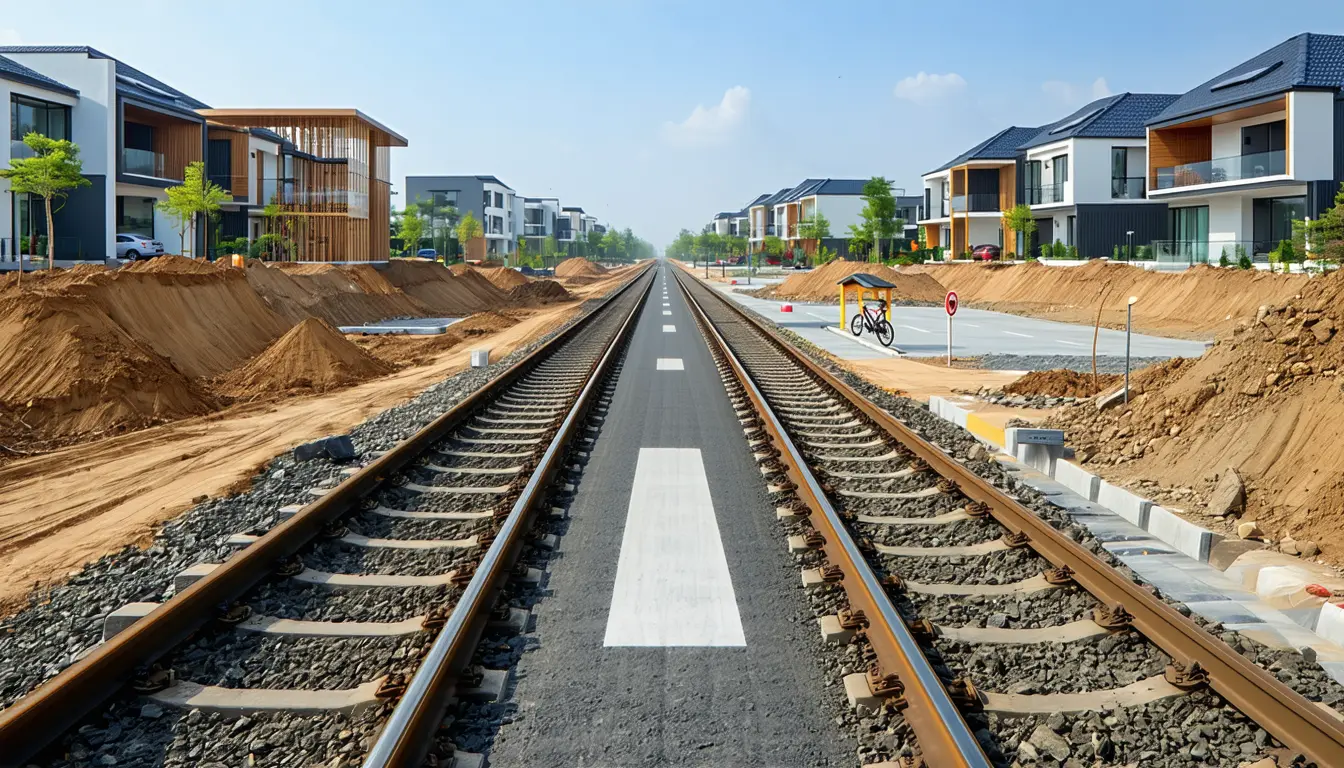
- Its conclusion is that public transport, walking and cycling networks must be planned and funded before homes are built, drawn from case studies of Freiburg, Cambridge and Harlow.
- Freiburg builds at higher density than the UK by arranging housing around tram or linked bus spines, and it uses the uplift in land values to pay for that transport up front.
Compiled by The ScientistSomething wrong?How this is made
Why it matters
- cost A tram or bus route that opens before the houses fill up needs somebody to fund the empty seats, and Joseph says Germany covers that with temporary operating subsidies while the UK has no comparable funding route at present.
- constraint Where transport and planning sit with different authorities, as the report found in Cambridge and Harlow, no single body is in a position to insist that the transport is built first.
- decision With 1.5 million homes committed and a new generation of new towns under consideration, the ordering question gets settled at each approval, site by site.
- precedent Because land value capture already helped pay for the Elizabeth Line, there is a domestic precedent for financing a line out of the development it makes possible.
The evidence behind that recommendation is a set of study visits. Joseph and Walsh went to Freiburg and to Cambridge and Harlow with officials and compared what they saw [7][3]. A comparison like that can show that something is deliverable, and it can show where delivery breaks down, but it cannot separate causes. Freiburg differs from the English sites on several things at once. It has one combined approval process instead of several, a governance and finance structure that can unlock advance funding, and land value uplift paying for the transport spine before the housing arrives [12][13][10].
In Freiburg the housing follows the line. Densities are higher than in the UK because homes are built around public transport spines, mostly trams or linked bus routes. The report says that arrangement allows a more efficient approach to parking, streets that support cycling and walking, and less need to own a car [8][9]. Joseph said, "It has been shown in the UK that we can build at higher density with less car use, but high-quality public transportation must be in place from the beginning and fully integrated with the master planning of the developments." [15] The account published by phys.org gives no figures for car use, density or capital cost at any of the sites [23].
Funding transport ahead of occupation needs an instrument to do it with. Joseph said, "Germany solves this by using land value uplift and public funding to cover temporary transportation subsidies for mass transit developments, but these funding routes are not really available in the UK at present." [16] The report notes that a similar land value capture approach helped finance the Elizabeth Line, and that Germany and France use it elsewhere for new transport schemes [11].
The Cambridge problem is delivery. The visits found some high-quality development there, with new train stations, guided buses and high levels of walking and cycling [17]. They also found that the guided bus route had not been fully integrated into the Northstowe development and that walking and cycling routes had not been fully delivered [18]. The report lists the UK's obstacles as the capital cost of mass transit, deregulated transport systems and fragmented governance [20]. Of those three, only the first is a question of how much money there is.
The diagnosis of recent UK practice is that decades of low-density, car-dependent building have left many residents with little choice but to drive, adding congestion, carbon emissions and pressure on local infrastructure [21]. Against that, the authors want more high-quality homes inside a compact footprint, with the space that releases going to parks and community facilities, and parking requirements coming down [22].
What to watch
- Whether the government's response to the New Towns Task Force attaches any condition that transport be funded before homes are built.
- Whether any English new town is given a land value capture power comparable to the one used to help finance the Elizabeth Line.
- Whether Northstowe's guided bus integration and its undelivered walking and cycling routes are completed.