Science1 distinct publisher3 min readPublished
Their evidence is a decade of interviews after Nepal's 2015 earthquake, which is enough to describe how vulnerability accumulates in a river basin and not enough to say how much of this toll it explains.
The Scientist · Science desk

Compiled by The ScientistSomething wrong?How this is made
Vulnerability, in the account these researchers give, accumulates before anything triggers it. In their Kathmandu study, people described, more than ten years after the 2015 earthquake, prolonged displacement, reconstruction that stalled part-way, water sources that disappeared and institutional support that did not arrive [6]. The authors read those as coupled systems rather than a list of separate deficits: when one becomes unstable, the instability travels through the others, and rebuilt houses and roads are a poor proxy for recovery [7]. They call the surrounding condition a polycrisis, in which climate pressures, water insecurity, infrastructure vulnerabilities, social inequalities and governance failures interact instead of running independently [8].
That has a direct bearing on forecasting. A hazard model is scored on lead time and on where it says the water will go. It is not scored on whether the valley has a trained and adequately resourced local team at the moment the water arrives, which is the item community members put on their own priority list [11]. This is the ordinary gap between a metric a research group can improve and the delivery step that decides whether the improvement reaches anyone.
What this commentary does not tell you is how much of the toll a different set of decisions would have prevented. There is no exposed-population denominator here, no counterfactual, and the casualty figure appears as hundreds dead with many more missing [16]. It also transfers across hazards: the empirical base is an earthquake preparedness study in Kathmandu, and the event it is read against is a glacial ice and rock collapse feeding mountain river valleys [18]. Interviews can establish a mechanism and cannot size an effect, and the authors are consistent about that limit elsewhere, warning against filing every flood or landslide under climate disaster before the attribution work is done [9]. The wider Himalayan trajectory they describe (glacier loss, changing snow conditions, permafrost degradation, shifting river systems) is a statement about the space of possible cascades rather than about this one [10].
Their governance claim is the part that could be measured. Who determines what knowledge counts, who controls funding, who decides, and who remains accountable after a project or emergency response ends [14]: those are answerable from budget documents and terms of reference, not from interviews. So is the divergence the Kathmandu work implies between structures rebuilt and water supplies restored [7].
The geography sharpens it. The flooding ran through Nepal and Tibet [2], so the accountability question already has two jurisdictional answers before anyone counts the governments whose citizens died as tourists there [3]. My own view, with its condition attached: forecasting skill will keep improving, and lead time converts into lives only where someone downstream holds both the standing and the money to act on it. That is a governance variable, and it is the one the authors say communities are routinely consulted about and rarely given authority over [13].
Ranked by verification strength, evidence, and original report placement.
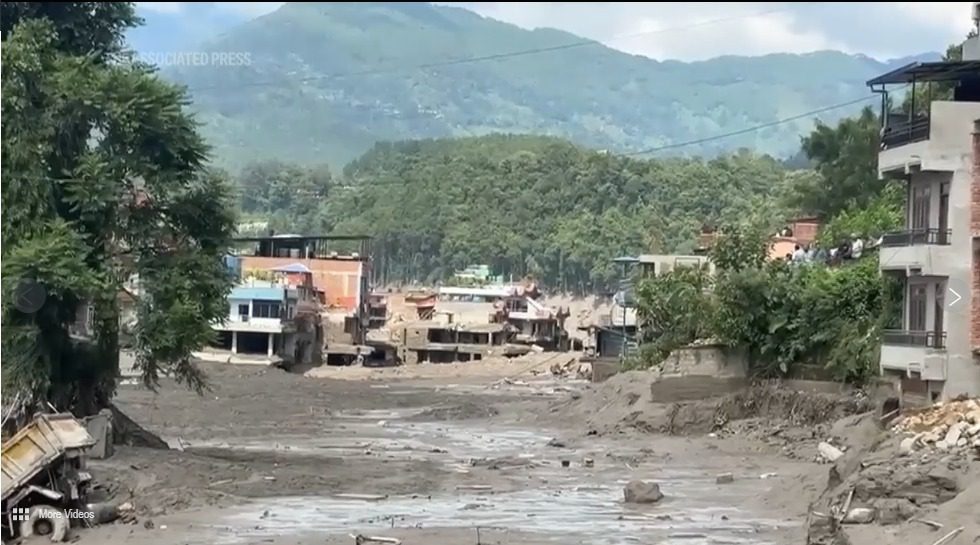
A massive collapse of glacial ice, rock and debris high in the Himalayas generated destructive flash flooding that swept through interconnected river valleys, killing hundreds, leaving many more people missing, and damaging villages, towns and infrastructure.
The catastrophic flood occurred in Nepal and Tibet.
The dead include Nepalis as well as tourists visiting from other countries, including dozens of Canadians and Americans.
More than a decade after Nepal's 2015 earthquake, community members described a disaster that had never completely ended, speaking of prolonged displacement, incomplete reconstruction, disappearing water sources, livelihood insecurity, psychological trauma and inadequate institutional support.
The authors argue that rebuilding houses and roads does not necessarily mean a community has recovered, because water, livelihoods, mental health, social relationships, ecological systems and trust in institutions are interconnected, and when one system becomes unstable vulnerability can cascade through the others.
The authors write that focusing only on the physical trigger risks missing a larger story, and that their research with communities in Nepal and elsewhere has led them to understand disasters as interconnected ecological, social, cultural, health, economic and governance crises.
Distinct publishers with included, body-backed reporting in this cluster.
phys.org
1 article · August 28, 2026
Follow any of these and your For You feed starts watching them — no settings page required.
Evidence-backed comparisons of source perspectives and observed adoption signals. Read the methodology
Which Builder, Operator, and Investor concerns the observed source mix emphasized—not a truth score.
Evidence, demonstrated adoption, hype gap, incentives, and confidence are assessed independently, each on its own current evidence. How these are measured.
One commentary, no numbers
Everything rests on a decade of interviews the reader cannot inspect — no sample, no sites, no interview window — plus a Kathmandu earthquake study cited but not shown. The flood itself is described in two paragraphs with 'hundreds' as the only magnitude, and the causal spine of the story, that the toll accumulated years in advance, is reasoned across a hazard boundary from earthquake recovery to a glacial-collapse flood.
No uptake recorded
The authors argue for resourced community disaster teams, sustained funding and community authority over decisions, but this reporting records no instance of any government, funder or agency adopting the approach — no programme, budget line or policy change is named, before or after the flood.
Toll attributed further than measured
Modest overreach, and it is not where you would expect. The authors give up the easy amplifier, explicitly refusing to file this event under climate change until attribution work is done — that is restraint. The stretch is scope: interviews about earthquake recovery in Kathmandu are asked to explain why a glacial flood in connected river valleys killed hundreds, a distance the evidence cannot cover in either direction.
Researchers arguing for their own agenda
The authors are visibly interested parties: the piece launches a recently published study, coins and promotes 'responsibility integration' as its contribution, and argues that researchers belong inside the accountability relationship rather than outside it — a conclusion that also positions academic partners as necessary to preparedness funding. That interest is worn openly, in the first person, which is the mitigating part; there is no disclosure of who funded the work.
Clear text, unchecked world
What the authors argue is unambiguous, so our read of the position is firm. Our read of the facts is not: one outlet, one document, no corroboration of the casualties, no access to the study, and no voice from the institutions accused of consulting without ceding control. A second account of either the flood or Nepal's reconstruction record would move this figure quickly.