Science1 publisher3 min readPublished
NanoTS calls SNPs from nanopore RNA at F1 above 0.980 on five-read sites
A Nature paper reports its largest gains on allelically imbalanced variants, where existing nanopore transcriptome callers struggle, and every accuracy figure it gives applies only to sites covered by at least five reads.
The Scientist · Science desk
What happened
- Researchers publishing on nature.com describe NanoTS, a deep learning caller that detects single nucleotide polymorphisms in nanopore transcriptome sequencing data from both direct RNA and cDNA libraries.
- Calling runs in two passes, with an unphased model first and WhatsHap phasing calls that score QUAL 10 or better before a phased model uses both haplotypes.
- The authors benchmark against Clair3-RNA and LongcallR, and report their largest improvements on allelically imbalanced variants.
Compiled by The ScientistSomething wrong?How this is made
Why it matters
- constraint Conditioning accuracy on five supporting reads moves the hard question upstream to sampling, because in transcriptome data the usable sites are whatever the sampled tissue expresses, and that set differs between tissues.
- decision A lab choosing between direct RNA and cDNA prep now has a number for what the cheaper route costs it: roughly 1.7 times the residual error at the reported floors.
- capability A run already being done for full-length transcripts and RNA modifications can return genotypes for its deeply covered sites, so one library can serve two purposes.
- precedent Because both the training data and the truth set come from reference material, the work that would convert the authors' clinical language into clinical practice is a patient cohort.
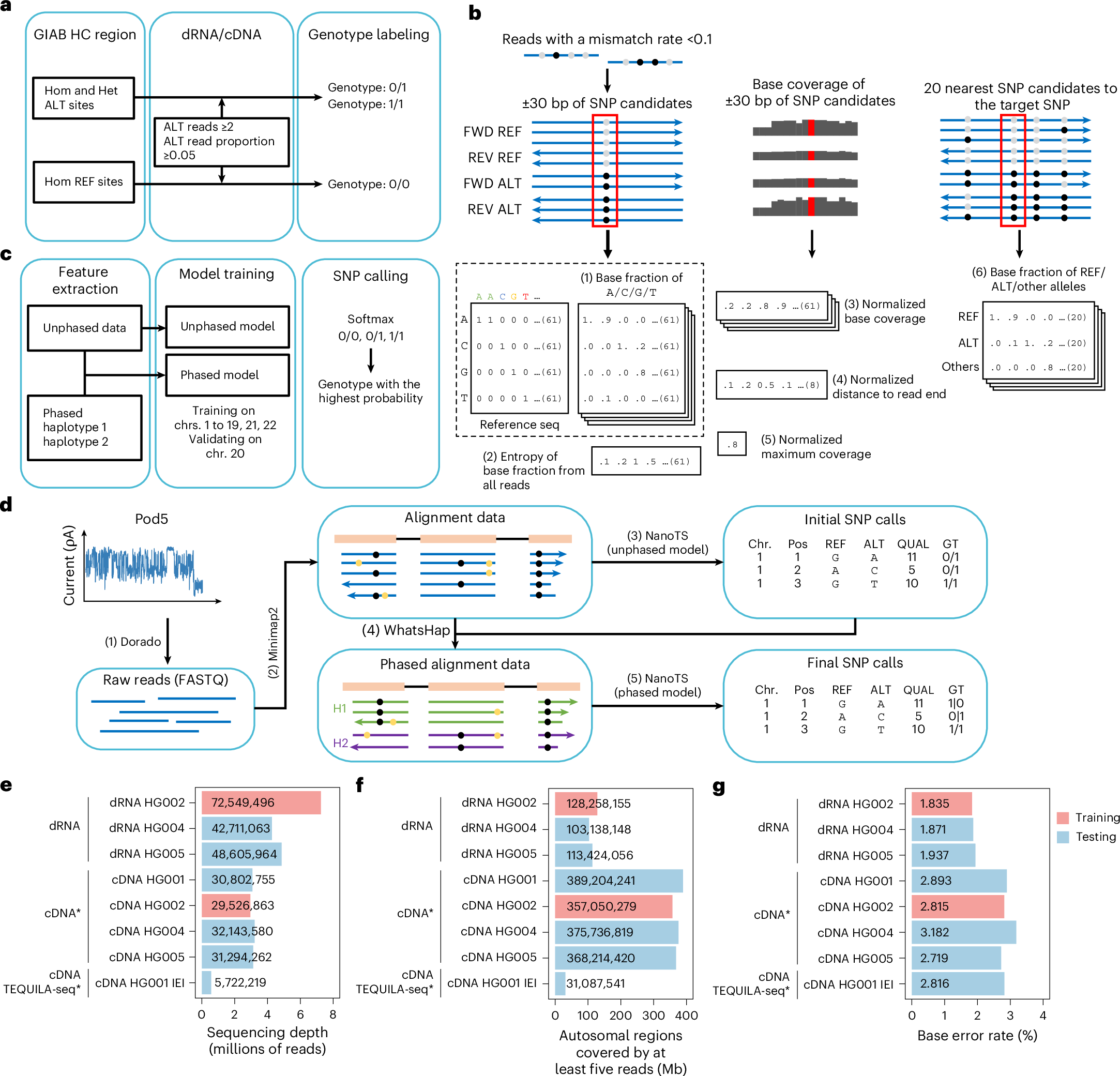
Coverage in a transcriptome follows expression. A gene that is silent in the tissue you sampled contributes no reads at all, and a gene that expresses one dominant isoform can be read almost entirely from one allele. The authors name four reasons standard long-read DNA callers do poorly on this kind of data: uneven read coverage across genes, transcript isoform diversity, allele-specific isoform expression and library artifacts [7][8].
The design answers those directly. At each candidate site NanoTS sorts reads into four groups by allele type and strand direction [9], which is the two allele types crossed with the two strands [17]. It then adds six features aimed at systematic error: base fractions of A, C, G and T, the entropy of those fractions, normalised base coverage, normalised distance to read ends, normalised maximum coverage, and the reference, alternate and other-allele fractions at the 20 nearest candidate SNPs [10]. Strand-biased errors, positional bias within reads and error-prone sequence contexts are the artifacts those features are meant to absorb [10].
Calling runs twice. The first pass uses an unphased model, calls scoring QUAL of 10 or better go to WhatsHap, which partitions the reads into haplotype 1 and haplotype 2, and the phased model then uses features from the unphased data plus both haplotypes [12][11]. Allelic imbalance is what that second pass is for. The paper describes it as a major challenge for long-read transcriptome-based variant callers and reports NanoTS's strongest improvements there [18][3].
An F1 above 0.980 leaves under 0.020 of residual error on direct RNA; 0.966 leaves 0.034 on cDNA, roughly 1.7 times as much at the stated floors [16]. Both numbers hold only for polymorphisms with at least five supporting reads [2].
Training and evaluation both rest on Genome in a Bottle high-confidence calls and regions, with homozygous and heterozygous alternate sites as gold-standard positives and homozygous reference sites as negatives [13]. The training reads are direct RNA and cDNA from HG002, which is also the sample other nanopore transcriptome callers were trained on [14]. The comparators are Clair3-RNA and LongcallR [15].
On clinical use the paper is careful with its own wording. It reports accurate detection and genotype calling of pathogenic variants underlying Mendelian disorders, "highlighting its potential clinical utility", the authors wrote [4]. A GIAB benchmark asks whether a caller agrees with a known answer in a well-characterised reference sample [13]. The F1 figures do not say how many diagnostically relevant positions clear five reads in whatever tissue a clinic can obtain, and that number changes with the tissue, not with the caller.
Nanopore transcriptome sequencing already delivers full-length transcripts and direct detection of RNA modifications [19]. A SNP caller that works on the same reads makes one run answer more questions, for the subset of sites deep enough to qualify [1][2].
What to watch
- Whether the direct RNA and cDNA accuracy holds on samples outside the GIAB reference material that supplied both training data and truth set.
- Whether the allelic-imbalance gains survive in a prospective patient cohort where no reference answer exists for the causal variant.
- Whether insertion and deletion calling gets added, since the reported tool is scoped to single nucleotide polymorphisms.