Science1 publisher3 min readPublished
MutexaGPT translates a chemist's plain-English hunch into a configured physics workflow
Its agents interview the user for what the request leaves out, then build and run the modelling. The paper shows this on two enzymes, which demonstrates the pipeline rather than measuring how often it is right.
The Scientist · Science desk
What happened
- MutexaGPT is presented as an open-access, multi-agent large language model platform that takes plain-English enzyme engineering requests through a web interface and returns variant designs.
- Its agent chain elicits the information a request leaves out, builds physics-based models, configures and runs high-throughput molecular modelling, and converts the output into proposals such as smart mutation libraries.
- The authors locate the field's problem in translation, arguing that no systematic approach exists for turning qualitative catalytic intuition into quantitative, actionable design principles.
- When that translation fails, the paper says, engineers fall back on hypothesis-agnostic screening of larger libraries, at greater labour and resource cost and with longer development cycles.
Compiled by The ScientistSomething wrong?How this is made
Why it matters
- constraint With two published campaigns and no reported hit rate, a lab has no basis yet for judging whether the proposed positions beat the ones its own people would have picked.
- cost Prompting the agents is cheap and the modelling they launch is not, so the question-asking step doubles as the spend control on somebody's cluster.
- decision For groups with no high-throughput screening assay, the budget question becomes simulation time against a larger wet-lab screen, and that is the comparison the platform has to win.
- precedent If a web front end becomes the unit of distribution, the artefact reviewers need to inspect is the set of questions the agent asked, not just the protocol in a methods section.
The agent worth watching in this stack is the one that asks questions. A plain-English request carries less than a simulation needs, and the described pipeline puts elicitation ahead of model construction, so the software interrogates the chemist before it builds anything [2]. That ordering is the actual claim, because the machinery downstream of it already existed in computational enzymology; what the authors say was missing is a systematic way to get from a qualitative thought to a quantitative, actionable design principle [14].
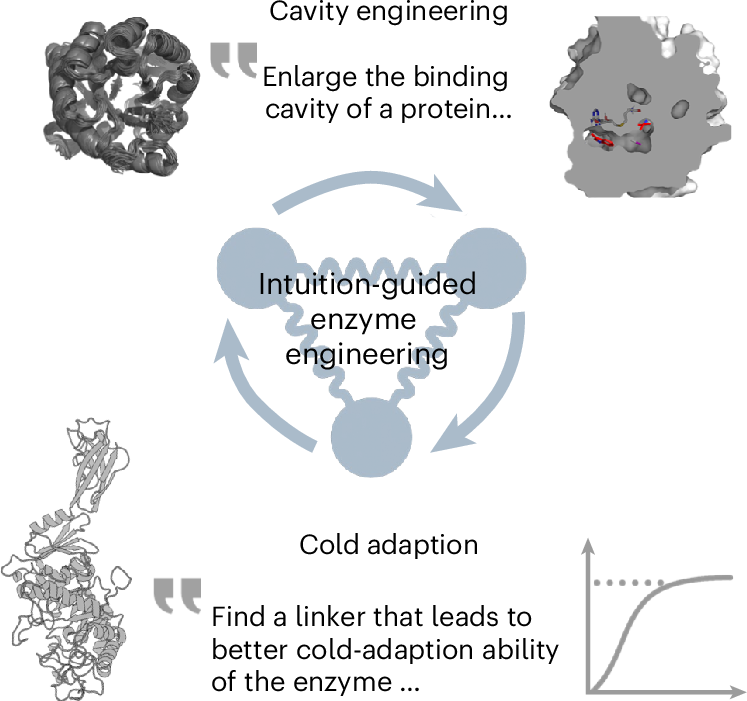
Two campaigns is the whole demonstration set [11]: one widening a halide methyltransferase's tolerance for bulkier substrates, one improving a bidomain amylase's activity at lower temperature [3]. Both are sensible targets and neither is a benchmark. The abstract and opening section report no hit rate for the proposed libraries and no comparison arm, whether an unassisted expert or a randomly chosen set of positions [8]. What that establishes is that the workflow runs end to end on real enzymes and produced proposals the authors were willing to publish under their names [4]. What it does not tell you is how often the proposals are right, which is the number a lab deciding whether to order the constructs actually needs.
There is also a cost asymmetry worth pricing before adoption. The language-model calls that parse a request are cheap; the high-throughput molecular modelling those calls configure and launch is not [2]. Lowering the barrier to expressing a hypothesis lowers the barrier to committing cluster time to a badly posed one, and the elicitation agent is the only thing sitting between the two.
The justification for any of this is the fallback it displaces. When intuition cannot be turned into a smart library, engineers screen a bigger one and pay in labour, resources and cycle time [7]. Smart libraries have so far been built by hand, as in the CASTing method from Reetz and coworkers, which saturates small residue sets and recombines the beneficial variants to catch cooperative effects [12]. That is the comparison production will make: variants screened per improvement found, sharpest in the case the paper itself flags, where no high-throughput assay is available [9]. It also explains why more simulation capacity was never sufficient on its own. The correlation between active-site electric field strength and rate enhancement tells you what to aim at and not which residue to change [6], and Gordon Hammes's flexibility maxim, quoted in the paper, does not even supply a target value to aim for [5].
Until a campaign publishes the size of the library the agents proposed and the fraction of it that improved the enzyme, this is credible infrastructure with two case studies attached, and the authors' word "democratize" is describing access to the workflow rather than a measured yield [4].
What to watch
- A campaign that reports the proposed library size and the fraction of variants that improved the enzyme, against an unassisted control.
- Third-party labs, not the authors, running the web platform on their own targets and publishing what the elicitation step failed to ask.
- Who supplies the compute for the high-throughput modelling once an open web interface starts launching workflows at volume.