Science1 publisher2 min readPublished
Empa measures 219 tonnes of microplastic falling on Switzerland below 2,000 metres each year
A year of monthly sampling at five sites puts about 219 tonnes of microplastic on Switzerland below 2,000 metres, with the four non-urban stations landing within about a third of one another.
The Scientist · Science desk
What happened
- Empa, Eawag and Agroscope measured about 219 tonnes of microplastic settling on Switzerland each year in areas below 2,000 metres, the first systematic accounting for the country.
- About 78 tonnes of that lands on agricultural land each year, and about 10 tonnes falls directly into water bodies.
- Sampling ran for a full year at Zurich, Dubendorf, Magadino, Payerne and Mount Chaumont in the Jura, with the results published in Atmospheric Chemistry and Physics.
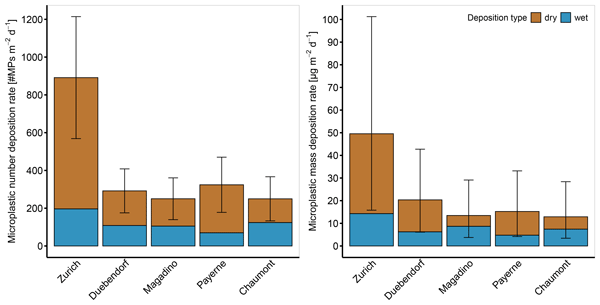
- The Zurich site averaged 881 particles per square metre per day, while the four other sites clustered between 249 and 331 particles per square metre per day.
- PET made up 31 percent of the identified particles, polyethylene 26 percent and polypropylene 21 percent.
Compiled by The ScientistSomething wrong?How this is made
Why it matters
- constraint Anyone quoting the 219-tonne figure as Switzerland's airborne plastic load inherits two exclusions, everything below 20 micrometres and all tire wear, and the study does not size either.
- exposure A field far from any city cannot be assumed to receive less than a suburban one, so distance from population stops working as a screening proxy for where to sample soil.
- capability With a stated size window and a random-area scanning protocol, later surveys have something they can be compared against, which is the deficiency Huglin identifies in the existing literature.
- decision FOEN paid for a deposition rate, and it now has to decide whether 78 tonnes a year onto farmland warrants monitoring; that call needs effect data this inventory was not designed to produce.
The total covers one size class. The analysis ran on particles between 20 and 215 micrometres across [7], so finer material is not counted, and neither is tire wear, which the team pulled into a separate study still under way for analytical reasons [19]. Both exclusions can only push the true mass up [27].
Farmland takes about 36 percent of the national total, water bodies about 5 percent, and the remaining 131 tonnes a year settles on everything else below 2,000 metres [21][20].
What was more unexpected for the team was how similar the values were outside the big cities [10]. The Zurich site ran a factor of 2.7 to 3.5 above the other four [22], and those four, one of them a ridge in the Jura Mountains, sat within about a third of one another [5][28]. "The closer the location is to densely populated areas, the higher the levels we would have expected. But we don't see such a difference," said Christoph Hüglin, the Empa researcher who led the work [11]. The published account credits dense population, traffic and plastic products in outdoor spaces for the urban excess [25].
That narrow spread is also what makes a national tonnage defensible from five stations. Had the non-urban sites disagreed among themselves, an area-weighted total would be an extrapolation across an unmeasured gradient; instead the gap to bridge is between one city and everywhere else [8].
Monthly samples of wet and dry deposition went to the joint particle laboratory of Eawag, Empa and Agroscope, onto filters, and under imaging infrared microspectroscopy [6][14]. Instead of picking out particles that looked like plastic, the team scanned randomly selected filter areas point by point [15]. Selecting suspicious particles yields identifications; scanning a random area yields a rate, because the denominator is the area scanned and not the analyst's judgement. "We wanted to collect data for Switzerland and apply an analytical method that delivers the most reliable results possible," Hüglin said [12]. According to Hüglin, many earlier results are hard to compare because they use different methods and size ranges [13].
The three commonest polymers together make up 78 percent of the particles [23]. PET led at 31 percent [16]. PET is bottle plastic and it is also polyester fibre, so the researchers suggest textile fibres could contribute significantly to atmospheric microplastic [17]. The study cannot determine which products the individual particles came from [18].
What to watch
- The separate tire-wear study Empa is still running: adding road and tire particles to the same size window would raise the national total by an amount nobody has yet published.
- Whether further stations, or any above 2,000 metres, widen the 249 to 331 particles per square metre per day band that the national extrapolation rests on.
- Whether FOEN, which supported the work, folds the 78 tonnes a year onto farmland into Swiss soil monitoring.