Invest1 distinct publisher2 min readUpdated
Seoul's midday meal has passed 10,000 won, and the biggest burger chain's answer is a second, cheaper price list rather than a cheaper menu board.
The Investor · Invest desk
Compiled by The InvestorSomething wrong?How this is made
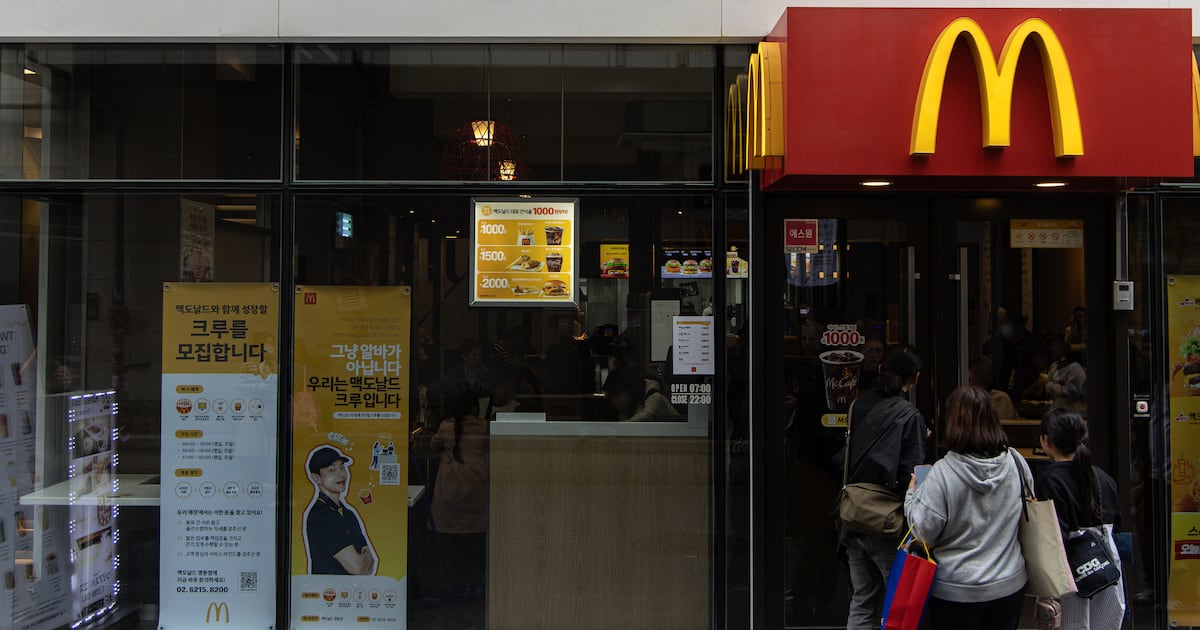
Raise 35 list prices in February and take 1,300 won off a single burger in August, and you have not changed your mind; you are running two price lists [8][1]. The February increases ran 100 to 400 won an item [8]. The Bulgogi Burger cut is 3.25 times the largest of those increases and 13 times the smallest [6]. The board above the counter stays where the annual price letter left it, and the lower number goes only to the customer who orders off the Happy Snack platform, which has rotated a fresh lineup each season since 2021 [4]. The expansion reached the press through industry sources on the 23rd rather than a price announcement [15].
That gap has to be funded. Last year McDonald's Korea reported 73.2 billion won of operating profit on 1.431 trillion won of revenue [12], a margin of 5.1% [3]. The 523% profit jump reads better than it lives: working back from the reported growth rates, the prior year was roughly 1.25 trillion won of revenue and about 11.8 billion won of operating profit, a margin under 1% [4]. A company that has just climbed off breakeven is spending the recovery on footfall.
The prices point at a competitor that is not another burger chain. A Bulgogi Burger with a medium iced drip coffee comes to 3,500 won, about 35% of the 10,000 won that en.sedaily.com puts on a typical Seoul lunch [5][6], and roughly a sixth of a samgyetang bowl heading toward 20,000 won [7]. Using the conversion in the same report, the pair runs about $2.50 [9]. Croquette wraps, churros and a shake are what you buy in addition to lunch [5]. A beef burger and a coffee are lunch.
The cost side has not moved to make this comfortable. The industry justified this year's increases, including Burger King's 49 items and Mom's Touch's 43 [9][10], on imported beef patties, buns, vegetables, a high exchange rate, cooking oil, labor and rent [11]. None of that unwound by August, so the discount is purchased volume rather than passed-through relief. BKR, which operates Burger King, earned 42.9 billion won on 892.2 billion won of revenue, a 4.8% margin [14][7]; Lotte GRS came in at 4.6% [13][8]. None of the three has the cushion for a long argument over a 2,500 won burger, and the one that folds will be whichever chain's volume does not answer the discount.
Follow any of these and your For You feed starts watching them — no settings page required.
Ranked by verification strength, evidence, and original report placement.
McDonald's Korea added the Bulgogi Burger to its Happy Snack lineup, cutting it by 1,300 won to 2,500 won from 3,800 won.
Iced drip coffee in the medium size fell to 1,000 won from 2,400 won, and the large size dropped to 1,500 won from 2,800 won.
Two pieces of McWings were discounted by 400 won to 3,300 won from 3,700 won.
Happy Snack is a customer benefit platform offering popular McDonald's burgers, sides, desserts and drinks at discounted prices throughout the day; since its 2021 launch it has introduced a newly configured lineup each season.
The Happy Snack lineup now includes crab cream croquette snack wraps, three salted caramel churros, a Grimace shake, two pieces of McWings, iced drip coffee in medium and large, and the newly added Bulgogi Burger.
As lunchflation pushes typical midday meal costs well past 10,000 won ($7.20), McDonald's Korea is strengthening Happy Snack to capture demand for value-priced options, according to en.sedaily.com.
Evidence-backed comparisons of source perspectives and observed adoption signals. Read the methodology
Which Builder, Operator, and Investor concerns the observed source mix emphasized—not a truth score.
Evidence, demonstrated adoption, hype gap, incentives, and confidence are assessed independently, each on its own current evidence. How these are measured.
Specific numbers, single outlet, unnamed sourcing
Every price point, price-hike detail and financial figure is concrete and internally consistent, and the derived margins and discount depths follow directly from the article's own arithmetic. But the cluster contains exactly one publisher, the expansion is attributed to unnamed 'industry sources' with no McDonald's Korea statement, and no filing, receipt or second outlet corroborates the changes.
Change is live in market, uptake unmeasured
This is an actual deployed pricing change rather than an announcement of intent, and Happy Snack has run since 2021 with seasonal refreshes, which implies a durable programme. However nothing in the supplied source measures customer uptake: no transaction counts, no share of orders through the discount lineup, no traffic or basket data, and no promotion window. Revenue growth of 14.5% is company-wide and cannot be attributed to the discount platform.
Value framing runs slightly ahead of the net price picture
The article's framing that burgers are 'gaining despite price hikes' and that the chain is capturing value demand is mildly overstated relative to what it shows: list prices rose on 35 items in February, the discounts cover a handful of items with no stated duration, and no demand data supports the value-capture claim. The overstatement is modest because the underlying numbers are specific and the article does disclose the price increases and cost pressures rather than hiding them.
Promotional pricing news relayed via unnamed industry sources
The story's core content is a company's own promotional price list, which the chain benefits from publicizing, and it reaches the reader through unnamed industry sources rather than attributed disclosure. The chain also has a clear interest in a value narrative immediately after raising 35 prices and posting a 523% jump in operating profit. Countervailing factors: the outlet reports the increases and competitor hikes, and cites peer financials that are verifiable, so this is not pure promotion.
Facts likely accurate, interpretation thinly supported
Confidence in the individual figures is reasonable because they are precise, mutually consistent and typical of routine trade reporting. Confidence in the story's interpretation is low: one publisher, unnamed sourcing, no company comment, no promotion duration, and no adoption or unit-economics evidence for whether the discount strategy works or is sustainable.
invest
Korean franchises trade flag-planting for menu maths in Laos, Brunei and Singapore1 distinct publisher
invest
Korea's 80% youth mortgage lands on a housing stock that barely qualifies1 distinct publisher
invest
Korea's brokerages added 402 staff in a quarter while mortgages headed to 5.78%1 distinct publisher
invest
Seoul's first EDCF-funded AI project is a $170m tied loan, and Tanzania holds the debt1 distinct publisher
Distinct publishers with included, body-backed reporting in this cluster.
en.sedaily.com
1 article · August 22, 2026