Science1 publisher2 min readPublished
Hokkaido team raises Mercury's measured contraction to 11.6 km after correcting for rough terrain
Shortening structures turn up more often on smooth ground than on rough. Correcting for that detection bias raises Mercury's radial contraction from 8.3 to 11.6 kilometres, and the authors say even that is probably low.
The Scientist · Science desk
What happened
- A team led by Hokkaido University with DLR and the University of Tokyo compared a global map of Mercury's surface roughness against maps of its shortening structures, and found the structures are identified far more often on smooth terrain.
- Correcting for the roughness relationship raised the estimated radial contraction of Mercury from 8.3 kilometres to 11.6 kilometres, in a paper published in Geophysical Research Letters.
- The researchers say 11.6 kilometres may still be too low and that Mercury's actual contraction could be greater.
Compiled by The ScientistSomething wrong?How this is made
Why it matters
- constraint Any figure for Mercury's lost radius that comes from counting mapped scarps is a minimum, because the counting method misses structures on exactly the terrain that hides them best.
- contradiction The phys.org account carries two sizes for the same revision, 40 percent in the headline and 10 to 30 percent in the text. A reader taking the headline number is quoting a bigger correction than the body supports.
- precedent If detection bias tracks roughness, then lunar shortening estimates are biased in the same direction and by more, and any lunar figure published without a roughness correction is a minimum.
- capability BELA's finer-scale roughness measurements would let the correction be calibrated against young deposits; at present it is inferred from global maps.
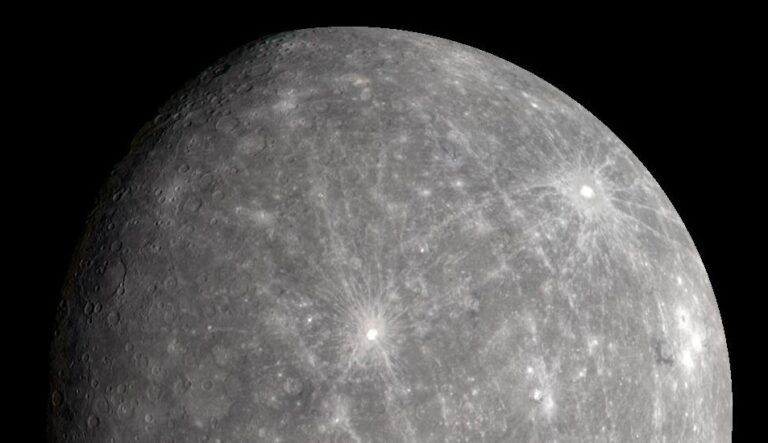
A correlation between roughness and mapped faults has an innocent reading: rough ground might simply have crumpled less. The young craters are how the team gets past that. Ejecta thrown out by a large impact lands on terrain that already carries whatever faults it has, and the deposits can cover older tectonic structures and make them harder to see [6]. A shortfall of mapped structures under fresh debris therefore points to burial. Around Rachmaninoff, some structures also become less visible closer to the crater, which the authors attribute to partial burial by impact material [7].
Accounting for the relationship between roughness and visible structures moves the estimated radial contraction from 8.3 kilometres to 11.6 [8]. The difference is 3.3 kilometres, an increase of about 40 percent on the earlier figure [9]. The same phys.org account also puts the revision at about 10 to 30 percent more than previous estimates [2]. The two numbers do not reconcile. The kilometre pair is the one the account ties directly to the roughness correction [8].
"Mercury's surface preserves a record of how the planet has cooled and contracted, but we found that this record is incomplete," said Gaku Nishiyama, the study's lead author [11]. On the method, he said the group compared a global map of surface roughness against maps of shortening structures and contraction: "Once we account for the effect of rough terrain, Mercury appears to have shrunk considerably more than what the visible tectonic record alone suggested" [12].
The revision changes the count of mapped structures. It does not change the modelled interior. Mapping shortening structures is how scientists estimate the decrease in Mercury's radius [17], and the correction says that census has been running short. The account does not include a revised cooling history for the planet's interior; it reports a larger radius loss and says the findings give new insight into Mercury's geological evolution [18].
Nothing in the argument is specific to Mercury, and the paper's title makes that general: underestimation of planetary contraction due to obscuration by surface roughness [19]. The researchers say the same effect could matter on other rocky worlds, particularly the Moon, whose surface is rougher than Mercury's [16].
What to watch
- Whether BELA's finer-scale roughness maps from BepiColombo push the correction up again once younger deposits can be resolved.
- Whether the published Geophysical Research Letters paper reconciles the 10 to 30 percent range with the 8.3 to 11.6 kilometre pair.
- Whether anyone applies the same roughness correction to lunar shortening structures, where the surface is rougher still.