Product1 distinct publisher3 min readPublished
The only peer-reviewed numbers behind the London operation come from an offline study of 640 still frames, where assistance lifted annotation accuracy by 6.8 points and helped medical students roughly twice as much.
The Product Desk · Product desk

Compiled by The Product DeskSomething wrong?How this is made
The person this was built for is holding an endoscope up a patient's nose and watching a screen. The pituitary gland sits behind the nasal cavity and directly beneath the optic nerves, and the endoscope threaded through the nose is both the route to the tumour and the camera the model was reading [4]. What the model added to that screen was recognition, not motion: UCLH says it picked out critical anatomy, instruments and tissue interactions as they appeared, and that the surgical team kept full control of the procedure throughout [3].
That is a narrower job than the surgical-AI category usually advertises, and a far easier one to check. Every frame the model labelled was a frame the surgeon also saw, which means disagreement is visible at the time and reviewable afterwards.
The published evidence sits one step back from the theatre. A 2024 paper in npj Digital Medicine tested the same approach offline on still images and found that assistance raised the accuracy of anatomical annotation from 70.7% to 77.5% on a standard overlap measure [14], a gain of 6.8 percentage points [1]. Medical students improved more than experienced participants, from 66.2% to 78.9% [15], which is 12.7 points [2], or roughly twice the overall gain [6]. The model was trained on 640 images drawn from 64 surgical videos [16], about ten frames per video [4]. The authors called it an offline evaluation rather than a test in an operating theatre [16].
One number in that study cuts against the assistance story. The model working alone scored 79.1% on a held-out test set [15], 1.6 points above the assisted humans [3]. On the evidence available, the loss is in the handoff rather than the model.
What has not been released is the part a second trust would need. The system used in the operation has not been named, and no accuracy or outcome figures from the procedure have been published [17]. The trial's name, size and design were not given, and no regulatory status was stated [18], which TNW contrasts with cleared clinical devices such as the FDA-authorised robotic blood-draw system [19]. Funding came from the NIHR as part of a clinical trial [13].
The forcing question for anyone assessing a tool in this class has two axes. First, does the output change what the operator sees, or what the machine does? Second, was the evidence gathered in the setting of use, or offline on recorded data? UCLH's case is a see-only tool with a live anecdote and offline numbers, and the see-only half is what makes the thin disclosure tolerable. The cell to be nervous about is the other diagonal: a system that acts, backed by evaluations run on still images.
The line UCLH is leading with is exposure. It says the system gathered in roughly 10 months the surgical experience a trainee would take about a decade to accumulate [12], which is around twelvefold if a decade is 120 months [5], and Dr Sophia Bano, the technical lead at UCL, framed it as learning from hundreds of surgical videos [10]. That measures footage seen, not judgement earned. The 12.7-point student gain [2] is the more useful figure, because it says where the tool pays: the trainee looking at unfamiliar anatomy, not the consultant who has done a thousand of these. Anyone writing the evaluation form should record which decision the overlay changes, and whose signature is on the operation note when the overlay is wrong.
Ranked by verification strength, evidence, and original report placement.
The system analysed live camera footage during the procedure, helping the team identify nerves and blood vessels near the tumour.
According to UCLH, the system helped the team recognise critical anatomy, surgical instruments and tissue interactions in real time, and the surgical team remained in full control of the procedure throughout.
The pituitary gland sits behind the nasal cavity and directly beneath the optic nerves, and in this type of surgery it is reached by an endoscope passed through the nose; that endoscope provided the camera feed the system read.
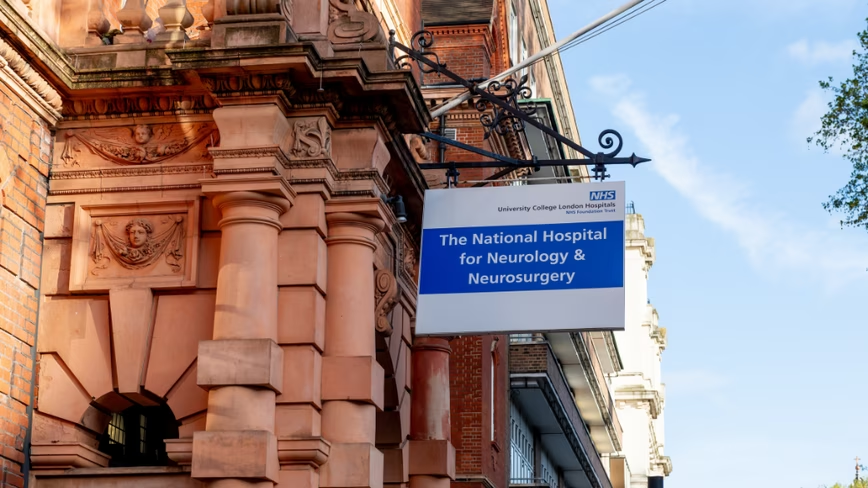
Surgeons at the National Hospital for Neurology and Neurosurgery in London removed a brain tumour in what University College London Hospitals says is the world's first successful AI-assisted operation of its kind.
The patient was Rhys Hibbert, a 48-year-old customer service manager from Bedfordshire, with an 11mm tumour on his pituitary gland diagnosed in 2024 and initially managed without surgery.
Hibbert's symptoms worsened after diagnosis and included severe hormone imbalance and problems with his vision; health officials said that without the operation he faced going blind.
Follow any of these and your For You feed starts watching them — no settings page required.
Evidence-backed comparisons of source perspectives and observed adoption signals. Read the methodology
Which Builder, Operator, and Investor concerns the observed source mix emphasized—not a truth score.
Evidence, demonstrated adoption, hype gap, incentives, and confidence are assessed independently, each on its own current evidence. How these are measured.
One peer-reviewed offline study behind an unmeasured in-theatre first
There is real, quantified, peer-reviewed evidence, but it is offline and small: 640 still frames from 64 videos, a 6.8-point assisted-annotation gain, and a 79.1% unassisted model score. Nothing quantifies the actual operation: the system is unnamed, no procedure accuracy or outcome figures were released, and the trial's name, size and design are undisclosed. The clinical result is a single named patient's recovery, reported by one publisher relaying institutional statements.
One patient, one hospital, inside a trial
Adoption is a single supervised use in one NHS neurosurgical theatre under NIHR trial funding, disclosed months after the fact. There is no second site, no repeat-use count, no named product, no regulatory authorisation and no commercial availability reported, so measured diffusion is minimal even though the deployment is genuine.
World-first superlative and decade-compression analogy outrun the numbers
The framing is stronger than the measurable substance: an unverified world-first priority claim, a 'ten months versus a decade of trainee experience' analogy with no stated methodology, and NIHR's 'pioneering surgery' language sit on top of a single supervised procedure with no released metrics and one small offline still-image study. The gap is moderate rather than severe because the underlying operation and peer-reviewed study are real and the reporting itself itemises the missing evidence.
Institutional announcement with promotional timing and funder endorsement
The disclosure is a coordinated institutional communication: UCLH/UCL supply the world-first framing and the experience-compression comparison, the named technical lead supplies the training-breadth quote, the public funder's innovation director supplies an endorsement quote, and a patient testimonial supplies the emotional proof, all released on a chosen date months after the operation. Those actors benefit from priority and profile; the publisher partly offsets this by cataloguing what was withheld.
Detailed and self-limiting, but single-publisher and single-sourced
Confidence is mid-range: the one report is specific, names people and institutions, cites a peer-reviewed paper with figures, and explicitly flags its own evidence gaps, which supports the descriptive claims. But there is no second publisher, no independent confirmation of the world-first claim, no primary trial documentation, and no intraoperative performance data, so conclusions about capability and significance remain provisional.
product
Enhanced Games' $62M quarter puts a price on buying legitimacy1 distinct publisher
science
97% of the record menthol-ban comments were form letters, Rutgers audit of all 246,808 finds1 distinct publisher
leadership
Detection got faster than tracing, and the produce buyer now owns the recall1 distinct publisher
invest
Cigna's $200M AI savings projection runs to about 2.4 basis points of a year's revenue1 distinct publisher
Distinct publishers with included, body-backed reporting in this cluster.
1 article · August 27, 2026