Loading today’s stories
Science1 distinct publisher3 min readUpdated
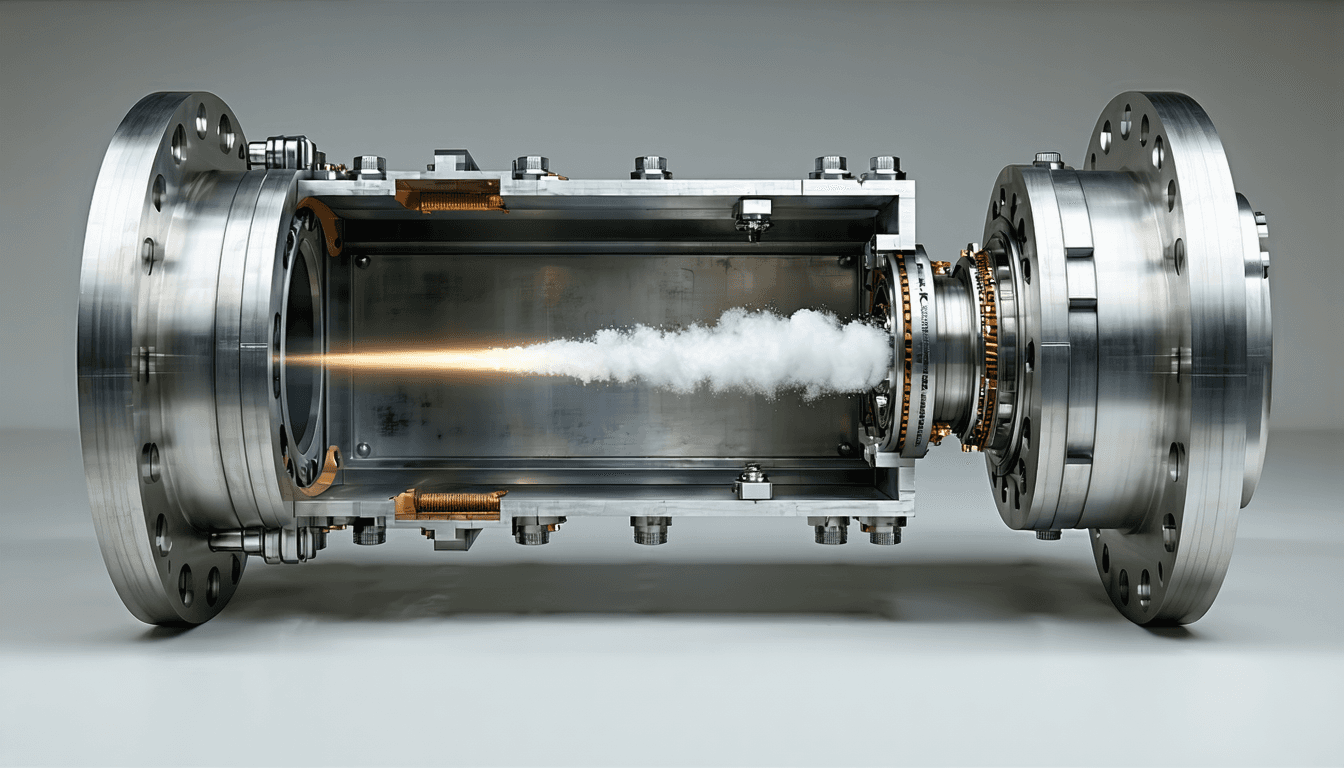
A helium cell as a lens: shaping free-electron laser pulses without glass
An MPIK-led team turned an atomic gas into a time-dependent refractive element at FLASH, shaping an XUV pulse in space and in spectrum where solid optics simply absorb the light.
The Scientist · Science desk
What happened
- An international collaboration led by researchers from the Max-Planck-Institut fuer Kernphysik in Heidelberg (MPIK) demonstrated the shaping of an XUV laser pulse both spatially and in its spectral composition, using an atomic gas as a time-dependent lens.
- The study is published in the journal Science Advances.
- High-energy XUV photons are strongly absorbed by conventional optical elements such as glass lenses, mirrors or prisms, rather than being reflected or refracted, whereas such elements easily bend, focus or spectrally split visible light.
- With the development of large-scale free-electron laser facilities, scientists can generate ultrashort, high-brilliance XUV pulses, but versatile tools to shape and manipulate these beams remain scarce.
- When an intense XUV pulse passes through an optically dense medium such as an atomic gas, it quickly excites and de-excites the atoms' energy levels in a dynamic quantum process known as Rabi oscillation, rapidly transferring electrons between those quantum levels.
Compiled by The ScientistSomething wrong?How this is made
Why it matters
An international collaboration led by the Max-Planck-Institut fuer Kernphysik in Heidelberg has used an atomic gas as a time-dependent lens, shaping an extreme ultraviolet pulse both spatially and in its spectral composition [1]. That matters because the optics that route visible light are not available at these photon energies: XUV photons are strongly absorbed by standard glass lenses, mirrors and prisms rather than reflected or refracted [3], and while free-electron lasers can now deliver ultrashort, high-brilliance XUV pulses, tools to shape those beams remain scarce [4]. The work is published in Science Advances [2].
The mechanism is not a passive material property. When an intense XUV pulse crosses an optically dense atomic gas, it rapidly drives electrons up and down between atomic energy levels, a Rabi oscillation [5]. A beam is brightest at its centre and weaker at the edges, so the strength of that interaction varies across the beam profile, producing a self-induced change in the medium's refractive index that is most pronounced near an atomic resonance [6]. According to Yu He, the study's first author, the interplay between this intensity-dependent interaction and macroscopic propagation effects along the medium "turns the atoms effectively into a refractive element, such as a lens or prism" [7]. He adds that the gas deflects the resonant light outward more effectively than other frequencies, and so reshapes the spectrum [8].
The measurement was made by focusing high-intensity XUV pulses from FLASH at DESY in Hamburg into a gas cell of helium [9]. Peak photon energy was 21.2 eV, matching the fundamental 1s-2p transition in helium [10].
Two constraints follow directly from how it works. First, the element is active rather than passive: because the index change is created by the pulse's own intensity driving Rabi oscillations, a weak beam gets no lens [1]. Second, the operating point is set by the gas. The effect peaks near resonance, and the demonstration used a photon energy chosen to sit on helium's transition, so the working energy of any such element is tied to the chosen species [3].
It is also worth being precise about the claim being made. MPIK frames the gas element as a route toward better XUV and X-ray pulse control, with chemical reaction steering, quantum computing and spectroscopy as targets [13], and the argument for caring is that many atomic transitions sit in this energy range [12]. But the experiment reported here is XUV at 21.2 eV in helium; X-ray control is a stated prospect, not a demonstrated result [2].
What to watch: throughput and conversion efficiency, which the supplied account does not quantify [15]; which gas-resonance pairs cover useful photon energies given that each species fixes its own operating point [3]; and whether the approach survives translation to shorter wavelengths, where the same absorption problem that motivates it is worse [3]. Beamline designers should also want to know the intensity threshold below which the lens stops existing [1].
Loading topic controls
Loading related stories