Product1 publisher3 min readPublished
ANYbotics gives its ANYmal inspection robots digital credentials for locked plant doors
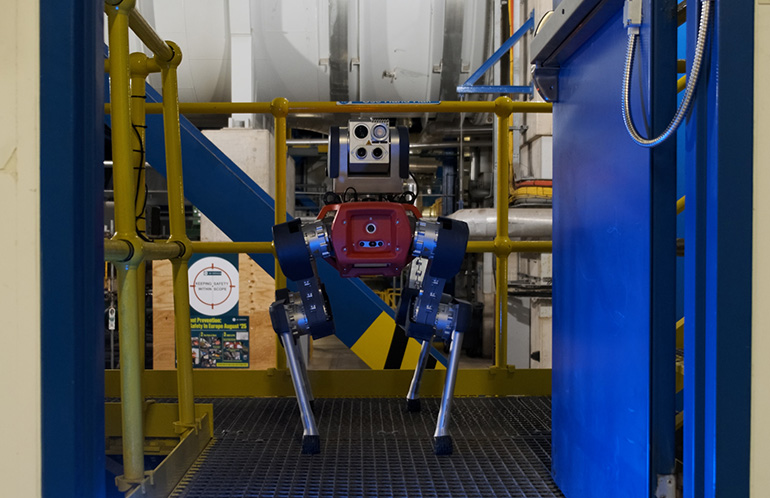
ANYbotics' ANYmal robots can now authenticate at locked plant doors using LEGIC credentials and dormakaba's access system, in a three-company pilot. Each door on an inspection route becomes a retrofit for facilities or a permission for security to write.
The Product Desk · Product desk
What happened
- ANYbotics has partnered with dormakaba and LEGIC Identsystems so its four-legged ANYmal robots can open doors and authenticate themselves at restricted entrances.
- At unlocked doors, a radar sensor detects the approaching robot and a retrofitted dormakaba ED 100 or ED 250 swing-door operator opens the door, then closes it behind ANYmal.
- At locked doors, a LEGIC payload gives ANYmal a digital identity, and dormakaba's exos system checks its permissions before unlocking.
- ANYbotics says the setup does not disable or bypass anti-tailgating measures, so mantraps, interlocks, cameras and guards keep working as normal.
- When the robot cannot resolve a situation itself, a remote operator can step in through tele-assist, change the mission or send it back to its charging dock.
Compiled by The Product DeskSomething wrong?How this is made
Why it matters
- decision Security teams now have to write a permission set for a machine, covering where and when it may enter and which inspection tasks it may carry out.
- cost Coverage is bought one door at a time, since every unlocked door on a route needs its own retrofitted operator even when the existing door stays in place.
- constraint Doors with mantraps or interlocks keep their normal controls for the robot too, so they stay the least certain part of any site's coverage plan.
- capability Robot entries can go through the same access controls and audit procedures as staff entries, so one set of records covers both people and machines.
A four-legged robot that can find its way through a complex plant still stops at a closed door until someone comes to open it [13]. On large energy, mining, chemical and metals sites, one inspection route can cross several buildings and zones [13]. On the route, coverage ends at the first door that needs a person, or somebody props that door open [13][2]. ANYbotics built its setup to avoid both without major structural changes [2].
"The joint pilot illustrates how access solutions are evolving beyond traditional applications for human users. By securely authenticating and authorizing autonomous machines, access management can become an important enabler for the next generation of industrial automation," said David Fuller, chief innovation officer at dormakaba [7]. The project is a joint pilot of one robot line, retrofitted door operators and a credential payload tied into an existing access-management system [7][12]. The report does not say how many sites are in the pilot or what a retrofit costs.
Split by owner, the rollout goes to two teams. Facilities gets the unlocked doors. The operators mount on doors already in place, so nobody has to order purpose-built robot doors, and ANYbotics says they suit indoor and outdoor installations and fire-rated doors [5][6].
Security gets the locked doors. The robot joins the site's existing access system as one more identity, with no separate system for machines [14]. Someone on the security team has to decide where and when the robot may enter and which inspection tasks it may perform [10]. I'd expect that permission work to take longer than fitting door hardware, because it moves a robotics project into the security team's change queue. ANYbotics' stated goal is for robot entries to follow the same access controls and audit procedures as a worker's [3].
Keeping anti-tailgating controls on answers the first objection a security lead will raise: a person following the robot through a restricted door [11]. It also means doors with mantraps or interlocks behave for the robot the way they behave today [11].
The buyer is an operator of a large, multi-building site who already controls doors electronically and wants the robot inside that system [13][14].
The practical sort before a pilot is to walk one route and place every door on two lines: restricted or not, and fitted with a mantrap or interlock or not. An unrestricted door with neither needs a door operator and nothing more [4][5]. A restricted door without a mantrap or interlock needs a permission written by security on top of any door operator [9][10]. A door with a mantrap or interlock keeps its controls, so count it as covered only after the robot has cleared it on site [11]. Until then, that group runs on tele-assist [8].
What to watch
- Pilot results from ANYbotics, dormakaba and LEGIC: how many sites and doors are involved, and how often a remote operator had to step in.
- A published price for the ED 100 or ED 250 retrofit and for the LEGIC payload per robot.
- Whether the locked-door path works with access-management systems other than dormakaba's exos.