Science1 publisher3 min readPublished
Indigenous collaborators are recording a Bornean hillside before Indonesia's new capital reaches it
Jakarta may be the fastest-sinking city in the world. The Bornean forest chosen to host its replacement is being recorded around the clock, so that someone will know what called there before construction arrives.
The Scientist · Science desk
What happened
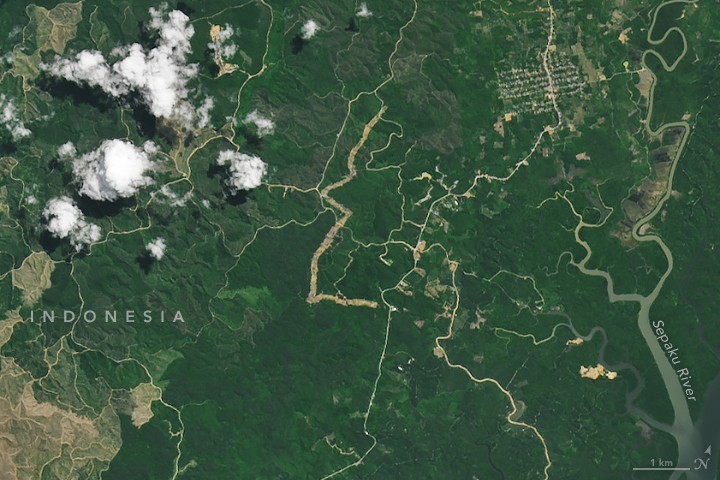
- Then president Joko Widodo announced the capital's relocation in 2019. The government picked a 256,000-hectare site in the hills of Eastern Borneo for a city named Nusantara, which means archipelago.
- Nusantara is designed as a forest city, all-electric and renewable-powered with lots of green open space, and it sits well inland from the coast that is drowning the old capital.
- The move answers subsidence. Most of Jakarta's drinking water is pumped groundwater under a Dutch-era segregated pipe system, and some neighborhoods now sink one foot per year.
Compiled by The ScientistSomething wrong?How this is made
Why it matters
- capability Weatherproof units cheap enough to leave on a tree and simple enough for residents to service are what make a pre-construction baseline collectable. A baseline only exists if someone gathers it first.
- constraint One microphone at one point bounds what the archive can claim: it can date the calls near that tree, and it cannot stand in for a species survey of 2,560 square kilometres.
- contradiction Someone has to publish how much primary forest lies inside the footprint before the recordings can measure what the city destroys. The episode describes the site as both a eucalyptus plantation and part of one of the world's most biodiverse rainforest areas.
- exposure On the episode's account the sinking is driven by wells under Jakarta, so the households and businesses that stay behind keep the cause of it, whatever the ministries do in Borneo.
The chosen ground is a plantation. Leah Varjacques, reporting for Scientific American's Science Quickly, describes the 256,000 hectares in the hills of Eastern Borneo as an industrial eucalyptus forest, sited far from the coast [5]. Host Rachel Feltman's introduction to the same episode describes construction beginning to transform one of the world's most biodiverse rainforest areas [3]. Both descriptions can hold at once if the footprint sits in a mosaic of plantation and older forest. The transcript gives no figure for primary forest inside or beside the site [24].
256,000 hectares is 2,560 square kilometres [20]. Varjacques puts that at about three times the size of New York City [4].
The instrument is modest. A white metal box marked Swift is strapped to a tree on Mount Tembinus, a caged microphone below it, a terrestrial passive acoustic recording unit of the cheap, sturdy, weatherproof kind used in research and conservation [8]. It has recorded continuously for 18 months [9], which is roughly 13,000 hours of audio from one point on one hillside [21]. A passive recorder captures what makes sound within its range, so it answers one question well: what called here, and when. Trends across 2,560 square kilometres are a different question, and they need more boxes.
Abidin, the guide in his late 40s who leads Varjacques up the slope, cuts a path to the box and swaps its batteries and SD card [10]. "This is the land of my ancestors from long ago," he said of the hillside [12]. Of the recorder, he said: "So with these wildlife recording devices, we are preserving the knowledge of our ancestors. Then from us, if possible, we'll pass it down to our children and, and grandchildren." [11]
The two archival clips the episode uses on Jakarta's future measure different areas. DW says 90 percent of North Jakarta could be permanently flooded by 2050 [16]. PBS News Hour says about 40 percent of Jakarta is below sea level and that nearly half the city could be inundated and uninhabitable by 2050 [17]. The first covers one district, the second the whole city. Sea-level rise made an existing problem worse, and Indonesia has been raising sea walls for years to buy time [15].
Widodo announced the relocation in 2019 [18]. "Indonesia as a great nation must dare to take steps," he said. "We must be brave to have a big agenda, and this is for the advancement of our country, for the progress of the nation." [19]
The comparison this archive can support is a before-and-after at the same tree on the same microphone. Eighteen months in, the earlier half of it exists [9].
What to watch
- Publication of the Mount Tembinus recordings with a matched post-construction period from the same unit, which is what would turn 18 months of audio into a measurement of change.
- A government figure splitting the 256,000 hectares between primary forest and eucalyptus plantation.
- Whether groundwater extraction in Jakarta falls as government functions move; the episode identifies that extraction as what compacts the sediment.