Product1 distinct publisher3 min readPublished
N+ hung a licensed Volkswagen badge on a $4,000 e-bike and called the result the world's safest, but the battery packs never made it to IFA, so the glasses, camera and handlebar screen the claim rests on were described rather than ridden.
The Product Desk · Product desk

product
Eddy Cue's services division reclaims the App Store after 11 years under marketing1 distinct publisher
invest
Your Landed Cost Is Being Litigated By Companies With $306,000 Problems1 distinct publisher
invest
Markets charged Rivian 6% for an interim CFO carrying a VP's title1 distinct publisher
product
The cheapest part in the car is now the one that stops the line1 distinct publisher
Compiled by The Product DeskSomething wrong?How this is made
Start with the LED strip in the top tube. A rep told Gizmodo it shows blind spot alerts, doubling the handlebar screen, and the reviewer's aside about it is the most useful line in the write-up: the strip is out of sight while you are riding [9]. That is a hazard indicator positioned where it reads best on a stationary bicycle in a product render.
Volkswagen's contribution is easier to see than to price. Gizmodo's tell for the license is the VW badge on the nose and the tail, lit white at the front and red at the back, sitting next to a separate headlight and brake light [15]. The motor is a 250W Yamaha mid-drive, the derailleur a mid-tier Shimano Cues 9-speed, the brakes Tektro [13][14]. The hands-on credits the safety hardware to those suppliers, not to Volkswagen engineering. The badge is wired into the lighting circuit, which is a fair summary of what the license buys: the bike is legible as a VW from thirty feet, and there is one more thing on it that glows.
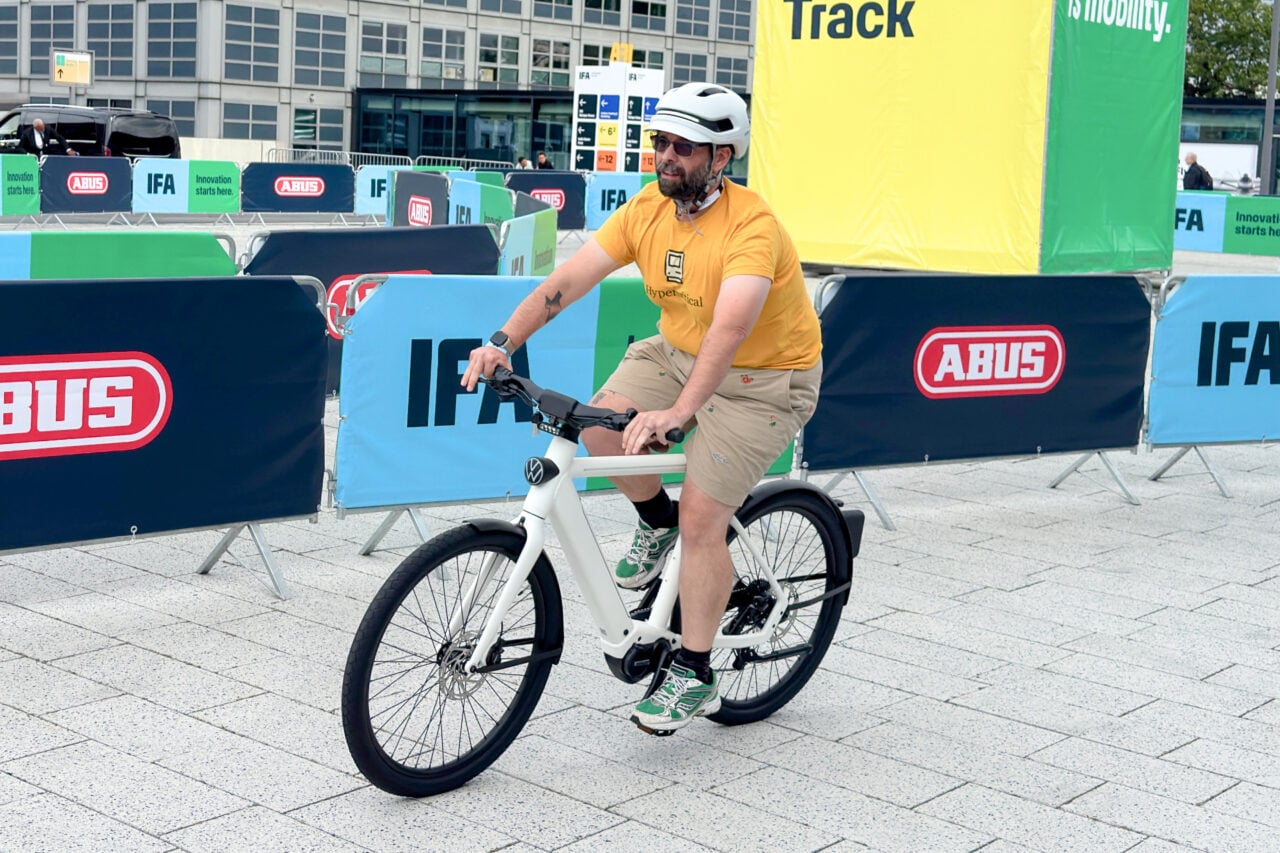
The bicycle itself did get tested. Without a battery in the downtube it was nimble and easy to accelerate, the thumb-lever shifting was smooth and the disc brakes were responsive [16]. The press email's safety claim, though, was never about the frame: of the four things it names, the helmet went on the reviewer's head [17], the glasses were a bench demo the company said was not ride-ready either way [5], and the rear camera and the Smart View screen were never switched on [8][19].
The pricing has the same problem in a different form. The add-on bundle that takes the Sport to its top figure includes a range extender battery alongside the helmet, the glasses and the security kit with its 85dB alarm and frame lock [11]. A range extender is about distance, not safety; the safety kit itself is priced only within that bundle, and N+ has not itemised it [21]. Someone deciding whether safety is worth the money cannot see the number they are deciding about.
If you are weighing this against the driver aids in a car, which is the comparison Gizmodo reaches for when it notes the bike costs far less than a new one [22], sort the features by what has to be charged and paired. The radar, the Smart View screen, the headlight and the brake light draw on the bike battery: one charge, no handshake. The helmet's rear light needs its own charge plus a Bluetooth connection to the bike before it will signal braking or turning [17]. The glasses need a charge, a pairing and a face they fit, and the reviewer's prescription pair would not sit comfortably underneath them [7].
The sort tells you where the durable safety is, and it is the stuff bolted to the frame. It also tells you what the marketing claim is made of. On a wet Tuesday, the rider who left the glasses on the kitchen counter is on a $4,000 bike with good lights [10]. Price each component as though it were sold on its own, and weight the ones that cannot be left at home.
Ranked by verification strength, evidence, and original report placement.
The reviewer did not get to test the "Smart View" handlebar screen, which is meant to show navigation and the rear camera view when radar detects a car approaching from behind, and which also displays blind spot alerts.
A rep told Gizmodo that an LED strip integrated into the top tube also shows blind spot alerts, and the reviewer noted it is out of sight while riding.
The e-bike uses a compact 250W mid-drive Yamaha motor with the battery integrated into the frame, and the N+ website says it should be good for about 100 miles on a charge.
The bike sits on 27.5-inch wheels with a middle-tier Shimano U4000 Cues 9-speed derailleur and Tektro brakes.
Gizmodo wrote that the price is a lot but far less than the cost of a new car, and that the bike has many of the same safety features as modern-day vehicles.
Electric bicycle maker N+ partnered with Volkswagen to produce the N+ Volkswagen eBike, and a press email to Gizmodo described it as "the world's safest e-bike".
Distinct publishers with included, body-backed reporting in this cluster.
1 article · September 5, 2026
Follow any of these and your For You feed starts watching them — no settings page required.
Evidence-backed comparisons of source perspectives and observed adoption signals. Read the methodology
Which Builder, Operator, and Investor concerns the observed source mix emphasized—not a truth score.
Evidence, demonstrated adoption, hype gap, incentives, and confidence are assessed independently, each on its own current evidence. How these are measured.
One hands-on, batteries absent
Everything traces to a single reporter's afternoon in Berlin, and his candour is what holds the piece up: he names the components he saw, says the battery packs never arrived, and marks the glasses as a demo and the handlebar screen as a render. The ride impressions are therefore solid and narrow. The safety system at the centre of the product has no observed behaviour attached to it at all, and the 100-mile range is lifted off N+'s own website.
Priced and dated, not yet delivered
Nothing is under a customer yet. Shipping is set for the fourth quarter, the price sheet is public, and the only unit anyone outside N+ has straddled is the batteryless demo bike parked beside IFA's test track. The Crossover was not even at the show.
Superlative ahead of the demo
"World's safest e-bike" arrived in a press email and rests on four things. The helmet was worn. The glasses sat on a table, unready by the reps' own admission, and the radar, rear camera and Smart View screen were described from an N+ render. No standard, crash test or rival product is cited for the comparison the superlative implies. The gap sits with N+'s marketing rather than with Gizmodo, which flags each hole as it goes.
Vendor-staged, openly disclosed
N+ set the terms of this encounter: a press invitation, its own stand, its own demo hardware, a rep supplying every spec claim, and a licensed Volkswagen mark that rents a carmaker's safety associations for the price of a royalty. Gizmodo names the invitation and the missing battery, then closes on the new-car price comparison and a line about seriously considering one, which is the response a staged first ride is built to produce.
Firm on the frame, thin on the tech
A named reporter marking his own gaps is good grounds for trusting the frame, the brakes and the price sheet. Radar behaviour, range, helmet signalling and winter corrosion resistance are still N+ talking to a journalist, with nothing measured, and a second outlet may well report the shipping units very differently once batteries are in them.