Product1 publisher3 min readPublished
A morning in Claude chat spends the afternoon's coding prompts
Every paid Claude plan meters against a rolling five-hour window and a weekly cap that every product on the account draws from. XDA's writer left Claude Code for OpenCode and a prepaid balance to get out of it.
The Product Desk · Product desk
What happened
- Every paid Claude plan meters usage twice over, by a rolling five-hour window and a weekly cap across models, and that quota is shared with Claude chat and anything else running on the same account.
- The five-hour window resets from the account's first prompt instead of a fixed hour, and XDA's writer says they kept losing track of when the clock had actually started.
- At the cap a user either waits for the window to reset or opts in to usage credits and continues at standard API rates on top of the monthly subscription.
Compiled by The Product DeskSomething wrong?How this is made
Why it matters
- constraint Nobody can size a coding allowance per seat, because the person approving a Max upgrade is really pricing one pool that covers chat, Design and Cowork use on the same login.
- decision The choice between waiting out a reset and paying API rates on top of a monthly seat arrives mid-task, and it lands on whoever is typing, hours before anyone reviews the credit spend.
- exposure The cheapest exit from the window runs work through a model whose free testing terms allow the collected data to improve it. Client material then sits on a different footing than it does under a paid seat.
- capability A prepaid balance with auto-reload switched off is a hard ceiling on spend that a buyer can set themselves; a Claude seat with usage credits enabled has no equivalent stop.
The moment that costs a team lands mid-afternoon, when the agent stops and the reset time depends on when somebody first opened a chat tab that morning [2]. XDA's writer describes it plainly: a heavy morning in Claude chat shrinking the afternoon coding window without them noticing [3].
Teams plan seats as though the coding agent has its own budget. The XDA account describes the other pattern, chat in the morning and coding after lunch, all of it drawing on one rolling five-hour allowance and one weekly cap across models [1] [3]. Claude Code Pro is roughly 90 prompts inside that window [4], which works out to 18 prompts per hour of window time [1]. A ten-hour day fits at most two complete windows, about 180 prompts, and only if the day's first prompt opens the first clock [2].
At the wall there are two moves, per XDA: wait for the reset, or opt in to usage credits and keep working at standard API rates on top of the monthly seat [5]. Heavy Cowork or Claude Design users, the piece says, are out of luck or onto Max [6].
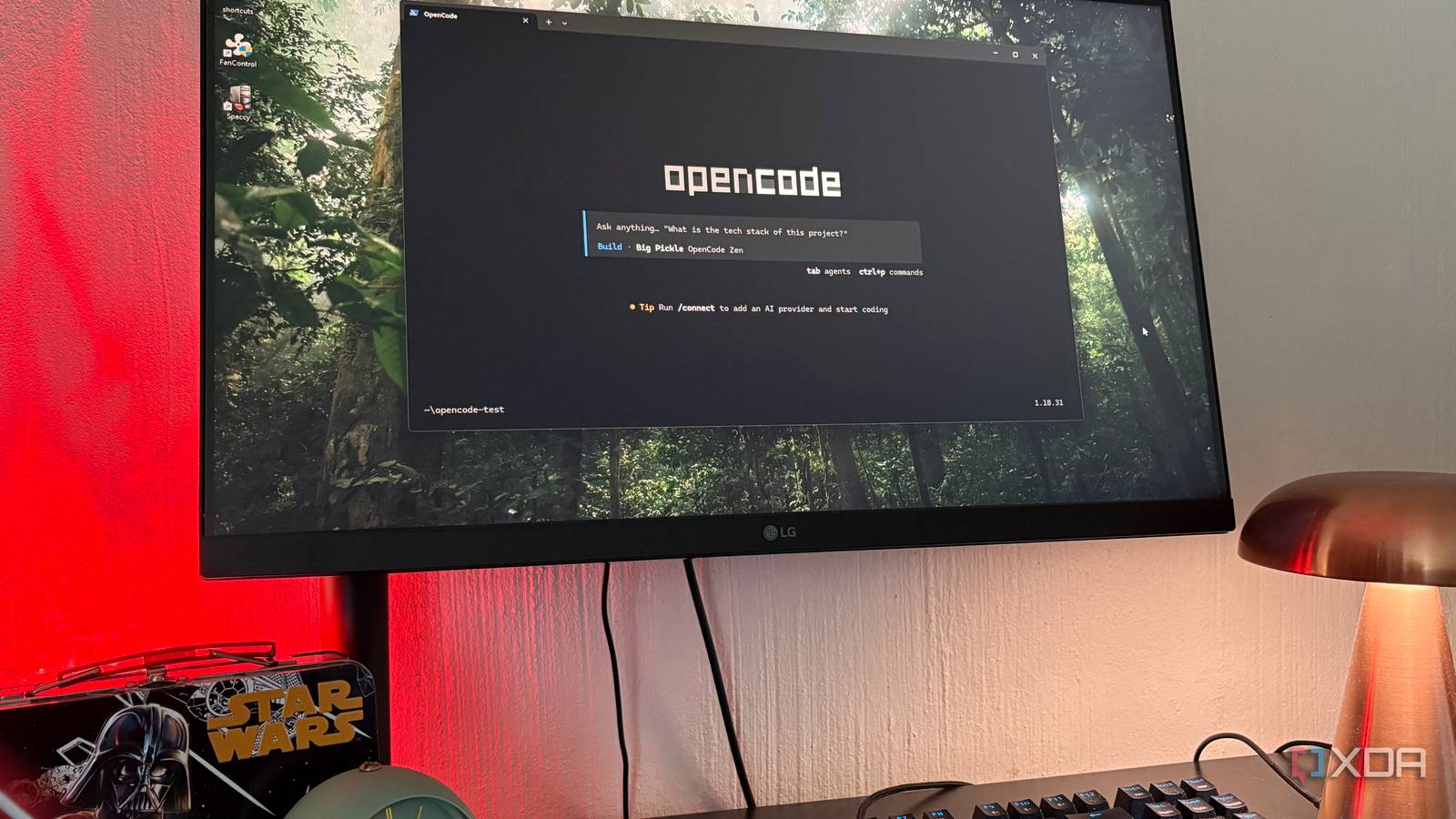
OpenCode is open-source and terminal-only, built by the small team that also runs the SST framework, and it works with dozens of providers [7] [8]. It is just a client, and whichever provider you connect through /connect sets the terms [10]. The writer connected OpenCode's own Zen provider because it was the recommendation [19], and Zen bills a prepaid balance rather than a subscription window, so prompts run until the balance empties [11]. On paid Zen models the billing is per token, at prices the writer puts anywhere from cents to hundreds of dollars [16]. That removes the five-hour timer and makes the monthly number variable.
The prepaid ceiling holds only with the top-up off: Zen auto-reloads $20 whenever the balance drops below $5, and the writer turned that off to get a hard cap [12].
OpenCode calls its Big Pickle entry a "stealth model", free during its testing period, and the data collected then may be used to improve the model, where paid Zen models treat zero retention as the norm [13] [14]. The writer also notes that Zen's other free entries, DeepSeek V4 Flash Free and MiMo-V2.5 Free, will not stay free forever [15].
The writer says they do not code apart from adjusting some HTML now and then, and had skipped terminal agents on that basis [17]. Then they found OpenCode simpler than Claude Code's GUI, because there are not a million-and-one things on the screen [18]. Setup was one line, npm install -g opencode-ai with Node.js already present, or a curl one-liner on Mac and Linux [9].
Per seat, the first question is which single Claude surface is allowed to spend the window during working hours. If the answer is more than one, the 90 prompts are funding chat as well as code, and Max is being bought as insurance against chat use [4] [6]. The second is whether the work can tolerate training reuse; if it cannot, the free models are out and the comparison is Zen's per-token spend against the Max upgrade [14] [16].
What to watch
- What Zen charges for Big Pickle once the free testing period ends, and whether the data-reuse terms end with it.
- Whether Anthropic ever separates the Claude Code allowance from chat, Cowork and Design usage on the same account.
- Whether Zen adds a hard spend ceiling that does not depend on a user switching off the $20 auto-reload.