Product1 publisher3 min readPublished
Huawei's 55% density gain over the Kirin 9030 Pro was already public in July. The new ChinaXiv paper adds the power and thermal case for folding logic vertically, and nobody outside the company has checked it.
The Product Desk · Product desk

Compiled by The Product DeskSomething wrong?How this is made
Heat is the chip spec phone owners can judge without a bench. A handset warms during a long capture, the frame rate sags, and the peak figures stop describing the device in your hand.
The density claim aimed at that problem is not new. Huawei's July paper already put the coming processor on track for a 55% transistor-density increase over the Kirin 9030 Pro [12], and the latest paper reports the same figure, a change of zero percentage points between the two [15]. What the new round of publishing adds is the power and thermal argument: measurements offered to show the coming Kirin runs cooler and draws less than its predecessor while carrying more transistors [1]. Kaiyuan Securities reads the result as a chip that "reduces power consumption while increasing transistor density, allowing it to flexibly switch between functional constraints and peak performance" [8].
For the person holding the phone, two things are missing from that. The power saving is quoted as "as much as" 66%, on workloads the account does not name, and no sustained-load result sits next to it [18]. That kind of figure reads as "runs cooler," but what a user actually feels is the average over the last twenty minutes, once the package has soaked and the scheduler starts trading frames for skin temperature.
The measurements are also Huawei's own [1], and the source's own framing is conditional: the approach matters beyond Huawei's next handsets if the claims hold up under independent testing [19]. Zheng Lei, chief economist at Samoyed Cloud Technology Group, calls the method "born out of necessity" while saying there is room for development, and expects the new Kirin to fix its overheating this way [13].
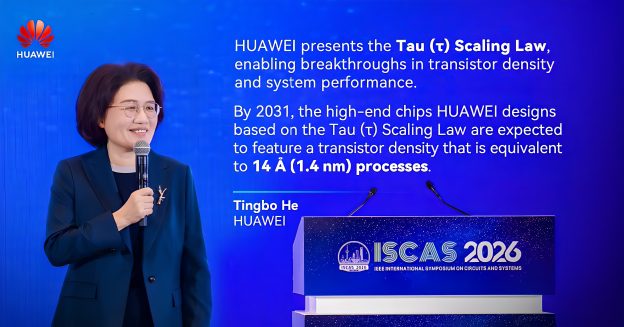
The necessity is lithography. Tau Scaling Law, unveiled in May, is Huawei's argument that transistor density can keep climbing without cutting-edge extreme ultraviolet lithography [9], with LogicFolding claimed to reach densities associated with 1.4-nanometre processes by 2031 [10]. Huawei has published three papers since May [11], a cadence aimed at an audience: the Chinese packaging, materials and equipment makers who would have to supply the three-dimensional integration this depends on, and who analysts expect the work to mobilise [16].
Each claim sorts onto two axes before it belongs in a plan: peak figure or sustained figure, and measured by the vendor or reproduced by someone else. The density and power numbers sit in the peak, vendor-measured box, which is the right place for a design argument and the wrong place for a purchase. The box that decides whether users notice anything is sustained and independent, and it takes three inputs: clock held after twenty minutes of the same workload, skin temperature at that point, and the workload's name. Until a retail Kirin lands on a bench, Huawei has published evidence about what its architecture permits, not about what the phone does at minute twenty.
Ranked by verification strength, evidence, and original report placement.
According to the paper, the new Kirin chip has 55% more transistors per square millimetre than the Kirin 9030 Pro.
Huawei also used thermal planning to spread heat across the chip; according to Kaiyuan Securities it reduced source power density through folding and positioned the most heat-intensive modules along paths where heat can escape more easily.
Kaiyuan Securities said: "The new chip reduces power consumption while increasing transistor density, allowing it to flexibly switch between functional constraints and peak performance."
A paper released in July said the upcoming smartphone processor was on track for a 55% transistor-density increase over the Kirin 9030 Pro.
Huawei has published new measurements for its Tau Scaling Law-based architecture, claiming a coming Kirin processor can increase transistor density while using less power and running cooler than its predecessor.
The research was led by He Tingbo, chairwoman of the Huawei Scientist Committee and president of the company's semiconductor business department.
Follow any of these and your For You feed starts watching them — no settings page required.
Evidence-backed comparisons of source perspectives and observed adoption signals. Read the methodology
Which Builder, Operator, and Investor concerns the observed source mix emphasized—not a truth score.
Evidence, demonstrated adoption, hype gap, incentives, and confidence are assessed independently, each on its own current evidence. How these are measured.
One outlet, one self-published preprint
Every number in this story comes from a ChinaXiv paper led by the president of Huawei's semiconductor business, relayed by Interesting Engineering without independent verification. ChinaXiv posts work before peer review, the 66% power saving names no workload, and the brokerage note and economist quote that give the paper its second and third voices both arrive inside the same article.
Nothing shipped to measure
The Kirin in question is described as coming, with no launch date, foundry or volume anywhere in the reporting. The only datable event is the publication of the paper itself, which measures a design rather than silicon in anyone's hands, so there is no uptake to score.
July's figure, September's headline
The density gain leading this coverage is a repeat: Huawei's July paper gave the same 55% over the Kirin 9030 Pro, so the new content is the power and thermal reasoning. And the heat objection is answered with a modelled argument plus a 66% best case on unnamed workloads, not with a measurement of a chip held under load. The gap is in the framing rather than in Huawei's own hedging, which the paper's conditional language partly preserves.
Measured and marketed by the same side
Huawei needs a density story that survives without EUV tools, and the paper making that case was led by the executive who runs its semiconductor business. The supporting commentary comes from a brokerage covering the sector and from the chief economist of a Chinese fintech group, neither of them disinterested in a Chinese workaround succeeding. Every party quoted stands to benefit if the numbers turn out generous.
Firm read on a thin record
What the record consists of is unambiguous, which makes the assessment steady even where the physics is unverified: a company preprint, one outlet, two friendly interpreters, one recycled figure. A second newsroom working from the paper's methodology, or any third-party density or power measurement, would move this materially in either direction.
product
Xiaomi qualifies CXMT's LPDDR6 for its September foldable1 publisher
product
Goldman's 2035 chip model leaves China short 209,000 advanced wafers a month1 publisher
build
China's accelerator swap makes Cambricon supply, not export policy, your ship-date risk1 publisher
security
Washington names industrial-scale distillation, then hands the detection bill to abuse teams1 publisher
Publishers with included, body-backed reporting in this cluster.
1 article · September 7, 2026