Product1 distinct publisher3 min readPublished
Zeke Hausfather logged eight weeks of Claude Code use and priced the electricity behind it, which hands operators a user-side number for agent energy and a reason to stop dividing by chat prompts.
The Product Desk · Product desk

Compiled by The Product DeskSomething wrong?How this is made
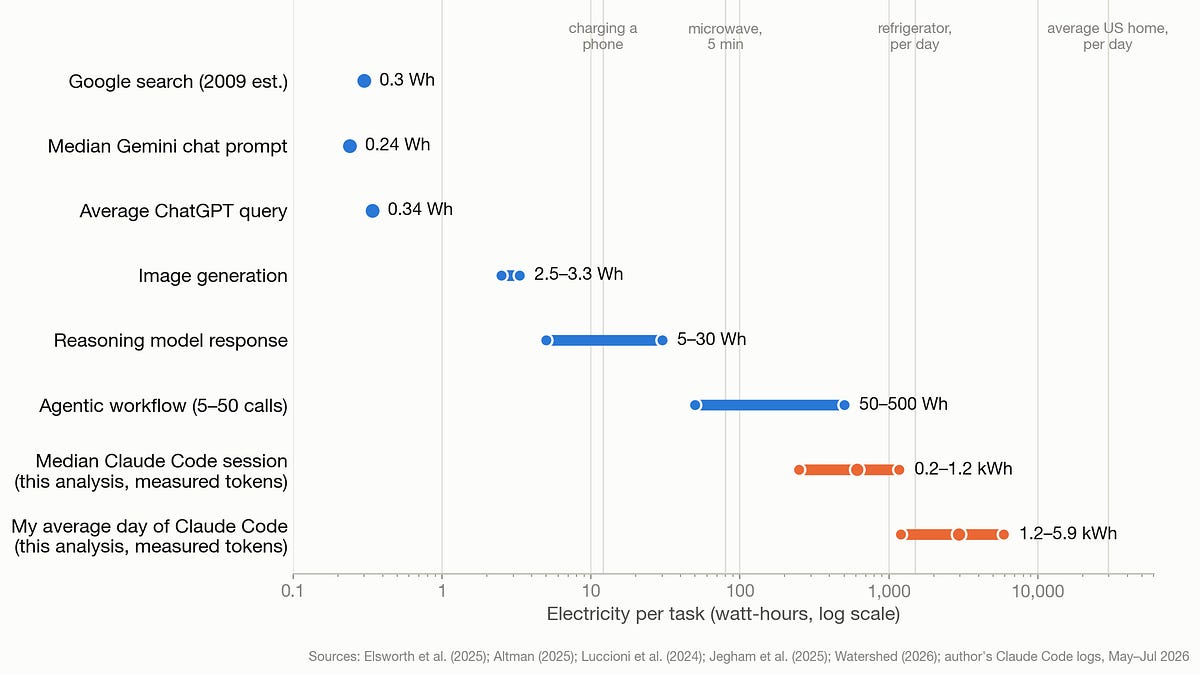
Somebody at your company will eventually be asked for kilowatt-hours per user per month, and the figures available to answer with were measured on products where one message gets one answer. Google's 0.24 watt-hours is per prompt [2]. So is the 0.34 watt-hours Sam Altman has given for a ChatGPT query [3]. In Claude Code one keystroke can hand the work to a fleet, which is what Hausfather describes when he talks about instructing an agent to spin up 20 subagents [5]. The unit of measurement is still the message, even though the job behind the message is now a queue.
Fast Company prints Hausfather's median prompt at around 150 kilowatt-hours and at 600 times a chatbot query in the same sentence [4], and those two readings sit a factor of a thousand apart. The multiple resolves it: 0.24 watt-hours times 600 is 144 watt-hours, so the median lands near 150 watt-hours [1]. His own dryer comparison resolves it again, because 1,138 prompts at 150 watt-hours is 170.7 kilowatt-hours across the eight weeks [2], while the same log at 150 kilowatt-hours each would come to 170,700 [3]. Take 150 watt-hours as the working number and an agentic prompt runs roughly 440 times Altman's chat query [4].
What makes the estimate usable is also what caps it. Hausfather built it from token counts, on the reasoning that tokens track price and price tracks energy because energy is a large share of what it costs to run a model, and he says the correlation is "certainly not perfect" [6]. No customer can do better, because vendors have published almost nothing [7]. So the assumption has to travel with the number wherever it gets pasted.
Proportion matters here too. The log works out to about 20 prompts a day from one heavy user [5], and Hausfather is not arguing for guilt; his position is that using energy is not the problem and how it is generated is [8]. That second part is the bit an operator does not control. Meta is paying to build seven natural gas plants to feed a Louisiana data center [9], which is the emissions decision sitting underneath everybody's per-prompt arithmetic.
Two tests, then, before quoting anyone's energy figure in a report you have to defend. The first is fan-out: if one user action dispatches subagents, the denominator has to be a task rather than a message, and a chat-era per-prompt number understates the work by orders of magnitude. The second is telemetry: with a token total for the period you can scale from tokens and carry the price-to-energy assumption alongside the result, and without one you have a seat count, which is worth reporting as a seat count rather than multiplying seats by 0.24 watt-hours.
Ranked by verification strength, evidence, and original report placement.
Climate scientist Zeke Hausfather tracked the 1,138 prompts he typed into Claude Code over eight weeks this summer and estimated how much electricity they consumed at data centers.
Hausfather's own heavy AI use over the eight weeks amounted to a little more than running an electric dryer for a year.
Google said last year that a typical text prompt on Gemini used 0.24 watt-hours, less than watching TV for nine seconds; it is one of the few public estimates of AI model energy use.
OpenAI CEO Sam Altman has said a ChatGPT query uses around 0.34 watt-hours.
Hausfather says agentic AI is increasingly dominant, "where you give a set of instructions to an agent to go spin up 20 different subagents, and do some massive process that is taking orders of magnitude more energy use," and that a year ago most AI use was still simple chatbot conversations.
The estimate is rough and based in part on token usage; Hausfather says "we can roughly assume that there's a correlation between tokens and how they're priced and the energy use of the system, because energy is a big part of the cost of running" the models, "but it's certainly not perfect."
Distinct publishers with included, body-backed reporting in this cluster.
1 article · September 3, 2026
Follow any of these and your For You feed starts watching them — no settings page required.
product
Meta's Mac app is a data connector wearing a chatbot's clothes6 distinct publishers
invest
ChatGPT ads reach 40% of this year's revenue target in their first 200 days9 distinct publishers
product
Washington's secret AI test is coming for open weights, and release dates go with it2 distinct publishers
invest
Scalable Capital puts ChatGPT, Claude and Grok inside the European order ticket2 distinct publishers
Evidence-backed comparisons of source perspectives and observed adoption signals. Read the methodology
Which Builder, Operator, and Investor concerns the observed source mix emphasized—not a truth score.
Evidence, demonstrated adoption, hype gap, incentives, and confidence are assessed independently, each on its own current evidence. How these are measured.
One log, one outlet
Every quantity in this story originates with the person who is also its subject, relayed by Fast Company and checked by no one else. Hausfather is candid that he inferred energy from token pricing rather than metering anything, and the headline per-prompt figure is printed in a unit its own surrounding sentences contradict. That combination supports a directional finding — agent runs are far heavier than chat turns — and not much beyond it.
Sample size: one
As a usage record this is n=1 — a climate scientist running about twenty prompts a day. The broader assertion that agentic patterns are now dominant is Hausfather's impression, offered without a count of users, runs, or tokens anywhere in the market. The one piece of hard build-out evidence sits on the supply side: Meta's seven gas plants in Louisiana, which tells you demand is being planned for, not how widely agents are actually being run.
Multiple outruns the arithmetic
600x is a number built to travel, and the reporting undercuts it twice within a few paragraphs: the unit as printed is a thousandfold too large, and the eight-week total is then described as roughly one clothes dryer running for a year. Add an unattributed 12%-of-U.S.-electricity projection and the framing is running ahead of what the log can carry. To Hausfather's credit, he supplies the deflating comparison himself; the overstatement is in the presentation, not the intent.
Vendor-set baselines
Two of the three energy figures in this story were published by the companies selling the models, and the premise of the reporting is that nobody else releases data — which leaves vendor-flattering per-query numbers as the default denominator for everyone else's math. Hausfather has a position too: a climate scientist whose conclusion is that the AI build-out should be redirected into tripling the grid. Meta's gas plants, meanwhile, show what the demand side does when clean supply is not ready. None of these interests make the numbers wrong; they explain who chose them.
Rough by the author's own account
Low, and for reasons Hausfather states out loud: a pricing proxy standing in for metered power, a one-person sample, and a printed unit that will not reconcile with the comparisons sitting beside it. With no second newsroom on this story, there was nobody positioned to catch that last problem before it went out.