Science1 publisher3 min readPublished
Ultraviolet light can delay the first stars long enough for JWST to catch them forming late
Candidate pristine starbursts are turning up hundreds of millions of years after theory said they should have burned out. A new arXiv model asks whether ultraviolet radiation can hold the gas back that long, and whether JWST could see the result.
The Scientist · Science desk
What happened
- A new arXiv preprint by Tae Bong Jeon of the Cosmic Frontier Center at the University of Texas at Austin asks how massive such a starburst could be and whether JWST could detect one.
- In the runs the halo's outer layers stayed extremely hot under prolonged external ultraviolet exposure while the inner core grew denser and shielded the gas behind it.
- The authors calculate that current instruments could pick up a Population III starburst if gravitational lensing magnifies it.
Compiled by The ScientistSomething wrong?How this is made
Why it matters
- constraint Detection rests on a chance alignment between the starburst and a foreground lens, so the search cannot be planned as a pointing at a known target and has to be run through wide surveys of lensed fields.
- decision If coolant destruction can stall collapse this long, observers looking for the first stars have reason to spend time on later cosmic epochs than pre-launch theory pointed them toward.
- exposure Any claimed detection is exposed to the classification problem: a very metal-poor Population II starburst can mimic the pristine case, and the paper leaves that discrimination unsolved.
- capability Treating a supernova as a source of early radiation and late metals gives modelers a window they can put numbers on, instead of a flat contradiction between abundant coolant and late pristine stars.
The puzzle here is a timing problem, and it runs the wrong way. Molecular hydrogen was the only coolant primordial gas clouds had [5], and it grew more abundant as the universe aged, so pristine stars should have formed more readily in later epochs and, given how short their lives are supposed to be, burned out well before the times JWST is now looking at [6]. One way out is to take the coolant away.
Lyman-Werner radiation is soft ultraviolet light that breaks molecular hydrogen apart on contact, leaving atomic hydrogen, which cools gas far less efficiently [7]. A cloud sitting in that radiation cannot collapse until it has accumulated enough material for atomic cooling to take over, and then the collapse comes all at once [8].
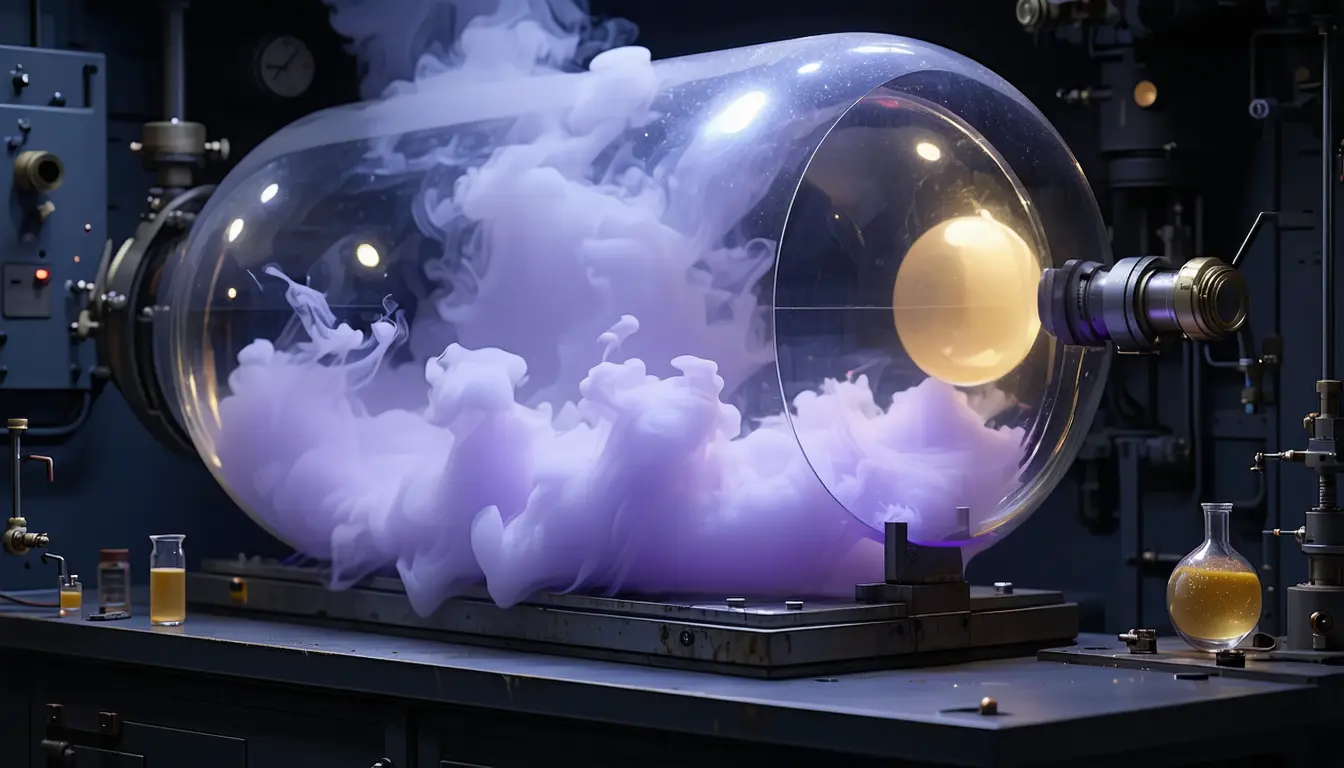
The model is a single dark matter halo, cooling toward collapse, exposed to different levels of Lyman-Werner radiation [9]. What came out of the runs was a layered halo: the outer gas stayed extremely hot under prolonged external ultraviolet exposure while the inner core became denser and shielded the gas inside it [10].
Delay alone is not enough, because a cloud counts as pristine only until metals arrive, and neighbouring supernovae supply those [4]. Jeon's argument is that the Lyman-Werner radiation from those same supernovae reaches the cloud hundreds of millions of years before the metal particles that would turn it into an ordinary metal-poor population [11] [16]. Radiation travels at the speed of light and debris does not, so there is an interval in which a cloud is both held back from collapsing and still chemically clean [17].
On detection, the paper calculates that current instruments can pick up a Pop III starburst with help from gravitational lensing [13]. That help is conditional. A lens only works when the target sits directly in line with the galaxy doing the lensing [14], and the conditions the model requires, an intense ultraviolet bath around a pocket of gas no supernova has yet polluted, are rare to begin with [15]. Telling a pristine starburst apart from its metal-bearing successors is still a technical problem in its own right [12].
The model cannot say whether any such cloud existed. No Population III star has been confirmed; JWST has produced features consistent with pristine starbursts in galaxies near the end of the Epoch of Reionization, hundreds of millions of years later than pre-launch models predicted [1] [2]. A model that keeps a halo sterile and starved of coolant for that long shows the late timing is physically reachable. The phys.org write-up reports the detectability calculation without the mass threshold itself, the number in the paper's own title question [18].
What to watch
- Whether the mass threshold in Jeon's preprint survives review, and whether it sits above or below what lensed JWST fields can reach.
- Spectroscopic follow-up on the reionization-era candidates that separates a pristine starburst from a very metal-poor Population II one.
- Whether independent simulations reproduce the hot outer layer and dense shielded core across a range of Lyman-Werner intensities.