Science1 publisher2 min readPublished
Heating only the electrons in twisted graphene raises its resistance by kilohms
Warming a metal's electrons without warming its atoms is hard to arrange. A team at the National University of Singapore managed it in twisted bilayer graphene with 0.14-terahertz light, then read the resistance.
The Scientist · Science desk
What happened
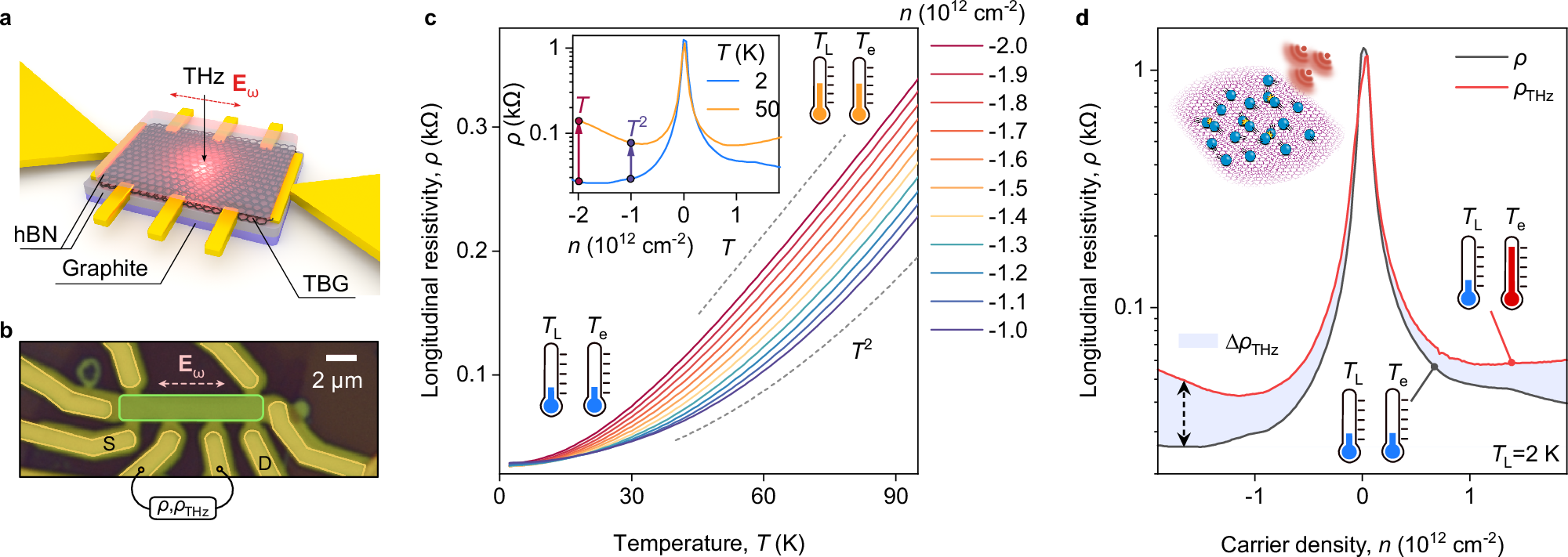
- Researchers at the National University of Singapore's Institute for Functional Intelligent Materials reported in Nature Communications on Aug. 13, 2026 that they warmed the electrons in twisted bilayer graphene with terahertz radiation while leaving the lattice almost unchanged.
- At the highest radiation power, the electrons were estimated to reach about 20 Kelvin above the lattice, which the experiment held near 2 Kelvin.
- Heat-transport tests put the maximum lattice temperature rise below 1 Kelvin, and separate electrical noise measurements supported the conclusion that electrons and lattice stayed thermally decoupled.
- Resistance climbed by several kilohms in devices twisted close to the magic angle, an electronic contribution appearing in regimes often assigned to phonons.
- Comparing resistance in the dark against resistance under illumination, the metallic regions of devices at several twist angles all showed a large positive photoresistance that grew with terahertz power.
Compiled by The ScientistSomething wrong?How this is made
Why it matters
- capability Electron temperature becomes a setting the experimenter controls independently of lattice temperature. A claim about which collisions dominate can be tested against a second measurement.
- constraint Reading a linear-in-temperature resistance in twisted bilayer graphene as evidence of phonon scattering now needs more support, because carriers heated on their own raised resistance in that regime.
- decision Groups publishing temperature-exponent fits in moire materials have to decide whether their apparatus can hold the lattice cold while the electrons warm, or state plainly that their two temperatures moved together.
The devices were small bars of twisted graphene sealed inside hexagonal boron nitride, with graphite gates to set the number of charge carriers and metal antennas to funnel the radiation in [10]. Each photon of that 0.14-terahertz beam carried 0.6 millielectron volts, too little to push an electron from one relevant band to another [11]. So nothing was excited across a gap. The beam stirred the carriers already present, and they shared the energy among themselves within femtoseconds, settling into a hot electronic state before much of that heat could leak into the lattice [12].
In a conventional Fermi liquid, resistance from electron interactions often grows with the square of temperature, while a linear rise can point to phonon scattering and has also been associated with strange metals that the standard description does not cover [8]. Twisted bilayer graphene has displayed both trends, with the exponent changing as researchers vary the twist angle and the number of carriers [9]. "In twisted bilayer graphene, the same temperature dependence can have more than one plausible microscopic origin," said Artur Shilov, a doctoral student at I-FIM and the paper's first author [6]. "We needed another control knob," he said [5].
The twist angle changes the band structure. Stacking two honeycomb sheets slightly out of alignment produces a moire superlattice that reshapes the energy landscape carriers move through [17]. Near 1.1 degrees, some of those bands become unusually flat, so electrons move more slowly and feel one another more strongly, and the material hosts correlated insulating states and superconductivity [16].
The two heatings differ by more than a factor of 20 [1]. In absolute terms the electrons sat near 22 kelvin while the lattice stayed near 2, roughly eleven times as hot [2]. "Conventional transport measurements heat the electrons and the lattice together, so their fingerprints are superimposed," said Denis Bandurin, the I-FIM assistant professor who led the study [3]. "We wanted to separate those two temperatures and ask what the electrons themselves were doing," he said [4].
The measurement answers a narrow question well. It shows that warming the carriers alone pushes resistance up in a regime where phonons were the natural candidate [2]. It does not split an ordinary temperature sweep between the two channels, because in that sweep both temperatures still rise together [7]. The electron temperature is an estimate [13], and the demonstration sits at a lattice near 2 kelvin with electrons no hotter than about 22 [2].
What to watch
- Whether the hot-electron method reproduces the switch between square-law and linear temperature dependence as twist angle and carrier density change.
- Whether an independent group confirms the 20-kelvin electron temperature, which the paper reports as an estimate.
- Whether the electrons and lattice stay decoupled with the lattice held well above 2 kelvin, where most transport data is taken.