Product1 distinct publisher3 min readPublished
Zhengzhou and Adelaide researchers report a coloured textile that reflects 87.6 percent of sunlight. Measured at simulated skin, its margin over white cotton is 3.4C.
The Product Desk · Product desk

Compiled by The Product DeskSomething wrong?How this is made
The buyer-facing number here is not 87.6 percent. It is 3.4C, the gap on simulated skin between the new textile and commercial white cotton [19]. Against commercially dyed purple cotton the gap is 5.2C [20], and that figure is the size of the penalty a coloured garment has been paying all along. Against white cotton, which is what anyone serious about staying cool already buys, the reward for keeping the colour is smaller [19]: 8C below bare skin versus 4.6C [6][7].
There is a second arithmetic worth noticing. Measured at the cloth under direct sun, the fabric ran 4.2C below white cotton [5]. Measured at the skin, its advantage over the same comparator was a full degree smaller [21]. Something between the outer surface and the wearer absorbs part of the win, and that something is decided by garment construction rather than by a spectrophotometer.
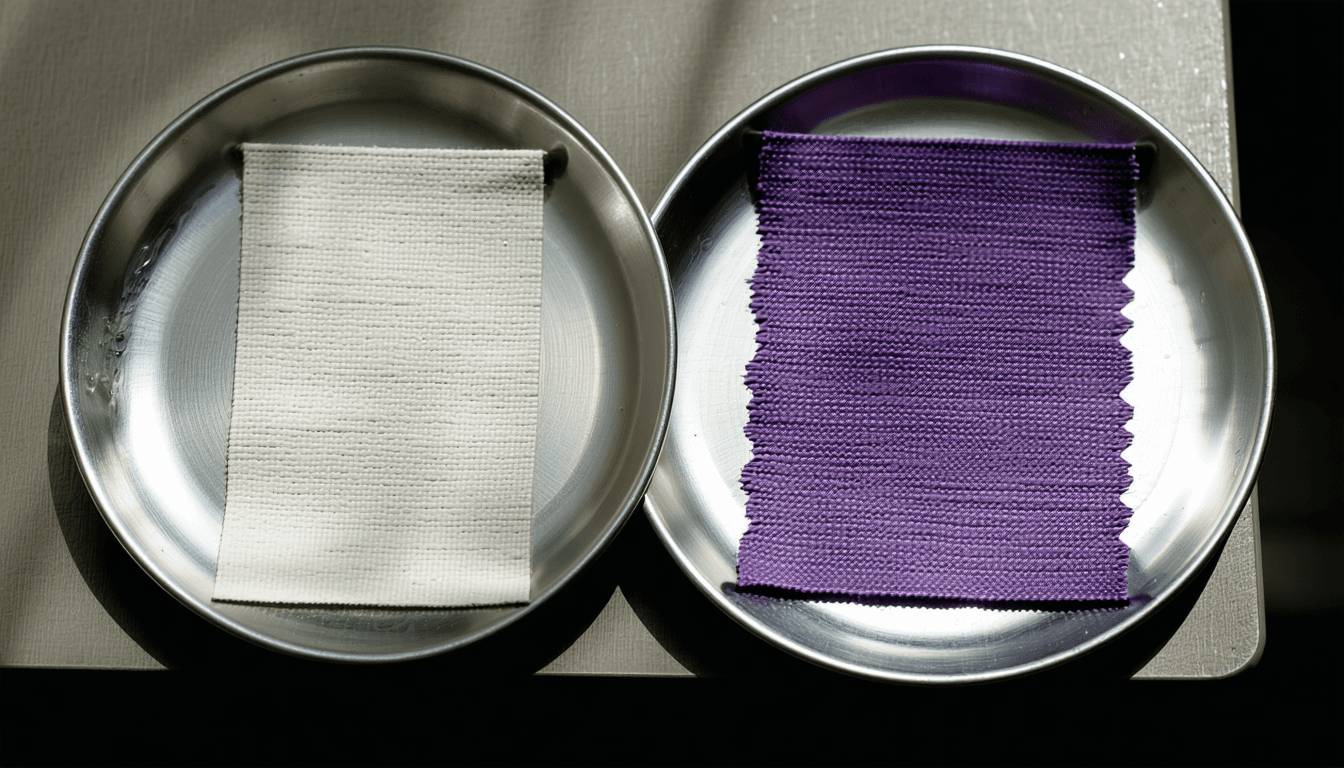
The colour is not a dye. The team spun microfibres carrying a purple metal-organic framework and zinc oxide nanoparticles, which supply both the appearance and the optical behaviour [8]. That matters because purple is the awkward case: producing it requires absorbing green light, which sits in one of the strongest bands of the solar spectrum [9]. So the material has to absorb in a narrow window and throw back almost everything else, and 87.6 percent reflectance still leaves 12.4 percent of incident sunlight going in [18]. The mid-infrared emittance of 96.4 percent is what carries the absorbed heat back out [3].
Whether the trick generalises is the commercial question the reported work does not answer. One shade is demonstrated [24]. If each colour needs its own framework compound rather than its own dye bath, a range becomes a materials programme, and every added shade arrives owing its own reflectance measurement.
Read the durability data narrowly. Cooling held after 50 wash cycles [11], and optical performance survived UV aging the team equates to roughly 108 days outdoors [12]. For workwear laundered twice a week, 50 cycles is about six months of laundry, and 108 days is under four months of exposure [22]. Co-author Yangzhe Hou points at outdoor workers and athletes as the beneficiaries [c15b], which is precisely the population that wears a garment daily and washes it hard. The fabric is also reported as water-repellent while still passing perspiration [13], so the sweat-management objection is at least addressed alongside the optics.
One framing correction. The publisher's headline sells skin 14F cooler [17]. That comparison is against uncovered simulated skin [6], not against a shirt, and no product line competes with wearing nothing. The honest comparison is the one the study also ran, against commercial cotton [5], and the comparison still missing is against an engineered white radiative cooling textile rather than an ordinary white weave [10].
Jun Ma's stated goal was to prove cooling need not cost appearance [14]. On these figures, in purple, the trade is roughly a degree of skin-level cooling against getting the colour you wanted [19]. That is a design conversation someone can now actually have.
Ranked by verification strength, evidence, and original report placement.
The fabric reflects an average of 87.6 percent of solar radiation.
The fabric emits 96.4 percent of mid-infrared radiation, allowing heat to escape through the atmosphere.
Jun Ma, materials engineering professor at Adelaide University and study co-author, said: "We have traditionally had to make a choice between cooling performance and appearance... Our research shows that we can have both."
Co-author Yangzhe Hou said the long-term opportunity is to move beyond the idea that cooling fabrics have to be white.
Hou said that for outdoor workers, athletes and anyone exposed to hot weather, staying cool is not just about comfort, and that the team is interested in fabrics that manage body temperature without consuming additional energy.
The publisher's headline states the fabric "reflects 88% sunlight, keeps skin 14F cooler, repels water".
Follow any of these and your For You feed starts watching them — no settings page required.
Evidence-backed comparisons of source perspectives and observed adoption signals. Read the methodology
Which Builder, Operator, and Investor concerns the observed source mix emphasized—not a truth score.
Evidence, demonstrated adoption, hype gap, incentives, and confidence are assessed independently, each on its own current evidence. How these are measured.
Specific measurements, one secondary account
The figures are unusually specific and internally consistent - reflectance, emissivity, two outdoor baselines, three simulated-skin baselines, wash and UV aging - and rest on a study published in the journal Small. But everything reaches us through one trade-press retelling with author quotes from a press statement: no methods, sample counts, ambient conditions, humidity or wind data, no link to the paper, and no independent replication or third-party testing.
No adoption evidence supplied
The sources describe laboratory and outdoor test results only. There is no reported production run, pilot deployment, garment product, licensee, purchase order, pricing or user disclosure, so adoption cannot be measured without inventing facts.
Framing overstates the practical margin
Positive gap. The headline's '88% sunlight' and 'keeps skin 14F cooler' are the most flattering readings available: 14.4F is versus uncovered simulated skin, while the relevant comparison - against a white cotton shirt at the skin - is 3.4C by the article's own arithmetic. Author framing generalises to an end of white-only cooling fabrics on a one-colour demonstration, and durability evidence covers only months of washing and UV exposure. The underlying measurements are real, so the gap is presentation-scale, not fabrication.
Institutional promotion via press statement
The only voices in the cluster are two co-authors, one quoted explicitly from a press statement, framing their own result as removing the colour-versus-cooling trade-off; the publisher amplifies with a superlative headline. That is a normal academic-communications incentive to maximise perceived impact rather than a disclosed commercial stake - no vendor, funder or licensing interest is reported - so the pressure is real but moderate.
Moderate-low: one publisher, arithmetic checks hold
Confidence is limited by single-publisher sourcing and no access to the primary paper, but raised by the fact that the reported figures are specific, repeated consistently within the article, and internally coherent when recomputed (8C minus 4.6C and 2.8C; 87.6 percent implying 12.4 percent unreflected). Adoption remains unmeasurable, so the overall picture is provisional.
science
Australia's degree premium: 38% in 2024, down from 53% at the 2010 peak1 distinct publisher
science
Two zinc MOFs and a process claim: UChicago ties prediction to synthesis in one loop1 distinct publisher
science
DNA polymerase writes, kinesin motors weave: a two-stage line for dissipative assembly1 distinct publisher
Distinct publishers with included, body-backed reporting in this cluster.