Invest1 distinct publisher2 min readUpdated
The company told investors that engine order inflow has already passed what its plant can handle. The expansion is a bet that generation capacity, not compute, is the scarce asset.
The Investor · Invest desk
Compiled by The InvestorSomething wrong?How this is made
The demand case is the least contested part of this: Goldman Sachs has global data center power demand in 2030 running 170% above 2025 [3]. What turns that into a supply story is the mismatch sitting inside HD Hyundai's own capacity figures. It can divert about 0.7 gigawatts a year to land-based power generation, while land-based demand that has nothing to do with data centers has already come close to 1 gigawatt [6][7]. Demand at the door is roughly 43% larger than the line serving it, before a single AI order is counted [2].
That is what makes the Coban Energy Group contract worth reading twice. The company says the 1,000 megawatts can be supplied out of existing production capacity [9]. At 9.6 megawatts a unit, that is about 104 engines [3], and set against 0.7 gigawatts a year of divertible line time it amounts to something like a year and a half of that capacity with nothing else on it [4]. "Existing capacity" here is a statement about tooling, not about the calendar.
The sequence the company has set itself is tight. Meritz Securities does not expect data center engine revenue to be recognised before 2028 [11], and HD Hyundai says it needs a concrete production plan drawn up inside this year [10]. Core casting and forging are already in-house; the long-lead item is large machine tools coming from overseas, and the investment is described as being in its final stages rather than announced with a number [2].
The prize is margin rather than volume. Land-based power plants are 5% of sales at a 23% profit margin, which on revenue alone puts about 1.15% of group sales into profit from that slice [12][6]. A small share earning a high return is exactly the case for adding a line to serve it, and Meritz's further argument is that the engines dampen the cycle: as expanded volume comes on, the profit mix swings less with vessel orders [11]. The floating data center plan, powerships carrying the same HiMSEN engines offshore, is the same margin trade with a hull under it [13].
Follow any of these and your For You feed starts watching them — no settings page required.
Ranked by verification strength, evidence, and original report placement.
The company said the investment was in its "final stages"; core casting and forging equipment essential to the expansion is already held in-house, large machine tools are being ordered from overseas, and partner firms have been instructed to prepare for the expansion.
The spare capacity HD Hyundai Heavy can divert to land-based power generation is about 0.7 gigawatts a year.
Land-based generation demand alone, excluding data centers, has already approached 1 gigawatt.
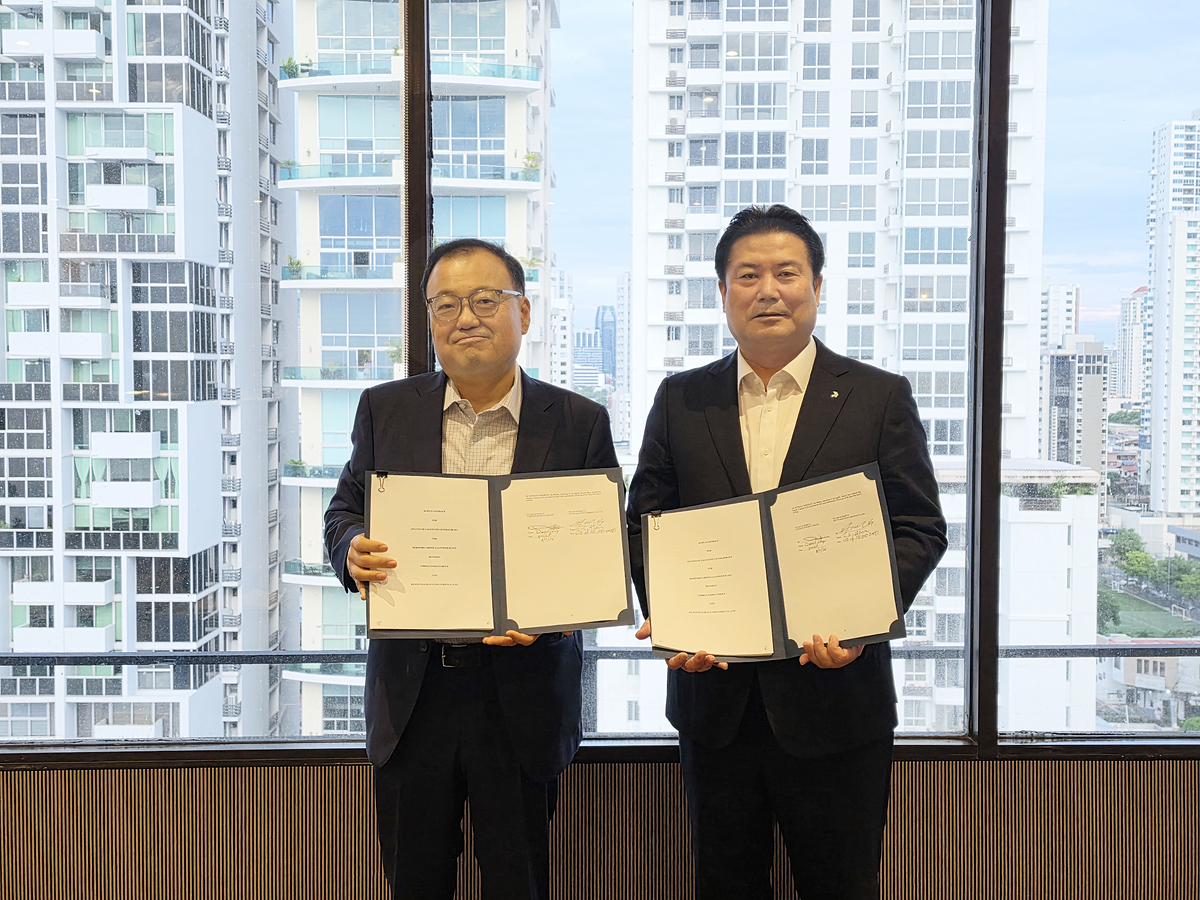
HD Hyundai Heavy recently signed a contract with Coban Energy Group, a U.S. energy infrastructure developer, to supply power-generation equipment based on 9.6-megawatt HiMSEN engines, totalling 1,000 megawatts and 956 billion won ($690 million), to serve as a power source for a local big tech firm's data center.
The company says the volume under the Coban contract can be supplied with existing production capacity.
Meritz Securities said data center engine sales would be recognised starting in 2028, and that as newly expanded volume comes on line engines would contribute more to the overall profit portfolio, with cyclical margins stabilising.
Evidence-backed comparisons of source perspectives and observed adoption signals. Read the methodology
Which Builder, Operator, and Investor concerns the observed source mix emphasized—not a truth score.
Evidence, demonstrated adoption, hype gap, incentives, and confidence are assessed independently, each on its own current evidence. How these are measured.
Single-outlet, largely anonymous sourcing with one hard contract
The entire cluster is one report from en.sedaily.com. The load-bearing framing claim — that order inflow exceeds plant capacity — comes from unnamed shipbuilding-industry sources describing an investor presentation that is not quoted or linked. Macro figures are attributed to 'the industry' with no methodology, and the expansion has no disclosed capex, filing, or capacity target. What lifts the score above floor is one specifically quantified contract (customer named, 1,000 MW, 956 billion won) and specific sales-mix and margin percentages.
One large signed contract; expansion itself not yet committed
Adoption is real but narrow: a single 1,000 MW order from one U.S. developer for an unnamed end customer, plus an existing land-based power line already generating 5% of company sales at a 23% margin. Against that, the plant expansion is only in 'final stages' with no capex or capacity number, revenue recognition is not expected until 2028 per Meritz, and the floating data center ambition has no orders attached. That is early commercial traction, not deployed capacity at scale.
Scarcity framing outruns the disclosed, verified facts
The narrative that watts, not chips, are the binding AI constraint is built on unattributed aggregate figures and an unquantified premium peak in 2029-2030, while the confirmed substance is one contract and a 5%-of-sales business line. There is also an internal tension the coverage does not resolve: the company says the Coban volume fits existing capacity, yet 1,000 MW is about 1.4 years of the stated 0.7 GW/year of divertible capacity. The gap is moderate rather than severe because the contract, margin, and capacity numbers are specific and non-trivial.
Company investor-relations and sell-side interests shape the frame
Every favourable element traces to an interested party: the capacity-constrained framing comes from a company investor presentation relayed by unnamed industry sources, the margin and mix figures are company-supplied, and the 2028 earnings path comes from a brokerage (Meritz Securities) that covers the stock. An AI-power scarcity narrative directly supports the equity story of a Korean industrial pivoting from marine engines. The outlet is a business daily reporting rather than advocating, and it does flag that the challenge 'lies ahead', which caps the score below the high end.
Low — one publisher, mixed verifiability
Assessment confidence is constrained by the single-source cluster and the reliance on anonymous attribution for the story's central claim. The contract particulars, the 2008 equipment vintage, and the disclosed percentages are specific enough to hold; the capacity-shortfall macro, the premium-cycle timing, and the scale of the expansion are not independently checkable from the supplied material.
invest
GE Vernova's 116 GW backlog outruns global turbine output, with slots quoted into 20311 distinct publisher
product
Nebius funds $4.5bn of AI capacity on terms that pay lenders mostly in stock2 distinct publishers
build
SMIC's first $3 billion quarter comes with a wafer price increase attached1 distinct publisher
invest
Nvidia's August 26 print: 92% of the quarter rides on one segment1 distinct publisher
Distinct publishers with included, body-backed reporting in this cluster.
en.sedaily.com
1 article · August 24, 2026